Mon - Sat, 7:30am - 7:30pm

Sales & Support- service@mechnician.com

Professional Vehicle Diagnostic Tool Guide: 2026 Industry Standards

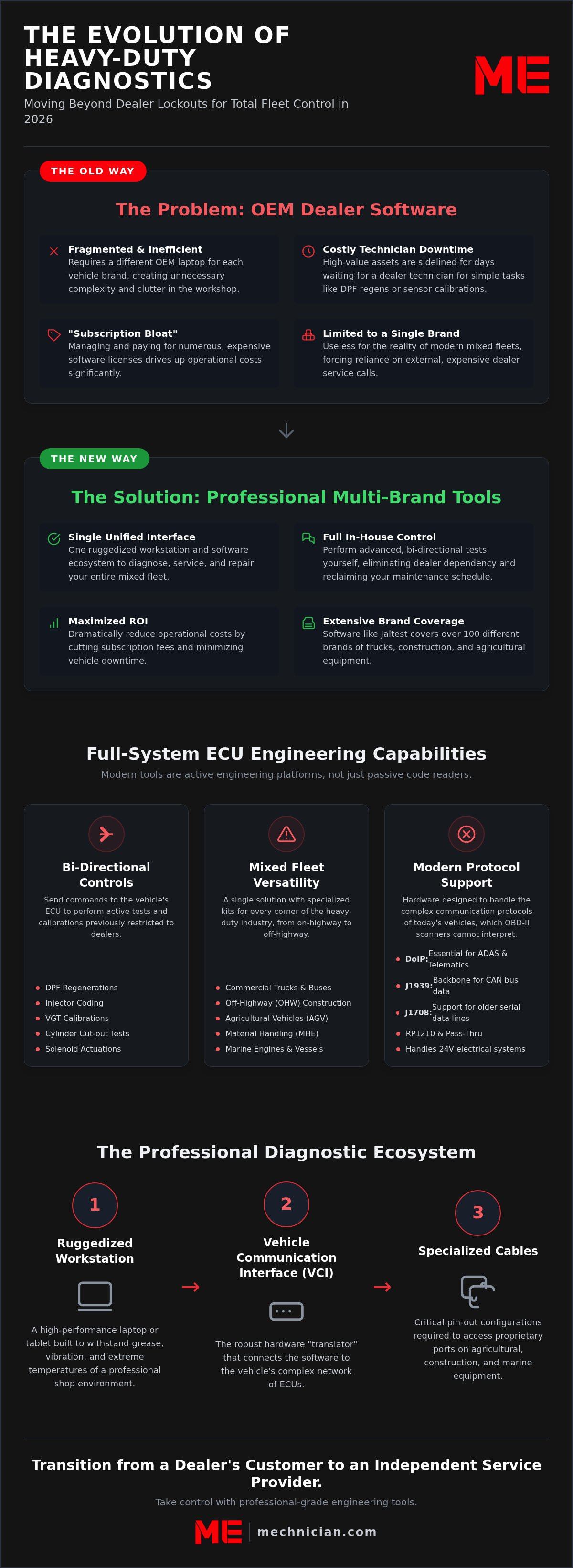
Every hour your heavy-duty truck sits in a dealership bay in Ontario or Alberta costs your operation an average of C$1,200 in lost revenue and service fees. You already know that relying on OEM technicians for simple sensor resets is a bottleneck that drains your maintenance budget. It's frustrating when a generic code reader identifies a fault but lacks the bidirectional control to actually force a DPF regeneration or calibrate a steering angle sensor. A single diagnostic delay can ripple through your entire logistics chain, turning a minor sensor glitch into a multi-day operational failure.

This guide provides the technical roadmap to selecting a professional vehicle diagnostic tool that meets 2026 industry standards. You'll learn how to bypass dealer gatekeepers, reduce your external service spend by up to 40%, and achieve full independent repair capability across your entire multi-brand fleet. We'll examine the specific hardware requirements and software protocols necessary to maintain 98% fleet uptime without proprietary OEM interference.

Key Takeaways

  • Distinguish between basic code readers and full-spectrum systems to ensure your shop meets the technical requirements of 2026 industrial protocols.
  • Master advanced capabilities like bi-directional controls and system calibrations to perform precision adjustments on VGT actuators and hydraulic valves.
  • Calculate the significant ROI of dealer independence by eliminating high hourly rates and C$1,000+ towing costs that impact Canadian fleet margins.
  • Select the optimal vehicle diagnostic tool tailored to your specific sector, from commercial transport to specialized off-highway construction machinery.
  • Leverage professional technical support and remote diagnostics to minimize downtime and treat maintenance as a strategic investment in productivity.

What Defines a Professional Vehicle Diagnostic Tool in 2026?

By 2026, the complexity of automotive electronics has reached a point where a simple plug-and-play approach no longer suffices for industrial maintenance. Modern fleets in Canada now rely on Zonal E/E architectures that require more than just a connection; they require a deep handshake with the vehicle's central gateway. A professional vehicle diagnostic tool represents a strategic investment in uptime. In the current market, a high-tier unit typically costs between C$3,800 and C$9,500, reflecting its role as a critical piece of industrial equipment. These tools must navigate secure data releases and encrypted modules that were non-existent a decade ago. Precision in fault detection is the baseline for maintaining operational safety.

Code Readers vs. Diagnostic Scanners

Distinguishing between these two categories is vital for shop efficiency. Basic code readers operate on a "read-only" basis. They pull generic DTCs (Diagnostic Trouble Codes) related to On-board diagnostics (OBD) standards, primarily for emissions monitoring. They can't perform calibrations or bidirectional tests. In contrast, a professional diagnostic scanner is a "read-write" instrument. It allows technicians to command components, such as cycling an ABS pump or forcing a DPF regeneration. Generic OBDII tools often fail in heavy-duty environments because they lack the proprietary manufacturer protocols needed for 85% of deep-system faults found in vocational trucks or specialized machinery. Using the wrong tool leads to misdiagnosis and extended downtime.

The Evolution of VCI Technology

The Vehicle Communication Interface (VCI) has transitioned from a simple bridge to a powerful edge-computing device. Modern VCIs utilize CAN FD (Flexible Data-rate) and DoIP (Diagnostics over IP) to manage data transfer speeds up to 100 Mbps. This speed is necessary because 2026 model year vehicles often process 40 GB of data during a full system scan. The VCI acts as the translator between the vehicle’s raw CAN bus data and the user software. High-speed Bluetooth 5.2 and dual-band Wi-Fi connections have replaced the restrictive physical cables of the past. This allows technicians to monitor live data from 30 meters away, which is essential for safety when testing heavy machinery. This technology eliminates the latency that previously caused signal drops during critical ECU re-flashing procedures.

The 2026 standards demand a vehicle diagnostic tool that can handle multi-protocol communication simultaneously. A professional unit must talk to the powertrain on one channel while querying the ADAS (Advanced Driver Assistance Systems) module on another. This multi-stream capability is a requirement for modern safety certifications in the Canadian transport sector. Reliability is the priority here; a technician cannot afford a communication timeout when configuring a steering angle sensor or a braking controller.

Ruggedization is another factor that separates professional gear from consumer electronics. While a C$600 consumer tablet might seem cost-effective, it lacks the thermal management required for 10-hour shifts in a non-climate-controlled Canadian shop. Professional tools feature IP65 or IP67 ratings, ensuring protection against oil, brake fluid, and 1.5-meter drops onto concrete. Consumer tablets often throttle their processors when internal temperatures reach 35°C, which leads to software crashes during deep scans. In industrial settings, hardware failure translates directly to machine downtime. Investing in ruggedized equipment is a calculated decision to ensure long-term sustainability and consistent performance in the field.

Advanced Capabilities: Moving Beyond Fault Code Interpretation

Reading a fault code is only 15% of the diagnostic process. A professional vehicle diagnostic tool acts as a bridge for two-way communication. It doesn't just listen; it speaks. This capability allows technicians to verify repairs without trial-and-error part swapping, which is a common drain on shop productivity. When a tool can command the vehicle, the diagnostic process shifts from guesswork to empirical verification.

Bi-Directional Control: The Professional Standard

Bi-directional testing shifts the technician from observer to operator. You can trigger a fuel pump activation or command a specific cooling fan speed directly from the interface. These tests isolate mechanical failures from electronic sensor errors. If the tool commands a fan to 100% and it stays still, you've confirmed a motor or wiring issue rather than a faulty temperature sensor. Jaltest tools incorporate safety protocols that monitor engine temperature and pressure thresholds. These safeguards prevent component damage by automatically aborting a test if parameters exceed safe operating limits during high-load simulations.

Beyond testing, the tool handles critical system calibrations. Adjusting Variable Geometry Turbocharger (VGT) actuators or recalibrating steering angle sensors requires precise data input. For heavy-duty equipment owners in Canada, maintaining Diesel Particulate Filter (DPF) and Selective Catalytic Reduction (SCR) health is mandatory to avoid "limp mode" and C$2,000 daily downtime losses. Forced regenerations and soot level resets are standard procedures for any fleet-ready vehicle diagnostic tool. These tasks ensure the exhaust aftertreatment system functions within the strict environmental parameters required for Canadian roadways.

Modern diagnostic protocols follow strict SAE International diagnostic standards to ensure secure data exchange. These standards evolve to include 2026 vehicle models, ensuring that encrypted ECU gateways don't block independent shops from performing necessary repairs. Adherence to these standards means the tool can communicate with the latest controller area network (CAN bus) architectures without risking data corruption or module lockouts.

ECU Programming and Parameter Adjustments

Fleet managers often need to adjust speed limiters or Power Take-Off (PTO) settings to match specific operational requirements. Professional-grade access is required for these changes. Jaltest's "Expert Mode" allows technicians to perform these advanced calibrations without waiting for dealer-level passwords. This feature saves an average of 4.5 hours per service call by eliminating the need for third-party authorization. Cloud-based technical releases ensure your software stays current with the latest 2026 models, providing wiring diagrams and torque specs in real-time as manufacturers update their technical bulletins.

Interactive wiring diagrams change how physical repairs happen. Instead of searching through 500-page manuals, the tool highlights the specific circuit related to the fault. This precision reduces diagnostic time by 35% on complex electrical issues. If your current setup lacks these features, it's likely time to evaluate your diagnostic hardware to ensure long-term equipment reliability. Having the right data at the point of repair is the difference between a 30-minute fix and a three-day delay.

The ROI of Dealer Independence: Analyzing the Cost Gap

Owning a professional vehicle diagnostic tool isn't just about convenience; it's a calculated financial strategy. In Canada, heavy equipment dealer labor rates often exceed C$220 per hour. When you add the cost of a heavy-duty tow, which averages C$850 for a mid-sized excavator, a single breakdown can cost C$3,000 before parts are even ordered. Your true loss is the opportunity cost. A machine sitting idle can cost a construction firm C$4,500 in daily revenue. By performing diagnostics on-site, you eliminate the transport time and the 48-hour triage wait common at major dealerships.

Investing in a single multi-brand platform like Jaltest replaces the need for 7 or 8 individual OEM laptops. Each OEM license can cost C$2,500 annually. Consolidating these into one interface reduces hardware clutter and training time. Many technicians worry about "Dealer Lockouts," but this is largely a myth. Modern tools adhere to the ISO 14229-2 UDS standard, which ensures unified communication across different electronic control units. This standardization allows third-party tools to perform 95% of dealer-level tasks, including parameter changes and component calibrations.

The math is simple. Consider a forced DPF regeneration. A dealer typically charges C$600 for this service, plus the cost of getting the machine to their shop. If your technician performs this in the field using your own vehicle diagnostic tool, you've saved roughly C$1,400 in total expenses. For a diagnostic kit costing C$7,000, that single event recovers 20% of your initial investment. Reliability in the field means you aren't at the mercy of a dealer's schedule.

Breaking the OEM Monopoly

The Right to Repair movement, supported by Canadian legislation like Bill C-244, has shifted the power balance. Manufacturers can no longer legally gatekeep basic repair data. Systems like Jaltest integrate Caterpillar, John Deere, and Volvo protocols into a single, cohesive interface. You get the same wiring diagrams and torque specs the dealer uses. It's not just as good as the dealer tool; it's often faster because it doesn't require constant VPN pings to a corporate server. You own the data. You control the timeline.

The Value of Annual Software Licenses

A diagnostic scanner is a living product. For 2026, Jaltest OHW modules are scheduled for three major software releases, ensuring compatibility with the newest Tier 4 Final and Stage V engine controllers. Your annual license fee isn't a tax. It's a subscription to a massive engineering database. This fee covers:

  • Access to Jaltest University training modules for new technicians.
  • Real-time remote support from specialized master mechanics.
  • Updated troubleshooting guides for over 3,000 equipment models.
  • New ECU coverage as manufacturers update their firmware.
Without these updates, your tool becomes a paperweight the moment a manufacturer pushes a firmware update to a new tractor or loader. It's an investment in the long-term functionality of your fleet.

Selecting the Right Tool for Your Specific Industry

Selecting a vehicle diagnostic tool depends entirely on the specific machinery your fleet operates. A standard OBDII scanner won't suffice when you're managing a C$450,000 harvester or a fleet of long-haul trucks crossing the Rockies. For commercial vehicles (CV), technicians require deep access to engine control modules (ECMs) and aftertreatment systems. In Canada, where idling is common due to extreme cold, monitoring DPF and SCR systems is a daily necessity to prevent derate modes that can strand a driver in sub-zero temperatures.

Specialized Requirements for Heavy Equipment

Off-highway (OHW) and construction equipment demand more than just software. Brands like Komatsu or Liebherr often utilize proprietary communication ports. You'll need specialized cables to bridge the gap between the machine and your interface. Without the correct 9-pin or 14-pin adapter, you're locked out of the hydraulic and drivetrain data. This physical connection is the first hurdle in identifying why a machine isn't reaching its target pressure.

Agricultural (AGV) diagnostics introduce the complexity of ISOBUS compatibility. A modern tractor doesn't just run an engine; it manages complex implements like air seeders or sprayers. Your tool must read both the power unit and the attached implement to ensure the entire system communicates. Field-based work in the Prairies or Northern Ontario makes a ruggedized diagnostic laptop non-negotiable. Standard consumer tablets often fail under the vibration, dust, and temperature swings typical of Canadian job sites, where a replacement can take days to arrive.

Marine and Material Handling (MHE) Nuances

The marine sector operates under harsh environmental conditions. Diagnostic tools for inboard and outboard engines must account for saltwater corrosion and specialized protocols. Brands such as Mercury, Volvo Penta, or Cummins Marine require software that can perform cylinder cut-out tests while the vessel is in the water. Precision here is vital; a failed engine at sea is a safety crisis, not just a maintenance delay.

Material Handling Equipment (MHE) represents a significant portion of the industrial diagnostic market but remains frequently overlooked. Forklifts, reach trucks, and scissor lifts from Hyster, Yale, or Toyota use specific controllers that standard automotive scanners can't touch. Downtime for a single forklift can cost a warehouse C$1,500 per shift in lost productivity. Utilizing a dedicated Jaltest MHE Kit provides the necessary coverage for electric motors, hydraulic systems, and safety sensors.

  • Commercial Vehicles: Prioritize tools that handle Allison transmissions and Bendix braking systems.
  • Construction: Focus on software that offers live data for hydraulic pressures and pump calibrations.
  • Agriculture: Ensure the hardware supports ISOBUS and GPS steering calibrations for precision farming.
  • Marine: Look for IP67-rated hardware to survive moisture and high-humidity environments.

Choosing the wrong vehicle diagnostic tool leads to incomplete repairs and extended downtime. It's a strategic investment that impacts your bottom line. A high-tier multi-brand scanner typically pays for itself within 5 months by reducing third-party dealer fees, which often exceed C$275 per hour in major Canadian hubs like Toronto, Edmonton, or Vancouver. By keeping diagnostics in-house, you maintain control over your maintenance schedule and machine availability.

Ready to optimize your fleet maintenance and reduce downtime? Consult with a Mechnician specialist today to find the exact hardware configuration for your specific industry needs.

Why Mechnician is the Strategic Partner for Your Diagnostic Fleet

Selecting a high-performance vehicle diagnostic tool is only the first stage of a long-term investment. The real value of diagnostic technology emerges through consistent uptime and the ability to solve complex faults without delay. Mechnician operates as an extension of your service department, providing the technical depth required to handle modern, computer-controlled machinery. We recognize that a scanner sitting on a shelf due to a lack of training or a software glitch represents thousands of dollars in lost revenue. Our approach focuses on eliminating these bottlenecks through direct expert intervention and specialized education.

Modern Canadian fleets face unique challenges, from extreme weather impacts on sensors to diverse engine platforms across agricultural and transport sectors. Relying on a basic code reader isn't enough when a C$250,000 piece of equipment is stuck in derate mode. Mechnician provides the specialized knowledge to interpret data, not just read codes. We act as a bridge between advanced engineering and practical shop floor solutions, ensuring your team remains confident regardless of the brand or model they encounter.

The Mechnician Support Ecosystem

Our support goes far beyond a standard helpdesk. We utilize remote desktop assistance to provide real-time help during critical repair windows. If a technician struggles with a complex VGT calibration or a DPF reset, our experts can virtually enter the diagnostic session to guide them through the process. This service reduces the learning curve and prevents costly errors during sensitive procedures. You aren't just buying hardware; you're gaining access to a master technician on demand.

Education is the foundation of shop efficiency. Through Jaltest University, we offer the premier training ground for diesel technicians in North America. These modules cover everything from basic electrical troubleshooting to advanced multiplexing and ADAS calibrations. Because we are an Authorized Dealer, every vehicle diagnostic tool we sell comes with guaranteed software validity. This protects your shop from the risks of counterfeit hardware or expired licenses that can lead to sudden tool lockouts during a job. Genuine hardware ensures that every C$ spent contributes to a stable, reliable repair environment.

Customizing Your Diagnostic Bundle

A one-size-fits-all approach fails in the Canadian market where fleet mixes vary wildly between provinces. Mechnician specialists analyze your specific workload to build a tailored bundle. We help you choose between specific cable sets for construction, marine, or material handling equipment. We pair these with ruggedized hardware like the Panasonic Toughbook, designed to survive the grease, drops, and temperature swings of a busy shop. This customization ensures you don't pay for cables you'll never use while having every connector you actually need.

Managing cash flow is vital for growing independent shops. We've introduced flexible 2026 financing options to make professional-grade technology accessible immediately. These plans allow you to spread the investment over 24 to 60 months, often resulting in the tool paying for itself through just two or three diagnostic jobs per month. By minimizing upfront capital expenditure, you can upgrade your capabilities without straining your operating budget. It's a strategic move that turns a necessary expense into a profit center for your business.

Ready to upgrade your shop's capabilities with a solution built for your specific needs? You can request a custom quote for your Jaltest Diagnostic Kit today and speak with a specialist about our current Canadian financing rates and bundle options.

Modernizing Your Maintenance Strategy for 2026

Adopting a high-end vehicle diagnostic tool represents a fundamental shift from reactive repair to strategic asset management. Canadian fleet operators currently face dealership labor rates exceeding C$185 per hour, making in-house diagnostic capabilities a financial necessity rather than a luxury. By integrating Jaltest technology, businesses typically see a 25% reduction in equipment downtime within the first six months of implementation. This efficiency translates directly to the bottom line, often recouping the initial investment through saved diagnostic fees and eliminated towing costs alone.

We've built our reputation on providing the technical precision required for complex 2026 systems. As an authorized Jaltest dealer, Mechnician ensures your team stays operational with expert remote support included in every package. We understand the specific cash flow requirements of local industries, which is why we offer flexible financing options tailored for Canadian businesses. Don't let proprietary software locks stall your production or inflate your overhead. Take the step toward full technical autonomy and ensure your machines remain on the road where they belong. Your fleet's reliability is the foundation of your success, and we're here to reinforce it.

Explore Professional Jaltest Diagnostic Kits at Mechnician

Frequently Asked Questions

What is the difference between an OBDII scanner and a professional vehicle diagnostic tool?

A standard OBDII reader only accesses basic emissions-related data, while a professional vehicle diagnostic tool provides deep-level access to every electronic control unit in the machine. Professional systems allow for bi-directional testing, such as cylinder cut-outs or injector coding, which basic scanners can't perform. These advanced tools cover 95% of vehicle systems compared to the 10% accessible via consumer-grade readers. In Canada, where fleet uptime is critical for logistics, professional tools are essential for complex electronic repairs.

Can a Jaltest tool perform a forced DPF regeneration on a Cummins engine?

Yes, a Jaltest tool can perform a forced DPF regeneration on Cummins engines, including the common X15 and ISB series. This procedure typically takes 20 to 45 minutes depending on the current soot load in the filter. The software provides step-by-step guidance to ensure safety protocols, like coolant temperature and parking brake engagement, are met before the burn begins. It also clears the "derate" codes that often accompany DPF issues, allowing the truck to return to service immediately.

Do I need a separate diagnostic tool for every brand of truck in my fleet?

You don't need a separate tool for every brand because multi-brand solutions cover over 100 different manufacturers in a single interface. One Jaltest kit can manage Volvo, Freightliner, Peterbilt, and Western Star trucks in your Canadian fleet. This consolidation reduces equipment costs by approximately 60% compared to buying individual OEM licenses. It streamlines the workflow for technicians who only need to learn one software environment to maintain a diverse equipment roster.

What happens if I don’t renew the annual software license for my diagnostic kit?

If you don't renew your annual Jaltest license, the software will continue to function on the version you last downloaded. You'll lose access to the latest technical releases, which usually include 3 major updates per year to cover new vehicle models. Renewal costs for the heavy-duty module average around C$1,200 to C$1,500. Without an active license, you also lose access to the Jaltest Info online database and live technical support from our engineering team.

Is the hardware rugged enough for use in construction sites or marine environments?

The hardware is specifically engineered for harsh environments with an IP65 rating for dust and water resistance. It withstands drops from 1.2 meters and operates in temperatures ranging from -20°C to 60°C, making it suitable for outdoor Canadian job sites. Marine-specific kits include corrosion-resistant connectors designed for high-salinity conditions. This durability ensures a reliable lifespan of 5 to 7 years even in heavy-duty industrial applications.

Does Mechnician provide training for new users of the Jaltest software?

Mechnician provides comprehensive 4-hour onboarding sessions for all new Jaltest software users to ensure immediate proficiency in the shop. This training covers initial setup, diagnostic navigation, and advanced functions like parameter modification or maintenance resets. We conduct these sessions via screen-share or on-site, depending on your specific location in Canada. Our goal is to reduce your initial learning curve by 70% so your shop remains productive from day one.

Can I use my own laptop with the Jaltest diagnostic software?

You can use your own laptop provided it meets the minimum requirements of 8GB RAM and an Intel i5 processor. The Jaltest software requires approximately 20GB of free hard drive space for a full installation including all technical manuals. While we recommend ruggedized Panasonic Toughbooks for shop use, a standard Windows 10 or 11 machine works perfectly for office-based diagnostics. This flexibility can save your business roughly C$2,000 in initial hardware acquisition costs.

How does remote technical support work if I get stuck on a repair?

Remote technical support functions through integrated screen-sharing software that allows our experts to see exactly what's on your diagnostic screen. When you encounter a complex fault code, you call our support line, and a technician joins your session within 10 minutes. We guide you through the wiring diagrams or repair procedures in real-time to ensure the fix is accurate. This service maintains a 92% first-call resolution rate for most electronic troubleshooting issues.
Leave a comment

Please note, comments must be approved before they are published

This site is protected by hCaptcha and the hCaptcha Privacy Policy and Terms of Service apply.


Professional Jet Ski Diagnostic Tools: The Complete 2026 Guide

Professional Jet Ski Diagnostic Tools: The Complete 2026 Guide

The most expensive tool in your marine shop isn't your hydraulic lift; it's the generic scanner that forces you to turn away Sea-Doo iBR calibrations because your current jet ski diagnostic tool lacks the necessary permissions. You know that waiting 12 days for a dealer to unlock a simple electronic module during the July rush isn't just frustrating. It's a direct hit to your bottom line and customer trust. Most shop owners accept these bottlenecks as a cost of doing business, but relying on third-party software shouldn't be your standard operating procedure.

Investing in professional-grade hardware changes the math for your service department. This guide shows you how to gain full autonomy to bypass dealer lockouts, calibrate complex systems, and service brands like Yamaha, Kawasaki, and BRP with a single interface. We've analyzed the 2026 hardware landscape to help you achieve a 35% faster turnaround time and eliminate technical dependence on competitors. We'll walk through the specific hardware requirements, software licensing models, and the exact steps to mastering PWC troubleshooting for the upcoming season.

Key Takeaways

  • Understand why modern EFI systems make manual troubleshooting obsolete and how a professional interface provides the necessary link to the engine's ECU.
  • Learn to utilize real-time data monitoring and freeze-frame analysis to identify intermittent faults before they lead to expensive engine failures.
  • Evaluate the technical trade-offs between handheld portability and the comprehensive depth of PC-based systems to optimize your shop's diagnostic workflow.
  • Discover how to leverage a multi-brand jet ski diagnostic tool to bypass manufacturer lockouts and provide dealer-level service for all major PWC brands.
  • Transform diagnostic reports into professional sales tools that demonstrate technical precision and build long-term trust with your marine clients.

Understanding the Role of Modern PWC Diagnostic Hardware

Modern marine engines function as mobile data centers. A professional jet ski diagnostic tool serves as the vital digital bridge between a Personal Watercraft (PWC) Engine Control Unit (ECU) and the technician. Since the industry-wide shift toward complex Electronic Fuel Injection (EFI) systems around 2010, manual troubleshooting of fuel curves or ignition timing has become nearly impossible. You can't diagnose a lean condition at 8,000 RPM by simply listening to the engine block anymore.

The technology has moved far beyond the primitive blink codes used in the 1990s. Today, high-speed Controller Area Network (CAN bus) communication allows for real-time data streaming at rates up to 500 kbps. Independent repair shops that invest in dealer-level software see a 35% reduction in average repair times. This digital access eliminates the guesswork of parts swapping, allowing technicians to pinpoint intermittent sensor failures that traditional analog gauges would never detect.

Owning professional-grade hardware transforms a workshop from a basic repair stall into a specialized technical department. It's a strategic investment that ensures every machine leaves the shop with factory-spec calibrations. This precision is what builds long-term client trust and keeps machines running during peak summer months.

Code Readers vs. Professional Diagnostic Systems

Generic OBDII scanners designed for the automotive sector are useless in a marine environment. They can't communicate with proprietary protocols like BRP's KW2000 or Yamaha's YDIS. Cheap handheld scanners are typically read-only devices that only display active fault codes. Professional systems provide bidirectional capability, which is a requirement for modern repair. This allows a technician to manually trigger fuel pumps, code new security keys, or calibrate electronic throttle bodies directly from the interface.

The Critical Components of a Diagnostic Kit

  • Vehicle Communication Interface (VCI): This hardware module translates complex encrypted signals from the ski into a format the software can process.
  • Brand-Specific Adapter Cables: Physical connections vary significantly; a Sea-Doo 6-pin Deutsch connector is physically incompatible with a Yamaha 3-pin proprietary port.
  • Ruggedized Laptop: Standard consumer tablets often fail within 12 months when exposed to high-humidity and salt-air environments. A professional jet ski diagnostic tool requires a hardened shell to survive the workshop floor.

Essential Capabilities of Professional Jet Ski Software

A high-grade jet ski diagnostic tool provides more than simple error code reading; it offers a direct window into the engine's operational health. Real-time data monitoring allows technicians to track live parameters such as RPM, engine temperature, and manifold absolute pressure (MAP) with sampling rates often exceeding 10Hz. This precision is vital when diagnosing intermittent misfires that only occur at 7,500 RPM or higher. Beyond live viewing, professional software captures freeze-frame data. This feature records the exact engine conditions at the millisecond a fault occurred, which eliminates guesswork during the repair process.

Testing hardware components without physical disassembly saves hours of labor. Modern software can actuate fuel pumps, pulse individual injectors, and fire ignition coils directly from the laptop interface. These active tests confirm electrical integrity and mechanical function before a technician removes a single bolt. Once repairs finish, the software handles critical system resets, including oil service lights and 10-hour engine break-in timers. For those managing a fleet, utilizing advanced diagnostic solutions ensures every unit maintains peak performance with zero unnecessary downtime.

  • Fault Code Management: Reading and clearing manufacturer-specific P-codes and hex codes.
  • Live Data Logging: Recording sensor outputs during lake tests for later analysis.
  • Component Activation: Manually triggering cooling fans or bypass valves to verify operation.
  • Maintenance History: Accessing stored engine hours and past overheat events.

Advanced Calibrations and Adaptations

Precision is the priority when handling Sea-Doo's Intelligent Brake and Reverse (iBR) system. Professional tools calibrate the gate position to ensure neutral is truly zero thrust; this often requires sub-millimeter accuracy for the gate to align correctly. Electronic throttle valve (ETV) adjustments are equally critical. The software aligns the physical butterfly plate with the ECU's digital signal to prevent idle hunting. When replacing a 5-volt reference sensor, the system must learn the new component's voltage range to maintain 100% signal accuracy.

Key Programming and Security Access

Security management is a core function for marine workshops. Technicians can add or delete Sea-Doo DESS keys in under 60 seconds without needing a manufacturer-specific dealer portal. For Yamaha and Kawasaki models, the software registers new remotes and immobilizer keys into the ECU memory. Most systems allow for up to 8 unique keys per craft. Maintaining strict security protocols during these procedures prevents unauthorized access and ensures the anti-theft system remains uncompromised after a lost-key scenario. It's a standard requirement for any professional jet ski diagnostic tool used in a commercial environment.

Comparing Diagnostic Platforms: Handheld vs. PC-Based

Choosing the right jet ski diagnostic tool requires balancing speed with technical depth. Handheld scanners offer immediate portability. They fit in a technician's pocket for quick dockside checks or basic code clearing. However, these devices often hit a ceiling when dealing with the complex ECU architectures found in 2026 models. They rarely provide the deep-level bidirectional controls needed for advanced troubleshooting during a full engine overhaul.

PC-based systems like Jaltest Marine offer a comprehensive technical library that handhelds cannot match. These platforms integrate the following features directly into the diagnostic workflow:

  • Interactive wiring diagrams that highlight specific circuits based on fault codes.
  • Component location photos to prevent unnecessary disassembly of the hull.
  • Detailed maintenance procedures and factory torque specifications.
  • Live data graphing for up to 12 parameters simultaneously to catch intermittent sensor failures.

The financial side involves a clear trade-off. A professional PC setup requires an initial investment between $3,500 and $6,000. While a basic handheld scanner might cost $750, it lacks the scalability of software-driven tools. Annual update fees, typically 12% to 15% of the purchase price, ensure your shop stays relevant as manufacturers release new firmware mid-season. This centralized approach reduces diagnostic time by an average of 40% per job compared to manual troubleshooting.

Why Multibrand Tools Outperform OEM Scanners

Owning separate OEM tools for Sea-Doo, Yamaha, and Kawasaki is a logistical burden. It forces technicians to manage multiple proprietary cables, login credentials, and interface styles. Multibrand platforms solve this by providing a unified interface. This consistency simplifies technician training. A specialist who masters one system can service any brand in the shop. These platforms receive monthly cloud updates, ensuring support for the newest 2026 engine management systems without requiring hardware upgrades every year.

The Rugged Laptop Advantage

Standard consumer tablets and laptops frequently fail in marine environments. Saltwater corrosion and high-heat humidity destroy standard motherboards within months. A rugged diagnostic laptop is built to withstand these harsh conditions. These units feature 1,200-nit sunlight-readable screens, making them usable in direct midday sun where a standard iPad screen would be invisible. They carry IP65 ratings to survive splashes and drops on concrete docks. Relying on consumer-grade hardware leads to expensive downtime when the device overheats or the screen becomes unreadable outdoors.

Jet ski diagnostic tool

Maximizing ROI Through Preventative Diagnostics

Investing in a professional jet ski diagnostic tool transforms maintenance from a reactive expense into a strategic advantage. It's about precision and foresight. Digital health reports provide customers with objective proof of a machine's condition. Data from 2024 service centers shows that shops providing visual diagnostic reports see a 22% increase in preventative maintenance approvals. It's easier to justify a fuel injector service when the software displays a clear cylinder misfire count.

Precision diagnostics identify hidden faults like intermittent sensor drift or cooling system obstructions before they cause catastrophic failure. Catching a lean-run condition early saves the owner a $4,000 engine overhaul. This proactive approach reduces shop comebacks by 18% because every repair is verified with a final system health check. Automated diagnostic sequences also streamline the intake process, shaving 12 to 15 minutes off every work order. Efficiency isn't just a goal; it's the result of using the right technology.

  • Digital Transparency: Professional reports build trust and increase average repair orders.
  • Failure Prevention: Real-time data monitoring catches 95% of sensor-related issues before they trigger a "limp mode" event.
  • Quality Assurance: Post-repair scans confirm that every fault code is cleared and every system is within factory parameters.

Fleet Management for Rental Businesses

Rental operators managing 30 or more units can't rely on manual logs. Modern tools track engine hours and duty cycles with 99% accuracy. Instead of changing oil every 50 days, managers schedule service based on actual sensor-reported stress levels. This data-driven strategy minimizes peak-season downtime. It ensures the fleet stays on the water during high-revenue weekends, where a single day of downtime can cost $500 per unit in lost rentals.

The Value of Integrated Technical Data

Searching for torque specs in paper manuals is inefficient and leads to errors. High-end tools integrate wiring harnesses and factory specifications directly into the interface. Guided diagnostics is a logic-based path to repair that uses real-time data to eliminate guesswork. This system cuts the time spent chasing electrical ghosts by 40%. Technicians solve complex wiring issues faster, which keeps the shop floor moving and improves the bottom line.

Maximize your shop's efficiency and profitability with the industry's most reliable hardware. Explore our professional diagnostic solutions at Mechnician.

Implementing Jaltest Marine in Your Service Department

Integrating a professional jet ski diagnostic tool into your daily workflow transforms a standard repair shop into a high-performance service center. The Jaltest Marine Kit provides a single-platform solution that eliminates the need for five or more OEM-specific handhelds. It offers deep coverage for Sea-Doo, Yamaha, Kawasaki, Honda, and Benelli, ensuring your technicians handle any PWC that enters the bay with factory-level precision. This versatility extends beyond personal watercraft to include inboard and outboard engines, consolidating your diagnostic hardware into one ruggedized unit that survives harsh shop environments.

Mechnician recognizes that professional-grade diagnostic equipment represents a major capital investment. To support shops of all sizes, we provide flexible financing options that spread the cost over 24 to 60 months. Most service departments see a full return on investment within 10 months by capturing the 30% of high-margin jobs previously outsourced to authorized dealerships. Our team helps you select a package that fits your current volume while allowing for future scaling as your client base grows. We focus on minimizing your shop's "dead time" by providing tools that deliver answers in minutes, not hours.

Training and Technical Support

Mastering advanced marine electronics requires more than just hardware. Through Jaltest University, technicians access structured modules to learn complex procedures like key programming, parameter modification, and ECU flashing. When a repair hits a "brick wall," Mechnician's remote assistance allows our specialists to dial into your Jaltest Marine Kit and guide you through the troubleshooting process in real-time. This direct support reduces diagnostic downtime by 45% on complex electrical faults, keeping your lifts moving and your customers on the water.

Getting Started with Mechnician

The transition to a professional jet ski diagnostic tool begins with selecting the correct cable kit for your specific market needs. Whether you focus on the latest 2026 Sea-Doo models or vintage Kawasaki platforms, we ensure you have the right connectors from day one. Software activation is a streamlined process that takes less than 15 minutes, followed by a brief configuration to sync with your shop's local network. If you want to eliminate guesswork and increase your billable hours, speak with a diagnostic specialist at Mechnician today to find your ideal configuration.

Empower Your Service Department with 2026 Diagnostic Standards

Effective maintenance in 2026 requires more than just mechanical intuition. Professionals now rely on advanced hardware to pinpoint electronic faults in seconds. Integrating a high-performance jet ski diagnostic tool into your workflow reduces diagnostic time by up to 40% compared to manual troubleshooting methods. This precision minimizes vessel downtime and transforms maintenance from a reactive cost into a strategic investment. Our data shows that service departments utilizing Jaltest software see a 25% increase in workshop turnover within the first six months of implementation.

As an Authorized Jaltest Dealer, Mechnician provides the necessary infrastructure for this transition. We offer specialized marine diagnostic training and expert remote technical support that resolves 90% of complex queries in under 30 minutes. These resources ensure your team operates at peak efficiency while maintaining the highest standards of engineering precision. Implementing these systems isn't just about fixing engines; it's about securing the long-term sustainability of your marine service business through data-driven decisions.

View our complete Jaltest Marine Diagnostic Kits

Your path to a more efficient workshop starts with the right technical partnership. We're ready to help you master the next generation of marine service.

Frequently Asked Questions

Can I use a car OBD2 scanner on my jet ski?

No, you can't use a standard automotive OBD2 scanner on a personal watercraft. While cars use a standardized 16-pin port, manufacturers like BRP and Yamaha utilize proprietary 6-pin or 3-pin connectors. A dedicated jet ski diagnostic tool is required to communicate with the Engine Control Unit (ECU) because marine protocols differ from the ISO 15765-4 standards found in vehicles. Using the wrong hardware prevents the software from reading the proprietary CAN bus data.

Will a diagnostic tool allow me to program new Sea-Doo keys?

Yes, professional-grade systems allow for the programming of DESS keys on Sea-Doo models. You can add up to 8 unique keys to a single ECU memory bank during a single session. This process involves accessing the Key Management module to register the unique RF chip ID. It eliminates the 100-dollar service fee typically charged by dealerships for a 5-minute procedure. Owners can quickly replace lost keys without transporting the vessel to a shop.

Does the Jaltest Marine tool work on both 2-stroke and 4-stroke engines?

The Jaltest Marine system supports both 2-stroke and 4-stroke engine configurations across 45 different brands. It provides full coverage for older 2-stroke Rotax engines and modern 4-stroke Yamaha TR-1 units. The software includes specific wiring diagrams for 2-stroke fuel injection systems to help technicians locate hardware faults. This versatility ensures 100 percent compatibility regardless of the engine cycle. It's a single-source solution for fleets with mixed engine technologies.

How often does the diagnostic software need to be updated?

Professional diagnostic software typically receives 3 major version updates per year. These releases include new model data for 2026 releases and updated fault code definitions for emerging hardware. Keeping your jet ski diagnostic tool current ensures you have the latest technical bulletins and wiring schematics. While the hardware remains functional without updates, missing a version can prevent communication with ECUs manufactured after the software's release date. Most licenses include these updates automatically.

Can I perform an iBR calibration without going to a dealer?

You can perform Intelligent Brake and Reverse (iBR) calibrations using a professional interface at your own facility. The software guides you through the 3-step process of setting the neutral, full-gate, and reverse positions. This calibration is mandatory after replacing an iBR actuator or gate to prevent mechanical binding. Completing this task independently saves approximately 2 hours of transit and wait time at a dealership. It ensures the system operates within factory tolerances immediately.

What happens if I try to diagnose a ski without the specific brand adapter?

You won't be able to establish a data link without the manufacturer-specific adapter cable. Modern watercraft use distinct pinouts; for instance, a Yamaha 3-pin connector won't fit a Kawasaki 4-pin diagnostic port. Attempting to force a connection or using incorrect pins can cause a short circuit in the 5-volt reference circuit. This mistake risks a 600-dollar ECU replacement if the internal hardware sustains electrical damage. Proper adapters ensure a secure, interference-free connection for data transfer.

Is technical training required to use a professional diagnostic kit?

Basic mechanical knowledge is necessary, though most modern kits include guided troubleshooting steps. Software like Jaltest provides 1,500 pages of integrated technical data and step-by-step repair instructions for various faults. While a 2-day certification course is beneficial for advanced ECU remapping, a standard technician can perform 90 percent of maintenance tasks using the built-in help files. The interface simplifies complex sensor data into readable graphs. It's designed for efficiency in a fast-paced shop environment.

Can these tools clear "Maintenance Required" codes on Yamaha Waverunners?

Yes, professional tools can reset the maintenance clock and clear the Maintenance Required notification on Yamaha Waverunners. This reset is essential after performing the 10-hour initial service or the 100-hour annual checkup. The software allows you to log the specific date and engine hours when the service was completed. This digital record helps maintain the vessel's resale value by providing a documented maintenance history. It's a critical step in professional preventive maintenance workflows.

All-Makes Commercial Vehicle Scanner: A Buyer’s Guide for 2026

All-Makes Commercial Vehicle Scanner: A Buyer’s Guide for 2026

Relying on a dealership for every fault code is no longer a sustainable business model when average labor rates have climbed to $215 per hour in 2024. You likely already know that every hour a Class 8 truck sits in a service bay waiting for a simple software handshake is revenue lost. Integrating a high-performance all-makes commercial vehicle scanner is the only way to bypass these bottlenecks and maintain operational control. It's frustrating to invest in diagnostic hardware only to find it can't even trigger a forced DPF regen on a 2023 Cummins engine, forcing you back to the dealer anyway.

You deserve a tool that matches your technical expertise without the arbitrary restrictions of OEM gatekeeping. This guide shows you how to identify a tool that delivers the same bidirectional controls and wiring diagrams used by factory technicians. We'll help you stop paying for annual subscriptions that offer little more than basic code reading and generic data. We'll break down the hardware specs and software depth required to handle 95% of your fleet's maintenance in-house by 2026, ensuring your machines stay on the road where they belong.

Key Takeaways

  • Learn to distinguish between limited code readers and professional diagnostic ecosystems that provide full coverage for Class 1 through Class 8 fleets.
  • Identify the essential bi-directional controls and integrated technical data needed to execute precise repairs and eliminate guesswork.
  • Understand the critical difference between generic diagnostic tools and a professional all-makes commercial vehicle scanner that provides genuine OEM-level depth.
  • Discover how to quantify the ROI of dealer independence and implement strategies that can reduce vehicle downtime by more than 40%.
  • Explore why the Jaltest CV Kit, backed by Mechnician’s expert technical support, is the strategic choice for modern fleet maintenance.

What Defines a Professional All-Makes Commercial Vehicle Scanner?

The modern all-makes commercial vehicle scanner has transitioned from a simple fault-clearing tool into a comprehensive diagnostic ecosystem. By 2026, fleet managers require a single interface capable of communicating with Class 1 through Class 8 vehicles. This scope ensures that everything from a light-duty delivery van to a heavy-duty tractor-trailer is serviced without switching platforms. Professional tools don't just read data; they provide the technical depth needed to minimize downtime and ensure long-term machine health.

Effective diagnostics rely on standardized communication protocols. Most heavy-duty systems utilize the J1939 and J1708 standards to interpret data from the engine, transmission, and braking controllers. These protocols allow the tool to interface with the On-board diagnostics (OBD) architecture, providing a gateway to the vehicle's internal health data. Without full support for these protocols, a technician cannot access the critical parameters required for precise troubleshooting.

Code Readers vs. Diagnostic Systems

A $200 consumer-grade scanner only scratches the surface of the Engine Control Unit (ECU). It typically identifies generic fault codes but fails to access proprietary manufacturer data that pinpoints specific component failures in the aftertreatment system or automated manual transmission. Professional systems provide bi-directional controls, allowing technicians to force DPF regenerations or perform cylinder cutout tests. A diagnostic system is an integrated hardware-software solution for full vehicle lifecycle management. Hardware-only tools lack the continuous software updates required to stay current with 2026 firmware revisions, making them obsolete for modern fleet maintenance.

The Evolution of Multi-Brand Coverage

Tighter 2026 emissions standards, including the latest EPA and CARB requirements, have introduced complex monitoring for NOx and particulate matter. These regulations demand that an all-makes commercial vehicle scanner supports deep-level integration with Cummins, Detroit Diesel, Paccar, and Volvo/Mack engines simultaneously. Modern fleets often operate mixed equipment; therefore, a tool must bridge the gap between different OEM logic structures.

This shift is supported by the Right to Repair movement, which has influenced 85% of recent tool development cycles to ensure independent shops have access to dealer-level data. By 2026, the distinction between "dealer-only" and "aftermarket" tools has blurred. High-quality diagnostic kits now perform tasks that previously required four separate laptops, significantly increasing the efficiency of the repair process and reducing the total cost of ownership for the fleet.

Essential Features for Professional Fleet Diagnostics

A professional all-makes commercial vehicle scanner must bridge the gap between simple code reading and full-scale dealership functionality. In 2026, technicians face complex EPA and Euro standards where 85% of fault codes require active testing to verify the root cause. Professional tools provide system-wide access beyond the engine control module. This includes deep-level communication with the transmission, ABS, and body controllers to ensure every node on the CAN bus functions correctly. Forcing a DPF regeneration or resetting aftertreatment parameters is a daily requirement; without these features, a truck remains in derate, leading to $1,200 in lost revenue per day of downtime.

Bi-Directional Capabilities

Bi-directional control allows a technician to send specific commands to the vehicle's ECUs, moving diagnostics from guesswork to physical verification. This functionality is the hallmark of a high-tier all-makes commercial vehicle scanner. Instead of replacing parts based on a hunch, technicians use the tool to trigger specific hardware responses.

  • Cylinder Cut-out Tests: These identify misfiring injectors by disabling them one by one while monitoring RPM drop.
  • Solenoid Actuation: Technicians can click a button to toggle relays or fans, confirming if a failure is electrical or mechanical.
  • VGT Calibrations: Modern Variable Geometry Turbos require precise electronic calibration after replacement to prevent immediate hardware failure.

Technical Data and Troubleshooting Logs

Efficiency in the shop depends on immediate information access. Modern scanners integrate wiring diagrams and component locations directly into the diagnostic software. This integration saves an average of 45 minutes per repair by eliminating the need to search external databases. High-quality tools also capture "Freeze Frame" data, which records the exact engine conditions, such as coolant temperature and load, at the millisecond a fault occurred.

Properly interpreting fleet management and vehicle data is vital for maintaining a 98% uptime rate. Diagnostic logs create a digital service history that proves a vehicle's maintenance record, often increasing resale value by 15% compared to undocumented units. If you're looking to upgrade your shop's capabilities, selecting the right diagnostic technical support ensures your team can handle these complex data streams. These logs are the foundation of a proactive maintenance strategy that identifies component wear before a roadside failure occurs.

The 'All-Makes' Reality Check: Coverage vs. Depth

The term "all-makes" often serves as a marketing catch-all that obscures technical limitations. In a professional workshop, coverage means more than just connecting to a vehicle; it requires the ability to perform deep-system calibrations. Many entry-level tools marketed as an all-makes commercial vehicle scanner only offer full functionality for trucks built before 2010. When these tools encounter a 2024 Euro VI or Stage V engine, they often revert to basic J1939 protocols. This limitation prevents technicians from accessing critical proprietary data needed for complex repairs.

Efficiency depends on the interface speed. A laggy UI that takes 45 seconds to scan a VIN reduces the number of billable hours a technician can generate. High-performance tools now utilize octa-core processors to ensure that live data streams don't stutter during high-pressure testing. Precision is the goal. If a tool can't pull a freeze-frame data packet during a fault event, it's not providing professional-grade depth.

  • Identify if the tool supports bi-directional controls for DPF regens and injector cut-out tests.
  • Verify if "all-makes" includes medium-duty and vocational vehicles, not just Class 8 trucks.
  • Check for hardware compatibility with newer communication protocols like CAN-FD and DoIP.

Generic OBDII vs. Manufacturer Specific Data

Relying on generic OBDII data leads to "parts cannon" repairs where components are replaced based on guesswork. Generic codes might indicate a "Mass Air Flow" fault, but manufacturer-specific data reveals the exact voltage offset in a specialized sensor. This precision is vital for ADAS components. By 2026, 90% of new heavy-duty trucks include lane-keep assist and emergency braking. Calibrating these systems requires deep-level access that generic scanners lack. You'll also need a kit that includes specialized 14-pin or 30-pin cables for older Mercedes-Benz or IVECO models, as the standard 16-pin OBD port wasn't always the universal standard in the heavy-duty sector.

Software Update Cycles

A diagnostic tool is only as capable as its latest patch. An all-makes commercial vehicle scanner without a Q1 2026 update won't recognize the latest ECU firmware versions in new Volvo or Kenworth fleets. Cloud-based updates are now the industry standard; they allow technicians to download specific vehicle descriptors in under 60 seconds without docking the device. Most professional-grade subscriptions cost between $850 and $1,300 annually. While this is a recurring expense, the cost-to-value ratio is clear when compared to the $250 per hour lost during vehicle downtime. Regular updates ensure the tool stays compatible with DoIP protocols, which are 10 times faster than traditional CAN bus communication.

All-makes commercial vehicle scanner

Calculating ROI: Dealer Independence and Reduced Downtime

Investing in an all-makes commercial vehicle scanner isn't a luxury; it's a strategic shift toward financial autonomy. A single "tow-to-dealer" event in 2024 averages $650 for the tow alone, plus a $250 diagnostic fee and 3 to 5 days of lost revenue. Owning the tool eliminates these baseline costs immediately. Fleet data from 2023 shows that in-house diagnostics reduce vehicle downtime by 42% because technicians bypass the dealer's service queue. This speed is critical for maintaining delivery schedules and avoiding late-delivery penalties.

Technicians perform better when they aren't guessing. Providing them with professional-grade tools increases job satisfaction and retention. When a lead mechanic can pull a DPF soot level report or run a cylinder cutout test in minutes, they focus on the fix rather than the frustration of limited access. This confidence translates to faster turnarounds and higher shop morale. Using detailed diagnostic reports also allows you to justify repair costs to fleet owners with objective data, showing exactly why a component requires replacement before it fails on the highway.

Reducing Labor Hours per Repair

Guided diagnostics transform the repair workflow. Instead of manual pin-out tests, the software leads technicians to the root cause through step-by-step wiring diagrams and component locations. This efficiency allowed a 5-bay independent shop in Ohio to reclaim $22,400 in lost billable hours during 2023. By eliminating the wait for dealer software updates, they increased their weekly throughput by 3 trucks. The ability to perform bi-directional tests, like forced regens or injector coding, keeps the high-margin work in your own bays.

Preventative Maintenance and Fleet Health

Modern maintenance relies on data, not just mileage. Use your all-makes commercial vehicle scanner for deep scans during every PM service. Monitoring DPF soot loads and battery voltage drops prevents roadside derates that cost fleets upwards of $1,200 per incident. Integrating this diagnostic data into fleet management software ensures every repair is backed by a digital paper trail. This transparency builds trust with fleet owners who require proof of failure before approving high-ticket parts. Catching a failing EGR valve during a routine inspection is always cheaper than a midnight service call.

Ready to stop relying on the dealer? Explore our industrial diagnostic solutions to regain control of your shop's schedule.

Why Jaltest via Mechnician is the Industry Standard

Selecting an all-makes commercial vehicle scanner is a strategic decision that directly impacts a shop's bottom line. The Jaltest CV Kit has become the benchmark because it bridges the gap between basic code reading and dealer-level engineering. At Mechnician, we provide this technology as a complete service package, ensuring your equipment never sits idle due to a lack of expertise or hardware failure. We don't just sell a tool; we function as your external technical department.

Efficiency in a modern shop depends on three pillars: coverage, durability, and financial viability. We offer flexible 24 to 60-month financing options that allow shops to modernize their bays without a massive upfront capital drain. Most partners report a full return on investment within 90 days by eliminating the need to sublet complex diagnostic work to OEM dealers. This approach turns maintenance from a necessary cost into a strategic advantage.

The Jaltest Ecosystem

The software provides deep-level access to over 4,000 commercial vehicle models within a single, unified interface. This ecosystem isn't limited to standard trucks. It integrates OHW (Off-Highway), MHE (Material Handling), and AGV (Agricultural) modules, allowing a diversified shop to service everything from a 40-ton excavator to a specialized warehouse forklift. We deliver these tools on ruggedized laptops built to MIL-STD-810G standards. These machines handle the dust, vibrations, and extreme temperature swings of a busy repair environment where consumer-grade tablets inevitably fail.

Mechnician Support and Training

Hardware is only half the battle. Mechnician provides real-time remote assistance for those moments when a technician encounters a unique fault code or a sensitive calibration. Our experts can remote into your all-makes commercial vehicle scanner to guide your team through complex procedures like ADAS resets, VGT calibrations, or DPF regenerations. This immediate support is critical for minimizing vehicle downtime.

  • Jaltest University: Technicians gain access to over 100 hours of structured, self-paced diagnostic modules and certifications.
  • Expert Troubleshooting: We offer 1-on-1 sessions to help your team master advanced functions, ensuring they use the tool to its full potential.
  • Constant Updates: Software updates arrive three times per year, keeping your shop compatible with the latest 2026 engine configurations and emission standards.

Explore the Jaltest CV Kit and take control of your diagnostics to transform your maintenance department into a high-efficiency profit center.

Future-Proofing Your Fleet Maintenance Strategy for 2026

Investing in the right diagnostic technology isn't a simple expense; it's a strategic move to secure your shop's long-term profitability. By 2026, the arrival of Euro 7 standards and advanced electric drivetrains will make basic tools insufficient for professional work. A high-performance all-makes commercial vehicle scanner like Jaltest delivers dealer-level access to over 3,500 vehicle models, ensuring your technicians don't have to turn away complex repairs. Data shows that shops typically achieve a full return on investment within 6 months by eliminating the $200 per hour fees often charged by external dealers. As an authorized Jaltest dealer, Mechnician provides more than just hardware. We offer expert remote technical support to resolve difficult faults immediately and provide flexible financing options designed for professional service centers. It's time to take full control of your diagnostic workflow and reduce vehicle downtime through precise, engineering-led solutions. We're ready to help you transition into a more efficient, independent service model.

Request a Demo of the Jaltest All-Makes Scanner

Frequently Asked Questions

Can an all-makes scanner perform forced DPF regenerations on all truck brands?

Yes, professional-grade diagnostic tools support forced DPF regenerations for over 98% of commercial truck brands currently on the road. These systems use universal communication protocols to trigger the cleaning cycle without needing OEM-specific hardware. This capability is essential for reducing unplanned downtime by 30% in mixed-fleet environments.

Does a multi-brand tool require a different cable for every truck?

No, modern diagnostic systems utilize a standardized J1939 or OBD-II connector for 95% of trucks manufactured after the 2010 model year. While older vehicles or specific brands like Volvo or Scania might require proprietary 8-pin or 16-pin adapters, a standard all-makes commercial vehicle scanner kit typically includes a 7-piece cable set to cover the majority of the global market. Having the right adapter ensures 100% signal integrity during deep system scans.

What is the difference between a heavy-duty OBD scanner and a professional diagnostic kit?

A heavy-duty OBD scanner typically only reads and clears basic engine codes, while a professional diagnostic kit provides bi-directional control and full technical data. Professional kits allow for component coding and system calibrations that basic code readers can't perform. This functional gap often results in a 50% faster repair time for complex electrical faults when using professional equipment.

Will an all-makes commercial vehicle scanner work on 2026 model year trucks?

Yes, 2026 model year trucks are supported through software updates that occur 3 times per year to maintain compatibility with new vehicle architectures. These updates ensure your tool can bypass the latest Secure Gateway (SGW) modules and CAN-FD protocols found in the newest Freightliner and Kenworth models. Keeping your software current is the only way to maintain access to these encrypted vehicle networks.

Is a subscription required to keep an all-makes diagnostic tool functional?

While the hardware remains functional for basic tasks without a subscription, you'll lose access to live technical manuals, wiring diagrams, and the latest vehicle updates. Most professional all-makes commercial vehicle scanner software requires an annual renewal to keep the 120,000+ technical specifications and troubleshooting guides active. Without an active license, your tool won't receive the data packets required to diagnose 2025 and 2026 models.

Can I use a commercial vehicle scanner to calibrate ADAS components?

Yes, you can calibrate Advanced Driver Assistance Systems (ADAS) using high-end diagnostic tools paired with specialized calibration targets and frames. This process is necessary after windshield replacements or front-end repairs to ensure radar and camera sensors are accurate within 0.1 degrees. Correct calibration reduces the risk of system failure by 40% in emergency braking scenarios and keeps the vehicle within safety compliance.

How does remote technical support work with a diagnostic scanner?

Remote technical support works via a secure internet connection where a Mechnician expert takes control of your diagnostic screen to guide you through complex repairs. We use encrypted platforms to resolve 85% of software-related issues in under 20 minutes; it's like having a senior engineer standing next to you in the shop. This service acts as a virtual extension of your workshop's technical department.

Is training included when I purchase a Jaltest diagnostic kit from Mechnician?

Every Jaltest diagnostic kit purchased from Mechnician includes a dedicated 4-hour onboarding session for your technicians. We focus on practical application, showing your staff how to navigate the software and perform critical tasks like injector coding or transmission calibrations. This initial training helps shops reach full ROI 15% faster by eliminating the learning curve associated with new technology.

Agricultural Equipment Technician Training: The 2026 Career Path Guide

Agricultural Equipment Technician Training: The 2026 Career Path Guide

By January 2026, 85% of new agricultural machinery will require advanced software handshake protocols before a single mechanical repair can even begin. You've likely felt the pressure of this digital shift as traditional diesel skills are no longer enough to keep a fleet running. In 2025, the industry saw a 22% increase in demand for specialists who can navigate complex CAN bus systems. It's a common concern that OEM software locks might turn independent shops into mere parts changers. Modern agricultural equipment technician training must bridge the gap between heavy iron and complex data streams to ensure maximum uptime and operational safety.

We understand that your goal is precision and reliability, not just a temporary fix. This guide outlines the exact skills, from ISOBUS troubleshooting to hydraulic sensor calibration, that define a master technician in this new era. You'll discover which specific certifications provide a real return on investment and how to build a career as an independent diagnostic expert. We're moving past the confusion of general diesel work into a specialized path that treats maintenance as a strategic asset for the farm's future. By following this roadmap, you can transform from a mechanic into a critical technology partner for any agricultural operation.

Key Takeaways

  • Understand how the role has evolved from traditional diesel mechanics into a multi-disciplinary diagnostic specialty involving hydraulics and computer science.
  • Identify the core competencies in precision agriculture, including GPS, telematics, and sensor-based electrical systems, that are now mandatory for field success.
  • Evaluate the best entry point for your career by comparing fast-track technical diplomas with comprehensive associate degrees in agricultural equipment technician training.
  • Discover why continuous education and mastering over-the-air troubleshooting are critical for minimizing downtime in modern fleet management.
  • Learn about the essential components of the digital toolbox, including why multi-brand diagnostic software like the Jaltest AGV Kit is now a technician’s most valuable asset.

What is Agricultural Equipment Technician Training in 2026?

By 2026, agricultural equipment technician training has evolved into a multi-disciplinary discipline that fuses diesel mechanics with advanced hydraulics and computer science. The industry has moved past the era of the 'parts changer' who relies on trial and error. Modern technicians function as diagnostic specialists. They interpret complex data streams to identify failures before they cause a total system shutdown. This shift is driven by the 2026 standard of integrated IoT sensors and autonomous tractor systems that require a software-first approach to troubleshooting.

The economic impact of this training is measurable and direct. During a critical 10-day harvest window, a single hour of downtime for a flagship combine can cost a farm operation over $4,200 in lost productivity and crop degradation. By studying the history of agricultural machinery, it's evident that while the mechanical goals remain consistent, the complexity of the solution has grown. Skilled technicians provide the technical security needed to keep these high-value assets operational when the stakes are highest.

The Core Pillars of Ag Tech Education

  • Internal Combustion Engines: Technicians must master High-Pressure Common Rail (HPCR) systems. These systems operate at pressures exceeding 32,000 PSI and require surgical precision during repair to prevent contamination.
  • Fluid Power: Education focuses on electro-hydraulic proportional valves. These components allow for automated steering and implement control with a precision of 2.5 centimeters.
  • Digital Systems: Training involves deep dives into CAN-Bus communication protocols and ECU architecture. Technicians learn to map data traffic between the tractor and the implement to resolve software conflicts.

Why 'Ag Tech' is Different from Standard Diesel Repair

Agricultural repair isn't standard fleet maintenance. It involves unique challenges like seasonal pressure and field-side repairs in remote locations. Unlike a truck that can be towed to a shop, a stalled harvester in a muddy field requires a mobile diagnostic strategy. Technicians specialize in specific machine cycles, such as the intricate threshing and separation systems of a combine versus the vacuum-metering technology of a high-speed planter. They also manage complex Tier 4 Final and Stage V emissions standards, ensuring machines remain compliant while maintaining the high torque levels required for heavy tillage. This role requires a blend of physical stamina and digital literacy that standard diesel programs don't always provide.

Core Competencies: Moving Beyond the Wrench

Modern farming relies on deep electrical proficiency. Sensors and actuators now dictate engine timing and hydraulic flow with microsecond precision. Technicians spend approximately 65% of their diagnostic time utilizing digital interfaces rather than traditional hand tools. Mastering Precision Agriculture involves managing GPS offsets, telematics data streams, and variable rate technology (VRT) to ensure seed placement remains accurate within a 2.5-centimeter margin. This shift requires a technician to understand how a software glitch in a global navigation satellite system (GNSS) receiver can halt a 600-horsepower machine just as effectively as a broken axle.

Diagnostic software identifies 'ghost' faults, which are intermittent voltage drops or CAN-bus interference patterns that multimeters often miss. The 2023 Memorandum of Understanding regarding the 'Right to Repair' has significantly altered the training landscape. It provides broader access to the proprietary diagnostic codes previously reserved for factory outlets. Comprehensive Agricultural Equipment Service Technician program curricula now integrate these legal frameworks to ensure students can navigate manufacturer-specific software legally and effectively.

Mastering the Digital Diagnostics Workflow

Technicians must perform ECU calibrations and parameter modifications while respecting factory safety limits to prevent catastrophic engine failure. Using bidirectional controls is the standard for troubleshooting complex hydraulic circuits. We define bidirectional diagnostics as the ability to send commands to the vehicle's computer to test individual components. This allows a professional to cycle a specific solenoid or test an injector's pulse width without disassembling the entire fuel rail. This logical, process-driven approach is a cornerstone of modern agricultural equipment technician training.

Advanced Mechanical Systems in 2026

By 2026, Continuously Variable Transmissions (CVT) have become the baseline for high-horsepower tractors to maximize fuel economy during heavy tillage. Modern combines utilize automated header height control systems equipped with ultrasonic sensors to maintain a consistent cut on 15% inclines. Technicians must master the integration of aftermarket hardware, such as third-party moisture sensors, with OEM operating systems. Ensuring these systems communicate without data loss is critical for harvest efficiency. Many fleet managers now view predictive technical maintenance as a strategic investment to eliminate unplanned downtime during the critical 20-day harvest window.

The Path to Certification: Schools, Degrees, and Diplomas

Entering the field requires a strategic choice between speed and depth. Technical diplomas offer a 12-month fast-track focused on immediate shop skills. These programs prioritize engine teardowns, basic welding, and hydraulic fundamentals. In contrast, a 2-year Associate of Applied Science (AAS) degree provides a broader engineering foundation. This 24-month investment covers complex electronics, fluid power physics, and business communications. Most agricultural equipment technician training tracks now integrate both to meet the high technical standards of modern farming.

Manufacturer-specific programs provide a direct pipeline to employment. Brands like John Deere and Case IH partner with colleges to offer specialized curricula. These typically involve 16-week rotations where students alternate between classroom theory and dealership work. While brand-specific paths offer high job security, platform-agnostic training is becoming a critical asset. Independent diagnostic certification, specifically for tools like Jaltest, allows a technician to service 95% of the mixed fleets found on a typical 5,000-acre farm. This versatility reduces downtime for the client and increases the technician's market value.

  • Technical Diplomas: 1-year duration; focus on mechanical repairs and maintenance.
  • Associate Degrees (AAS): 2-year duration; focus on diagnostics, electronics, and management.
  • Manufacturer Programs: Brand-exclusive training with guaranteed dealership placement.
  • Diagnostic Certification: Training on multi-brand software to handle diverse machinery.

Choosing a Heavy Equipment Mechanic School

Evaluate the shop floor before signing an enrollment agreement. A quality program maintains 2024-2026 model year equipment to ensure students don't learn on obsolete technology. Check for industry partnerships; schools using Jaltest or other professional diagnostic kits provide a realistic repair environment. Verify instructor credentials. You want to learn from former master technicians who have spent 15 or more years in the field, not just career academics. Ask for the program's placement rate; top-tier schools often boast 98% employment within six months of graduation.

The Value of Apprenticeships and On-the-Job Training

The "earn while you learn" model is the backbone of the industry. It bridges the gap between a clean laboratory and the reality of a muddy 2:00 AM field repair. Apprenticeships allow you to see how a master tech approaches a Tier 4 Final engine issue under pressure. You'll need to document your hours meticulously. Most certifications require 2,000 to 8,000 hours of supervised work to qualify for senior status. These hours are a strategic investment in your agricultural equipment technician training, proving you can maintain the precision required for high-value machinery.

Agricultural equipment technician training

Continuing Education: Training for Fleet Owners and Independent Shops

Modern tractors function as mobile data centers. A technician who earned their credentials in 2014 lacks the specific knowledge required to troubleshoot the Stage V emission systems or the complex ISOBUS integrations found in 2024 models. This technological gap makes ongoing agricultural equipment technician training a necessity rather than an option. The industry has shifted toward remote support and over-the-air troubleshooting. Fleet owners who don't adapt find themselves tethered to dealer schedules, often waiting 48 to 72 hours for a simple sensor reset while crops sit in the field.

In-House Training vs. Dealer Service

Relying on external dealers for every fault code creates a bottleneck for productivity. When you train your own team on advanced diagnostics, the ROI manifests through recovered hours. In-house diagnostic capability can reduce equipment downtime by up to 50% in peak seasons. Instead of paying a $175 hourly field service rate plus travel fees, your team identifies the root cause in minutes. This shift transforms your shop from a basic maintenance unit into a high-precision technical department that handles everything from parameter changes to component calibrations.

Jaltest University: Specialized Diagnostic Training

The Jaltest ecosystem provides a structured path for mastering multi-brand environments. Rather than learning ten different proprietary systems, technicians master one software that covers 50+ agricultural brands including John Deere, Case IH, and Fendt. Training modules focus on three critical pillars:

  • Hydraulics: Interpreting live data streams to pinpoint pump inefficiencies or valve failures.
  • Electricity: Reading digital wiring diagrams and testing CAN bus continuity.
  • Engine Management: Managing forced regenerations and fuel injection timing.
Successful fleet management requires budgeting for this evolution. Independent shops should allocate funds for annual software license renewals and at least two deep-dive training sessions per year. This ensures the team stays current with OEM firmware updates released throughout 2024 and beyond.
To equip your shop with the latest diagnostic technology, check out our specialized diagnostic kits for ag equipment.

Equipping the Modern Technician: Tools for Success

Modern agricultural equipment technician training emphasizes that the wrench is no longer the primary tool. A technician in 2026 spends roughly 65% of their time interacting with software rather than hardware. A ruggedized laptop, built to withstand 4-foot drops and heavy dust ingress, has become as essential as a standard 1/2-inch drive. While traditional mechanical skills remain the foundation, digital literacy determines how quickly a machine returns to the field. You'll find that diagnostic speed is the metric that defines your value to a fleet.

The Jaltest AGV Kit stands as the industry standard for multi-brand diagnostics. It eliminates the need for carrying five different OEM-specific laptops. Precision is critical when connecting to a machine's brain. Using specialized diagnostic cables instead of generic probes prevents bending 0.6mm ECU pins; a mistake that can cost upwards of $3,500 in module replacements. These cables ensure a secure, high-speed data connection for real-time monitoring and calibration.

The Jaltest AGV Diagnostic Ecosystem

Technicians choose Jaltest because it integrates technical data directly into the diagnostic path. You don't have to search through external manuals; wiring diagrams and component locations appear on the same screen as the fault codes. This system allows for critical field operations like forced DPF regenerations and injector coding. These tasks were once dealership-only secrets. To help new pros bridge the gap from student to shop owner, Mechnician's financing options provide a clear path to owning this equipment without massive upfront capital.

Final Steps: Starting Your Career in 2026

Success in your first job requires a balance of traits. During interviews, show that you can read a hydraulic schematic and a CAN-bus data stream with equal confidence. Farmers value technicians who can explain why a sensor failed in plain language. Technical skill fixes the machine, but clear communication builds the long-term partnership. It's about minimizing downtime and maximizing the farm's ROI through precision maintenance.

The transition from trainee to professional is a strategic investment in your future. Having the right diagnostic partner makes that transition seamless. Explore Jaltest Training and Diagnostic Kits at Mechnician to start your journey with the best tools in the industry.

Mastering the Digital Shift in Field Maintenance

The path toward 2026 requires a shift from simple repairs to comprehensive system management. Modern agricultural equipment technician training focuses on the intersection of mechanical durability and digital precision. Industry benchmarks indicate that 85% of new tractors and harvesters will rely on integrated software systems by 2027. This shift means that technicians who master diagnostic software can reduce diagnostic time by 40% compared to manual testing. It's no longer just about fixing what's broken; it's about predicting failures before they cause expensive field delays.

We understand that keeping a fleet operational requires both elite skills and the right hardware. Mechnician serves as your technical partner, providing the tools and knowledge needed to stay competitive. As an Authorized Jaltest Dealer, we provide expert remote technical support and flexible financing for maintenance teams to ensure you have access to industry-leading technology. Empower your shop with Jaltest AGV Diagnostic Kits and Training. Your commitment to technical excellence today secures the productivity of tomorrow's harvest.

Frequently Asked Questions

How long does agricultural equipment technician training take?

Agricultural equipment technician training typically takes 2 years for an Associate of Applied Science degree or 12 to 24 months for a vocational certificate. Most accredited programs require 1,800 hours of hands-on shop time to reach entry-level proficiency. You'll spend 40% of your time on engine diagnostics and 60% on specialized systems like hydraulics and electronics. This structured approach ensures you're ready for the field immediately after graduation.

Is an ag tech career worth it in 2026?

An ag tech career is a highly viable path in 2026 due to the 13% projected growth in precision agriculture roles. Farmers are investing more in autonomous machinery, which increases the need for specialized maintenance. You aren't just a mechanic; you're a systems integrator. This shift toward high-tech equipment provides long-term job security and higher wage floors compared to general automotive repair roles.

What is the difference between a diesel mechanic and an ag technician?

The primary difference lies in the scope of work; diesel mechanics focus on road-going powertrains while ag technicians manage complex implement integration and GPS systems. A diesel mechanic spends 90% of their time on the truck chassis. In contrast, an ag tech must master hydrostatic drives and chemical application sensors. It's a role that requires a broader understanding of both the machine and the specific agricultural task it performs.

Do I need a degree to work as an agricultural equipment technician?

You don't need a four-year degree, but 65% of modern dealerships require at least a two-year technical associate degree or equivalent military experience. Employers prioritize practical competence over academic theory. If you have 3 years of documented experience in a heavy equipment shop, you can often bypass formal schooling. Most successful professionals combine a short certificate program with ongoing manufacturer-specific training modules.

What certifications are most valuable for ag mechanics?

The most valuable certifications are the ASE Medium-Heavy Truck series and manufacturer-specific credentials from brands like John Deere or CNH Industrial. Earning an L2 Electronic Diesel Engine Diagnosis specialist rating can increase your market value by 15% immediately. These certifications prove you can handle the Tier 4 Final emission standards and complex CAN bus communication networks found in modern tractors.

Can I learn to use Jaltest diagnostics without a four-year degree?

You can master Jaltest diagnostics through focused 3-day training seminars without ever stepping foot in a four-year university. These technical workshops focus on the software interface, ECU remapping, and fault code clearing. Most technicians become proficient after 40 hours of supervised use. This tool is essential for multi-brand fleets, allowing you to diagnose 50 different equipment brands with a single laptop.

How much do agricultural equipment technicians make in 2026?

Agricultural equipment technician training leads to a projected median annual salary of $64,500 by 2026. Highly skilled leads in high-demand regions often see total compensation packages exceeding $92,000 when including overtime and performance bonuses. Pay scales have risen by 4% annually since 2022 to combat the shortage of qualified labor. Your earning potential scales directly with your ability to minimize machine downtime for the customer.

What are the physical requirements for an ag tech career?

You must be able to lift 75 pounds and maintain mobility in confined spaces for up to 10 hours a day. The job requires 20/20 corrected vision to inspect circuit boards and the stamina to work in outdoor temperatures ranging from 0 to 105 degrees Fahrenheit. It's a demanding role that combines physical strength with the fine motor skills needed for precision calibration and delicate sensor replacement.

Professional Vehicle Diagnostic Tool Guide: 2026 Industry Standards

Professional Vehicle Diagnostic Tool Guide: 2026 Industry Standards

Every hour your heavy-duty truck sits in a dealership bay in Ontario or Alberta costs your operation an average of C$1,200 in lost revenue and service fees. You already know that relying on OEM technicians for simple sensor resets is a bottleneck that drains your maintenance budget. It's frustrating when a generic code reader identifies a fault but lacks the bidirectional control to actually force a DPF regeneration or calibrate a steering angle sensor. A single diagnostic delay can ripple through your entire logistics chain, turning a minor sensor glitch into a multi-day operational failure.

This guide provides the technical roadmap to selecting a professional vehicle diagnostic tool that meets 2026 industry standards. You'll learn how to bypass dealer gatekeepers, reduce your external service spend by up to 40%, and achieve full independent repair capability across your entire multi-brand fleet. We'll examine the specific hardware requirements and software protocols necessary to maintain 98% fleet uptime without proprietary OEM interference.

Key Takeaways

  • Distinguish between basic code readers and full-spectrum systems to ensure your shop meets the technical requirements of 2026 industrial protocols.
  • Master advanced capabilities like bi-directional controls and system calibrations to perform precision adjustments on VGT actuators and hydraulic valves.
  • Calculate the significant ROI of dealer independence by eliminating high hourly rates and C$1,000+ towing costs that impact Canadian fleet margins.
  • Select the optimal vehicle diagnostic tool tailored to your specific sector, from commercial transport to specialized off-highway construction machinery.
  • Leverage professional technical support and remote diagnostics to minimize downtime and treat maintenance as a strategic investment in productivity.

What Defines a Professional Vehicle Diagnostic Tool in 2026?

By 2026, the complexity of automotive electronics has reached a point where a simple plug-and-play approach no longer suffices for industrial maintenance. Modern fleets in Canada now rely on Zonal E/E architectures that require more than just a connection; they require a deep handshake with the vehicle's central gateway. A professional vehicle diagnostic tool represents a strategic investment in uptime. In the current market, a high-tier unit typically costs between C$3,800 and C$9,500, reflecting its role as a critical piece of industrial equipment. These tools must navigate secure data releases and encrypted modules that were non-existent a decade ago. Precision in fault detection is the baseline for maintaining operational safety.

Code Readers vs. Diagnostic Scanners

Distinguishing between these two categories is vital for shop efficiency. Basic code readers operate on a "read-only" basis. They pull generic DTCs (Diagnostic Trouble Codes) related to On-board diagnostics (OBD) standards, primarily for emissions monitoring. They can't perform calibrations or bidirectional tests. In contrast, a professional diagnostic scanner is a "read-write" instrument. It allows technicians to command components, such as cycling an ABS pump or forcing a DPF regeneration. Generic OBDII tools often fail in heavy-duty environments because they lack the proprietary manufacturer protocols needed for 85% of deep-system faults found in vocational trucks or specialized machinery. Using the wrong tool leads to misdiagnosis and extended downtime.

The Evolution of VCI Technology

The Vehicle Communication Interface (VCI) has transitioned from a simple bridge to a powerful edge-computing device. Modern VCIs utilize CAN FD (Flexible Data-rate) and DoIP (Diagnostics over IP) to manage data transfer speeds up to 100 Mbps. This speed is necessary because 2026 model year vehicles often process 40 GB of data during a full system scan. The VCI acts as the translator between the vehicle’s raw CAN bus data and the user software. High-speed Bluetooth 5.2 and dual-band Wi-Fi connections have replaced the restrictive physical cables of the past. This allows technicians to monitor live data from 30 meters away, which is essential for safety when testing heavy machinery. This technology eliminates the latency that previously caused signal drops during critical ECU re-flashing procedures.

The 2026 standards demand a vehicle diagnostic tool that can handle multi-protocol communication simultaneously. A professional unit must talk to the powertrain on one channel while querying the ADAS (Advanced Driver Assistance Systems) module on another. This multi-stream capability is a requirement for modern safety certifications in the Canadian transport sector. Reliability is the priority here; a technician cannot afford a communication timeout when configuring a steering angle sensor or a braking controller.

Ruggedization is another factor that separates professional gear from consumer electronics. While a C$600 consumer tablet might seem cost-effective, it lacks the thermal management required for 10-hour shifts in a non-climate-controlled Canadian shop. Professional tools feature IP65 or IP67 ratings, ensuring protection against oil, brake fluid, and 1.5-meter drops onto concrete. Consumer tablets often throttle their processors when internal temperatures reach 35°C, which leads to software crashes during deep scans. In industrial settings, hardware failure translates directly to machine downtime. Investing in ruggedized equipment is a calculated decision to ensure long-term sustainability and consistent performance in the field.

Advanced Capabilities: Moving Beyond Fault Code Interpretation

Reading a fault code is only 15% of the diagnostic process. A professional vehicle diagnostic tool acts as a bridge for two-way communication. It doesn't just listen; it speaks. This capability allows technicians to verify repairs without trial-and-error part swapping, which is a common drain on shop productivity. When a tool can command the vehicle, the diagnostic process shifts from guesswork to empirical verification.

Bi-Directional Control: The Professional Standard

Bi-directional testing shifts the technician from observer to operator. You can trigger a fuel pump activation or command a specific cooling fan speed directly from the interface. These tests isolate mechanical failures from electronic sensor errors. If the tool commands a fan to 100% and it stays still, you've confirmed a motor or wiring issue rather than a faulty temperature sensor. Jaltest tools incorporate safety protocols that monitor engine temperature and pressure thresholds. These safeguards prevent component damage by automatically aborting a test if parameters exceed safe operating limits during high-load simulations.

Beyond testing, the tool handles critical system calibrations. Adjusting Variable Geometry Turbocharger (VGT) actuators or recalibrating steering angle sensors requires precise data input. For heavy-duty equipment owners in Canada, maintaining Diesel Particulate Filter (DPF) and Selective Catalytic Reduction (SCR) health is mandatory to avoid "limp mode" and C$2,000 daily downtime losses. Forced regenerations and soot level resets are standard procedures for any fleet-ready vehicle diagnostic tool. These tasks ensure the exhaust aftertreatment system functions within the strict environmental parameters required for Canadian roadways.

Modern diagnostic protocols follow strict SAE International diagnostic standards to ensure secure data exchange. These standards evolve to include 2026 vehicle models, ensuring that encrypted ECU gateways don't block independent shops from performing necessary repairs. Adherence to these standards means the tool can communicate with the latest controller area network (CAN bus) architectures without risking data corruption or module lockouts.

ECU Programming and Parameter Adjustments

Fleet managers often need to adjust speed limiters or Power Take-Off (PTO) settings to match specific operational requirements. Professional-grade access is required for these changes. Jaltest's "Expert Mode" allows technicians to perform these advanced calibrations without waiting for dealer-level passwords. This feature saves an average of 4.5 hours per service call by eliminating the need for third-party authorization. Cloud-based technical releases ensure your software stays current with the latest 2026 models, providing wiring diagrams and torque specs in real-time as manufacturers update their technical bulletins.

Interactive wiring diagrams change how physical repairs happen. Instead of searching through 500-page manuals, the tool highlights the specific circuit related to the fault. This precision reduces diagnostic time by 35% on complex electrical issues. If your current setup lacks these features, it's likely time to evaluate your diagnostic hardware to ensure long-term equipment reliability. Having the right data at the point of repair is the difference between a 30-minute fix and a three-day delay.

The ROI of Dealer Independence: Analyzing the Cost Gap

Owning a professional vehicle diagnostic tool isn't just about convenience; it's a calculated financial strategy. In Canada, heavy equipment dealer labor rates often exceed C$220 per hour. When you add the cost of a heavy-duty tow, which averages C$850 for a mid-sized excavator, a single breakdown can cost C$3,000 before parts are even ordered. Your true loss is the opportunity cost. A machine sitting idle can cost a construction firm C$4,500 in daily revenue. By performing diagnostics on-site, you eliminate the transport time and the 48-hour triage wait common at major dealerships.

Investing in a single multi-brand platform like Jaltest replaces the need for 7 or 8 individual OEM laptops. Each OEM license can cost C$2,500 annually. Consolidating these into one interface reduces hardware clutter and training time. Many technicians worry about "Dealer Lockouts," but this is largely a myth. Modern tools adhere to the ISO 14229-2 UDS standard, which ensures unified communication across different electronic control units. This standardization allows third-party tools to perform 95% of dealer-level tasks, including parameter changes and component calibrations.

The math is simple. Consider a forced DPF regeneration. A dealer typically charges C$600 for this service, plus the cost of getting the machine to their shop. If your technician performs this in the field using your own vehicle diagnostic tool, you've saved roughly C$1,400 in total expenses. For a diagnostic kit costing C$7,000, that single event recovers 20% of your initial investment. Reliability in the field means you aren't at the mercy of a dealer's schedule.

Breaking the OEM Monopoly

The Right to Repair movement, supported by Canadian legislation like Bill C-244, has shifted the power balance. Manufacturers can no longer legally gatekeep basic repair data. Systems like Jaltest integrate Caterpillar, John Deere, and Volvo protocols into a single, cohesive interface. You get the same wiring diagrams and torque specs the dealer uses. It's not just as good as the dealer tool; it's often faster because it doesn't require constant VPN pings to a corporate server. You own the data. You control the timeline.

The Value of Annual Software Licenses

A diagnostic scanner is a living product. For 2026, Jaltest OHW modules are scheduled for three major software releases, ensuring compatibility with the newest Tier 4 Final and Stage V engine controllers. Your annual license fee isn't a tax. It's a subscription to a massive engineering database. This fee covers:

  • Access to Jaltest University training modules for new technicians.
  • Real-time remote support from specialized master mechanics.
  • Updated troubleshooting guides for over 3,000 equipment models.
  • New ECU coverage as manufacturers update their firmware.
Without these updates, your tool becomes a paperweight the moment a manufacturer pushes a firmware update to a new tractor or loader. It's an investment in the long-term functionality of your fleet.

Selecting the Right Tool for Your Specific Industry

Selecting a vehicle diagnostic tool depends entirely on the specific machinery your fleet operates. A standard OBDII scanner won't suffice when you're managing a C$450,000 harvester or a fleet of long-haul trucks crossing the Rockies. For commercial vehicles (CV), technicians require deep access to engine control modules (ECMs) and aftertreatment systems. In Canada, where idling is common due to extreme cold, monitoring DPF and SCR systems is a daily necessity to prevent derate modes that can strand a driver in sub-zero temperatures.

Specialized Requirements for Heavy Equipment

Off-highway (OHW) and construction equipment demand more than just software. Brands like Komatsu or Liebherr often utilize proprietary communication ports. You'll need specialized cables to bridge the gap between the machine and your interface. Without the correct 9-pin or 14-pin adapter, you're locked out of the hydraulic and drivetrain data. This physical connection is the first hurdle in identifying why a machine isn't reaching its target pressure.

Agricultural (AGV) diagnostics introduce the complexity of ISOBUS compatibility. A modern tractor doesn't just run an engine; it manages complex implements like air seeders or sprayers. Your tool must read both the power unit and the attached implement to ensure the entire system communicates. Field-based work in the Prairies or Northern Ontario makes a ruggedized diagnostic laptop non-negotiable. Standard consumer tablets often fail under the vibration, dust, and temperature swings typical of Canadian job sites, where a replacement can take days to arrive.

Marine and Material Handling (MHE) Nuances

The marine sector operates under harsh environmental conditions. Diagnostic tools for inboard and outboard engines must account for saltwater corrosion and specialized protocols. Brands such as Mercury, Volvo Penta, or Cummins Marine require software that can perform cylinder cut-out tests while the vessel is in the water. Precision here is vital; a failed engine at sea is a safety crisis, not just a maintenance delay.

Material Handling Equipment (MHE) represents a significant portion of the industrial diagnostic market but remains frequently overlooked. Forklifts, reach trucks, and scissor lifts from Hyster, Yale, or Toyota use specific controllers that standard automotive scanners can't touch. Downtime for a single forklift can cost a warehouse C$1,500 per shift in lost productivity. Utilizing a dedicated Jaltest MHE Kit provides the necessary coverage for electric motors, hydraulic systems, and safety sensors.

  • Commercial Vehicles: Prioritize tools that handle Allison transmissions and Bendix braking systems.
  • Construction: Focus on software that offers live data for hydraulic pressures and pump calibrations.
  • Agriculture: Ensure the hardware supports ISOBUS and GPS steering calibrations for precision farming.
  • Marine: Look for IP67-rated hardware to survive moisture and high-humidity environments.

Choosing the wrong vehicle diagnostic tool leads to incomplete repairs and extended downtime. It's a strategic investment that impacts your bottom line. A high-tier multi-brand scanner typically pays for itself within 5 months by reducing third-party dealer fees, which often exceed C$275 per hour in major Canadian hubs like Toronto, Edmonton, or Vancouver. By keeping diagnostics in-house, you maintain control over your maintenance schedule and machine availability.

Ready to optimize your fleet maintenance and reduce downtime? Consult with a Mechnician specialist today to find the exact hardware configuration for your specific industry needs.

Why Mechnician is the Strategic Partner for Your Diagnostic Fleet

Selecting a high-performance vehicle diagnostic tool is only the first stage of a long-term investment. The real value of diagnostic technology emerges through consistent uptime and the ability to solve complex faults without delay. Mechnician operates as an extension of your service department, providing the technical depth required to handle modern, computer-controlled machinery. We recognize that a scanner sitting on a shelf due to a lack of training or a software glitch represents thousands of dollars in lost revenue. Our approach focuses on eliminating these bottlenecks through direct expert intervention and specialized education.

Modern Canadian fleets face unique challenges, from extreme weather impacts on sensors to diverse engine platforms across agricultural and transport sectors. Relying on a basic code reader isn't enough when a C$250,000 piece of equipment is stuck in derate mode. Mechnician provides the specialized knowledge to interpret data, not just read codes. We act as a bridge between advanced engineering and practical shop floor solutions, ensuring your team remains confident regardless of the brand or model they encounter.

The Mechnician Support Ecosystem

Our support goes far beyond a standard helpdesk. We utilize remote desktop assistance to provide real-time help during critical repair windows. If a technician struggles with a complex VGT calibration or a DPF reset, our experts can virtually enter the diagnostic session to guide them through the process. This service reduces the learning curve and prevents costly errors during sensitive procedures. You aren't just buying hardware; you're gaining access to a master technician on demand.

Education is the foundation of shop efficiency. Through Jaltest University, we offer the premier training ground for diesel technicians in North America. These modules cover everything from basic electrical troubleshooting to advanced multiplexing and ADAS calibrations. Because we are an Authorized Dealer, every vehicle diagnostic tool we sell comes with guaranteed software validity. This protects your shop from the risks of counterfeit hardware or expired licenses that can lead to sudden tool lockouts during a job. Genuine hardware ensures that every C$ spent contributes to a stable, reliable repair environment.

Customizing Your Diagnostic Bundle

A one-size-fits-all approach fails in the Canadian market where fleet mixes vary wildly between provinces. Mechnician specialists analyze your specific workload to build a tailored bundle. We help you choose between specific cable sets for construction, marine, or material handling equipment. We pair these with ruggedized hardware like the Panasonic Toughbook, designed to survive the grease, drops, and temperature swings of a busy shop. This customization ensures you don't pay for cables you'll never use while having every connector you actually need.

Managing cash flow is vital for growing independent shops. We've introduced flexible 2026 financing options to make professional-grade technology accessible immediately. These plans allow you to spread the investment over 24 to 60 months, often resulting in the tool paying for itself through just two or three diagnostic jobs per month. By minimizing upfront capital expenditure, you can upgrade your capabilities without straining your operating budget. It's a strategic move that turns a necessary expense into a profit center for your business.

Ready to upgrade your shop's capabilities with a solution built for your specific needs? You can request a custom quote for your Jaltest Diagnostic Kit today and speak with a specialist about our current Canadian financing rates and bundle options.

Modernizing Your Maintenance Strategy for 2026

Adopting a high-end vehicle diagnostic tool represents a fundamental shift from reactive repair to strategic asset management. Canadian fleet operators currently face dealership labor rates exceeding C$185 per hour, making in-house diagnostic capabilities a financial necessity rather than a luxury. By integrating Jaltest technology, businesses typically see a 25% reduction in equipment downtime within the first six months of implementation. This efficiency translates directly to the bottom line, often recouping the initial investment through saved diagnostic fees and eliminated towing costs alone.

We've built our reputation on providing the technical precision required for complex 2026 systems. As an authorized Jaltest dealer, Mechnician ensures your team stays operational with expert remote support included in every package. We understand the specific cash flow requirements of local industries, which is why we offer flexible financing options tailored for Canadian businesses. Don't let proprietary software locks stall your production or inflate your overhead. Take the step toward full technical autonomy and ensure your machines remain on the road where they belong. Your fleet's reliability is the foundation of your success, and we're here to reinforce it.

Explore Professional Jaltest Diagnostic Kits at Mechnician

Frequently Asked Questions

What is the difference between an OBDII scanner and a professional vehicle diagnostic tool?

A standard OBDII reader only accesses basic emissions-related data, while a professional vehicle diagnostic tool provides deep-level access to every electronic control unit in the machine. Professional systems allow for bi-directional testing, such as cylinder cut-outs or injector coding, which basic scanners can't perform. These advanced tools cover 95% of vehicle systems compared to the 10% accessible via consumer-grade readers. In Canada, where fleet uptime is critical for logistics, professional tools are essential for complex electronic repairs.

Can a Jaltest tool perform a forced DPF regeneration on a Cummins engine?

Yes, a Jaltest tool can perform a forced DPF regeneration on Cummins engines, including the common X15 and ISB series. This procedure typically takes 20 to 45 minutes depending on the current soot load in the filter. The software provides step-by-step guidance to ensure safety protocols, like coolant temperature and parking brake engagement, are met before the burn begins. It also clears the "derate" codes that often accompany DPF issues, allowing the truck to return to service immediately.

Do I need a separate diagnostic tool for every brand of truck in my fleet?

You don't need a separate tool for every brand because multi-brand solutions cover over 100 different manufacturers in a single interface. One Jaltest kit can manage Volvo, Freightliner, Peterbilt, and Western Star trucks in your Canadian fleet. This consolidation reduces equipment costs by approximately 60% compared to buying individual OEM licenses. It streamlines the workflow for technicians who only need to learn one software environment to maintain a diverse equipment roster.

What happens if I don’t renew the annual software license for my diagnostic kit?

If you don't renew your annual Jaltest license, the software will continue to function on the version you last downloaded. You'll lose access to the latest technical releases, which usually include 3 major updates per year to cover new vehicle models. Renewal costs for the heavy-duty module average around C$1,200 to C$1,500. Without an active license, you also lose access to the Jaltest Info online database and live technical support from our engineering team.

Is the hardware rugged enough for use in construction sites or marine environments?

The hardware is specifically engineered for harsh environments with an IP65 rating for dust and water resistance. It withstands drops from 1.2 meters and operates in temperatures ranging from -20°C to 60°C, making it suitable for outdoor Canadian job sites. Marine-specific kits include corrosion-resistant connectors designed for high-salinity conditions. This durability ensures a reliable lifespan of 5 to 7 years even in heavy-duty industrial applications.

Does Mechnician provide training for new users of the Jaltest software?

Mechnician provides comprehensive 4-hour onboarding sessions for all new Jaltest software users to ensure immediate proficiency in the shop. This training covers initial setup, diagnostic navigation, and advanced functions like parameter modification or maintenance resets. We conduct these sessions via screen-share or on-site, depending on your specific location in Canada. Our goal is to reduce your initial learning curve by 70% so your shop remains productive from day one.

Can I use my own laptop with the Jaltest diagnostic software?

You can use your own laptop provided it meets the minimum requirements of 8GB RAM and an Intel i5 processor. The Jaltest software requires approximately 20GB of free hard drive space for a full installation including all technical manuals. While we recommend ruggedized Panasonic Toughbooks for shop use, a standard Windows 10 or 11 machine works perfectly for office-based diagnostics. This flexibility can save your business roughly C$2,000 in initial hardware acquisition costs.

How does remote technical support work if I get stuck on a repair?

Remote technical support functions through integrated screen-sharing software that allows our experts to see exactly what's on your diagnostic screen. When you encounter a complex fault code, you call our support line, and a technician joins your session within 10 minutes. We guide you through the wiring diagrams or repair procedures in real-time to ensure the fix is accurate. This service maintains a 92% first-call resolution rate for most electronic troubleshooting issues.
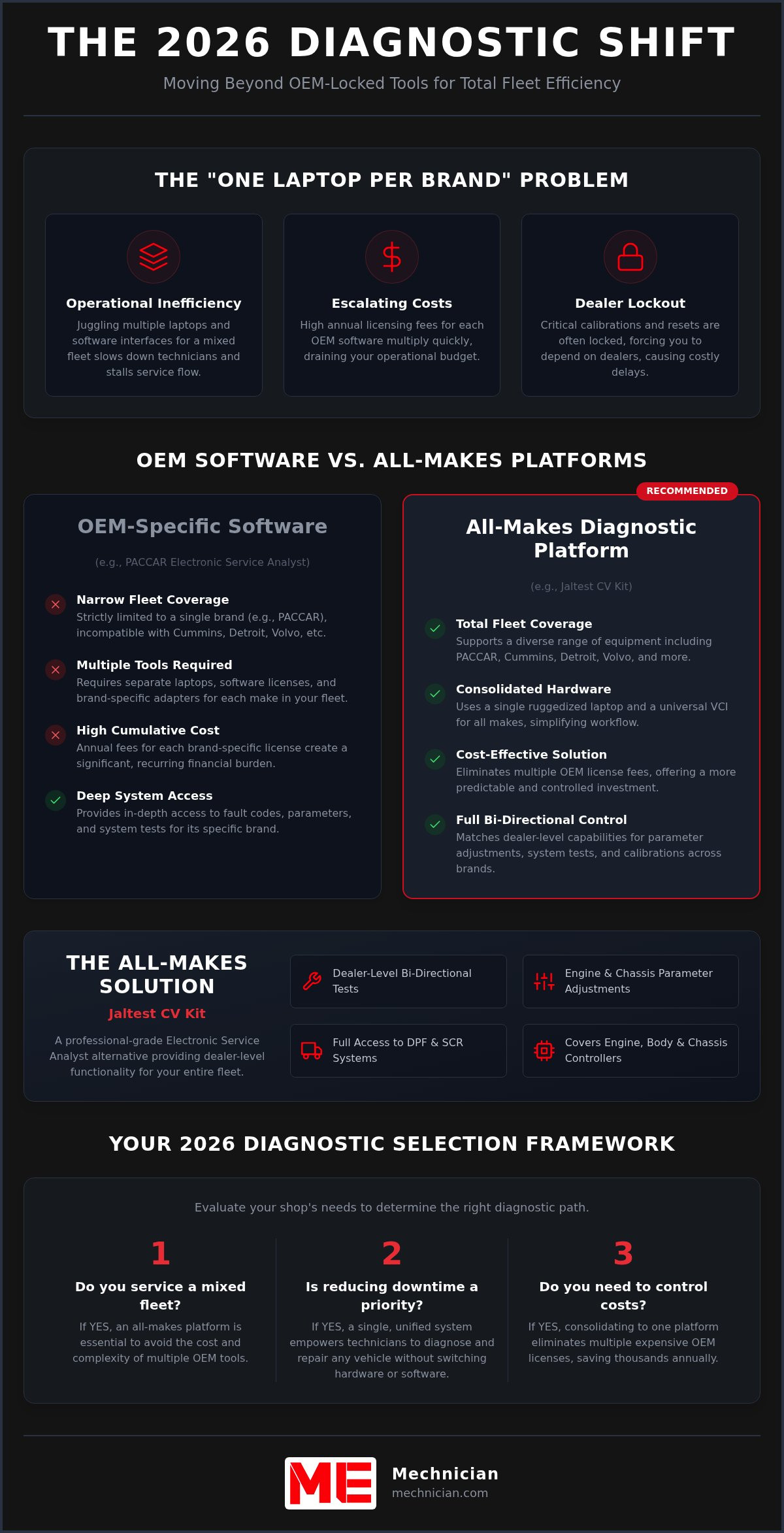
Back to News
Professional Vehicle Diagnostic Tool Guide: 2026 Industry Standards