Mon - Sat, 7:30am - 7:30pm

Sales & Support- service@mechnician.com

Heavy Equipment Diagnostic Training: The Master Guide for 2026

Heavy Equipment Diagnostic Training: The Master Guide for 2026

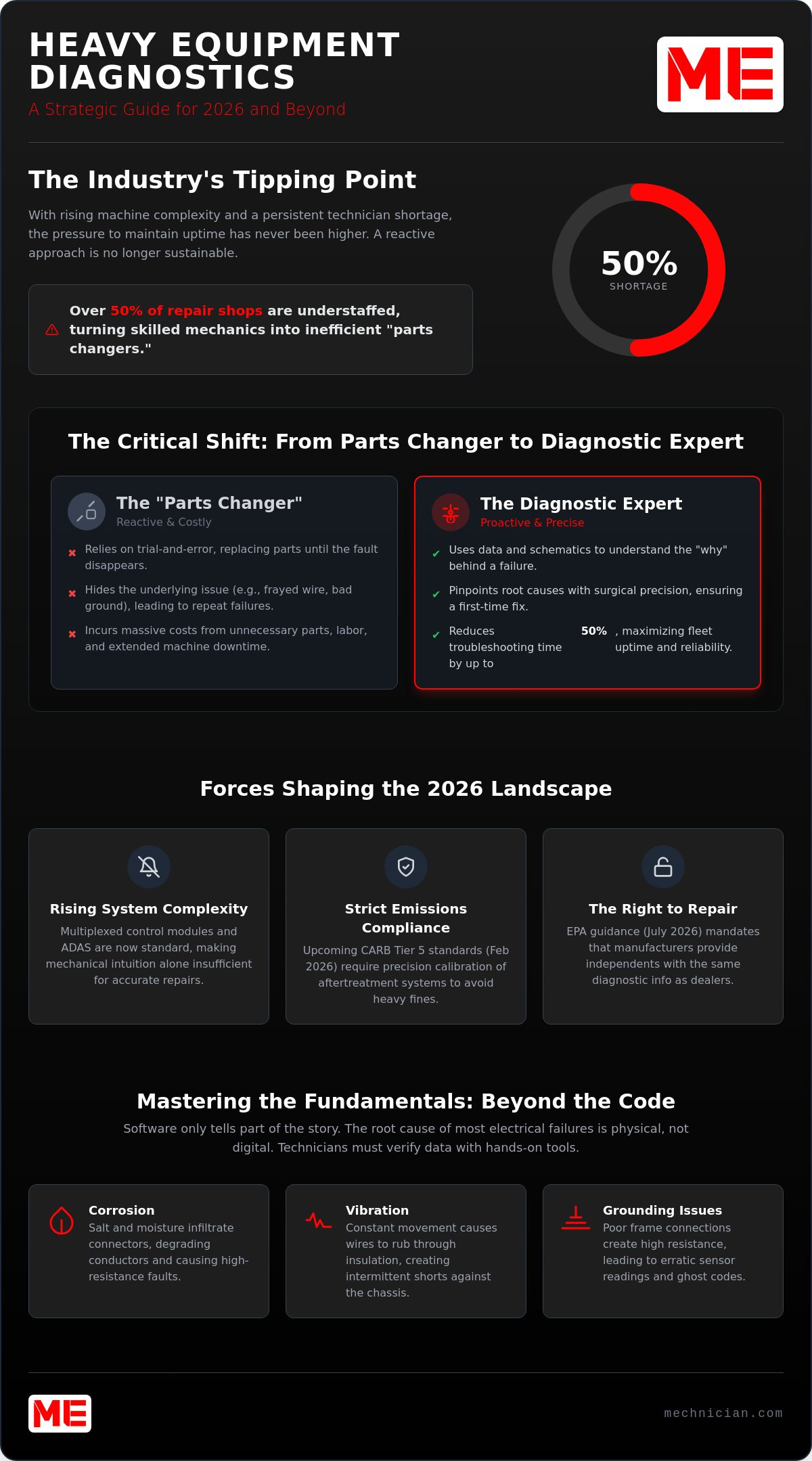
What if your maintenance team could resolve complex fault codes without waiting days for a dealer technician to arrive on-site? With over 50% of heavy-duty repair shops currently facing understaffing, the pressure to maintain uptime has never been higher. It's frustrating to watch skilled mechanics become "parts changers" simply because they lack the specific knowledge to interpret modern Tier 4 Final or Stage V emission systems. Investing in heavy equipment diagnostic training isn't just an elective choice for fleet managers. It's a strategic requirement for operational stability.

We understand that the increasing density of sensors and ECUs can feel overwhelming. This master guide for 2026 will show you how to bridge the technical skills gap, master intricate system diagnostics, and significantly reduce your reliance on outside dealers. We'll walk through the latest industry developments, including the July 2026 EPA "Right to Repair" guidance and the advanced capabilities of Jaltest version 26.1. Our goal is to help your shop operate with the precision and confidence that modern machinery demands.

Key Takeaways

  • Understand why modern heavy equipment requires a shift from reactive parts replacement to proactive, system-level analysis.
  • Learn why fundamental knowledge of electrical flow and hydraulic pressure is critical before connecting any software.
  • Discover how professional heavy equipment diagnostic training through Jaltest University enables your team to manage hundreds of brands with one interface.
  • Identify the hardware and culture shifts, including the use of ruggedized laptops, needed to maintain a high-functioning shop floor.
  • Explore how technical support and authorized partnerships help your technicians solve complex faults without dealer intervention.

Why Heavy Equipment Diagnostic Training is Essential in 2026

The heavy equipment industry has reached a tipping point where mechanical intuition alone is no longer sufficient. In 2026, machines are defined by multiplexed control modules and Advanced Driver Assistance Systems (ADAS) that require a higher level of technical literacy. Comprehensive heavy equipment diagnostic training serves as the bridge between traditional mechanical repair and modern system engineering. It represents a fundamental shift from reactive parts replacement to proactive, data-driven system analysis.

Relying on a "trial and error" approach creates a cascade of financial losses. When a technician replaces a high-pressure fuel pump only to find the fault remains, the business loses the cost of the part, the labor hours, and the potential revenue from the machine's downtime. Professional training transforms these "parts changers" into diagnostic experts who can pinpoint root causes with surgical precision. This shift is critical for maintaining fleet operational stability, especially since reports from 2025 and 2026 indicate that over 50% of repair shops are struggling with a persistent technician shortage.

Precision calibration is also a matter of compliance. With the California Air Resources Board (CARB) developing Tier 5 emissions standards as of February 2026, the margin for error in exhaust aftertreatment systems has narrowed. Accurate heavy equipment diagnostic training ensures that your team can maintain machines to these stringent requirements, preventing heavy fines and environmental non-compliance while ensuring the safety of the operator through properly calibrated ADAS sensors.

The Shift from Parts Changer to Diagnostic Expert

Throwing parts at a fault code is the most expensive way to manage a fleet. It hides the underlying issue, such as a frayed wire or a failing sensor, which will inevitably cause the new part to fail again. Developing an engineering mindset involves using technical data to understand the "why" behind a failure. Industry professionals report that utilizing integrated technical data can reduce troubleshooting time by up to 50%, allowing machines to return to the field faster and with greater reliability.

Dealer Lockouts and the Right to Repair

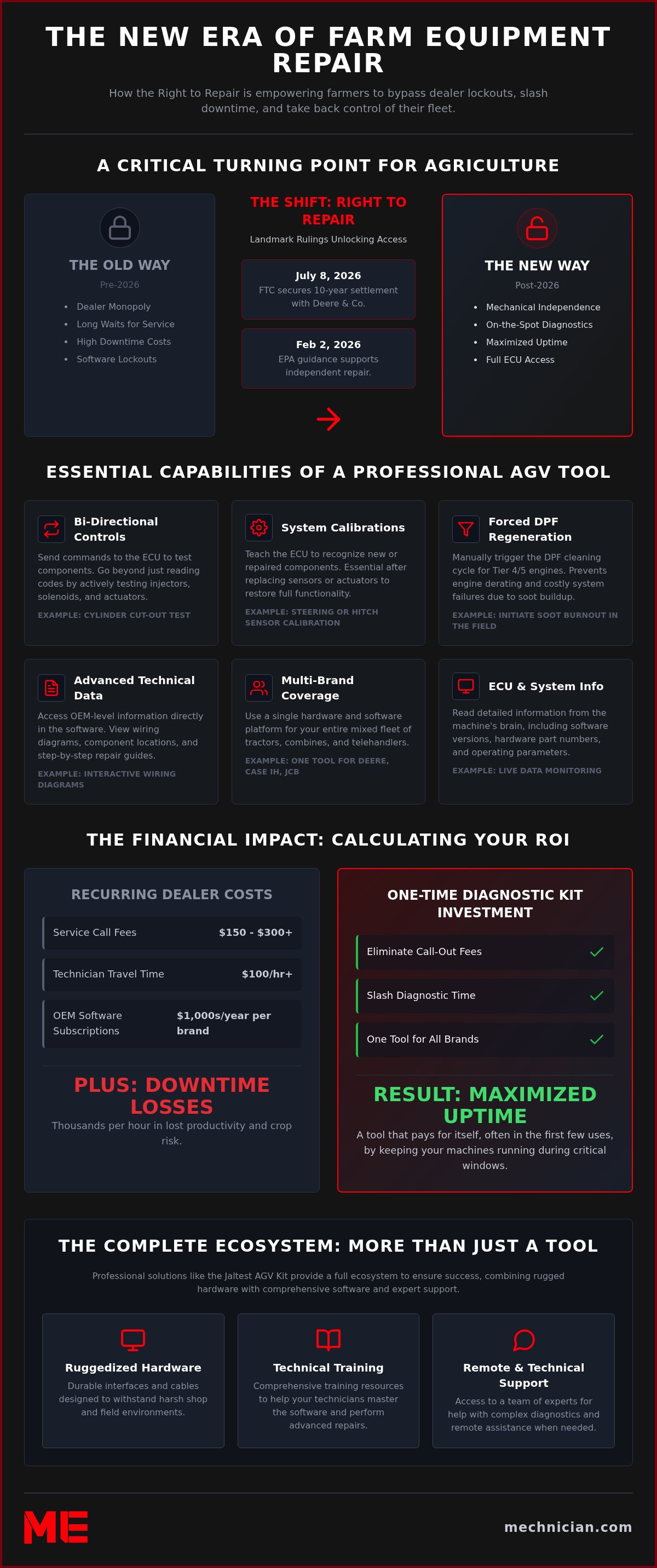
Independent shops often feel sidelined by proprietary software lockouts. However, the regulatory landscape changed significantly on July 1, 2026, when the EPA issued new guidance affirming that manufacturers must provide independent shops with the same diagnostic information available to branded centers. By mastering all-makes diagnostic tools, your team can reclaim revenue that was previously lost to dealer service departments. To understand how these tools fit into current requirements, refer to our Professional Vehicle Diagnostic Tool Guide for more details on industry standards.

Mastering the Core Fundamentals: Electrical and Hydraulic Systems

High-end software is a powerful asset, but it remains ineffective if the technician doesn't understand the physical medium it monitors. Professional heavy equipment diagnostic training must prioritize the physics of the machine before the logic of the code. A fault code for "low fuel pressure" might lead a technician to replace a sensor, but a manual pressure gauge might reveal a clogged primary filter or a failing lift pump. Without these fundamentals, the software is merely a digital suggestion box rather than a precision instrument.

The technician’s toolkit must move beyond the code reader. While a laptop provides the data, multimeters and pressure gauges identify the physical reality. Interpreting complex wiring harnesses and hydraulic circuits requires more than just looking at a screen; it requires the ability to read and understand schematics. In the heavy-duty sector, most electrical failures aren't caused by computer glitches. They're caused by physical stressors:

  • Corrosion: Salt and moisture infiltrating connectors and eating away at copper conductors.
  • Vibration: Constant movement causing wires to rub through insulation against the chassis or brackets.
  • Grounding Issues: Poor connections at the frame that create high resistance and erratic sensor readings.

Developing a diagnostic mindset means using these tools to verify what the software reports. If the software shows five volts at a sensor but the multimeter shows three, you've identified a wiring issue, not a component failure. This level of precision saves hours of unnecessary labor. To ensure your shop is equipped with tools that match this level of expertise, consider exploring the professional diagnostic kits and support available for modern fleets.

Electrical Theory for Heavy-Duty Technicians

Ohm’s Law is the foundation for troubleshooting sensors and actuators. Technicians need to be able to calculate expected values to identify open circuits, short circuits, or high resistance. When dealing with J1939 data links, a multimeter is essential for performing voltage drops and continuity tests. This ensures the communication highway is functional before an expensive ECU is condemned. Accuracy here prevents the costly mistake of replacing healthy modules.

Hydraulic Diagnostics and System Integration

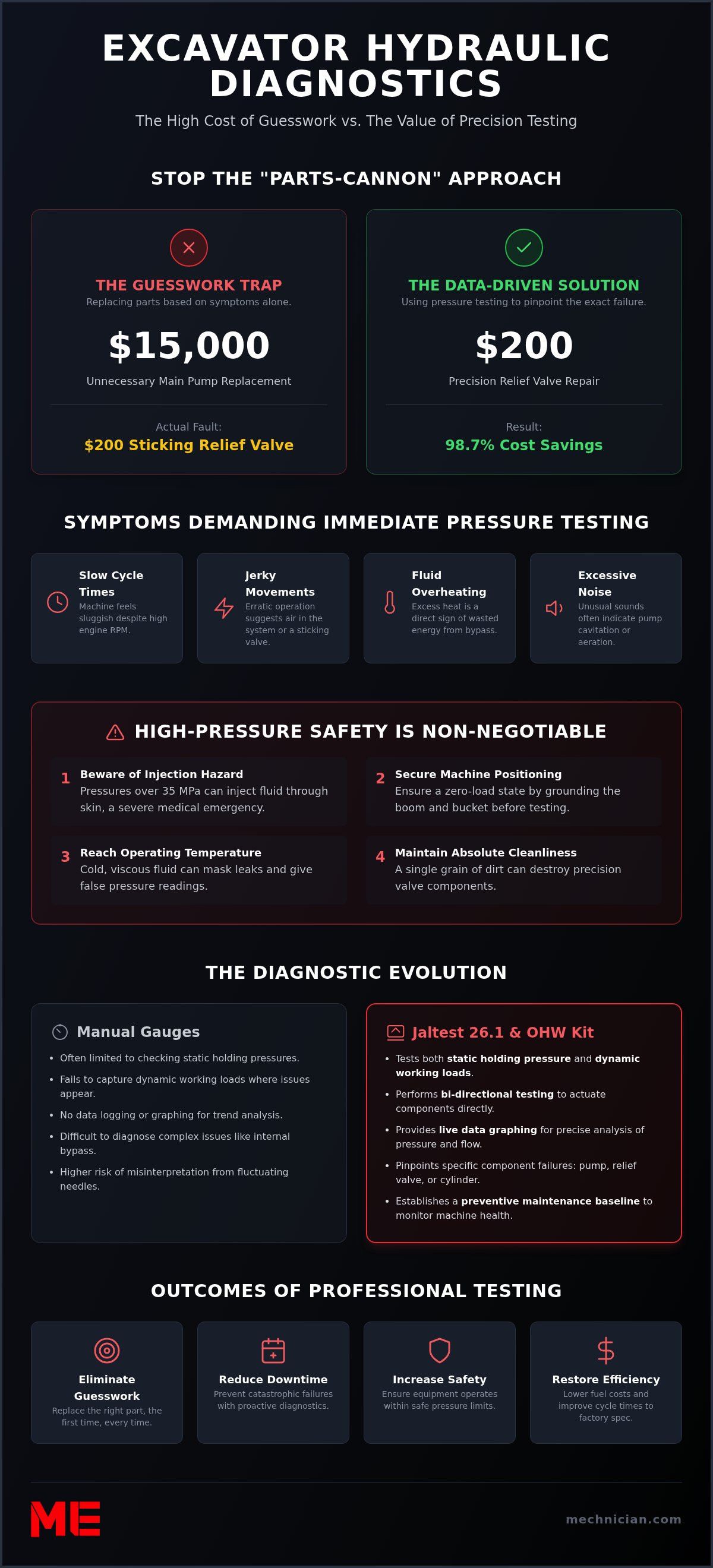
Modern hydraulics rely on the seamless integration of electronic control valves and mechanical outputs. Diagnosing a solenoid failure often involves software-driven activation tests, but the technician must verify the actual hydraulic response at the cylinder or motor. Safety protocols are critical during these routines. High-pressure systems can be lethal if handled incorrectly. Training must emphasize pressure relief procedures and the correct use of test ports to ensure the diagnostic process remains safe and controlled.

Jaltest University: A Comprehensive Software Training Ecosystem

Modern diagnostics requires more than just a tool; it requires a structured learning environment that evolves alongside the machinery. Jaltest University represents this shift by providing a dynamic training ecosystem rather than a static set of instructions. With the release of version 26.1 in March 2026, the platform has integrated advanced web-based workshop management and expanded vehicle coverage. This ensures that heavy equipment diagnostic training stays relevant as manufacturers release new ECU configurations and complex subsystems. By consolidating diagnostic capabilities into a single interface, technicians can apply a consistent methodology across diverse brands like Caterpillar, Komatsu, or John Deere, reducing the cognitive load on your team.

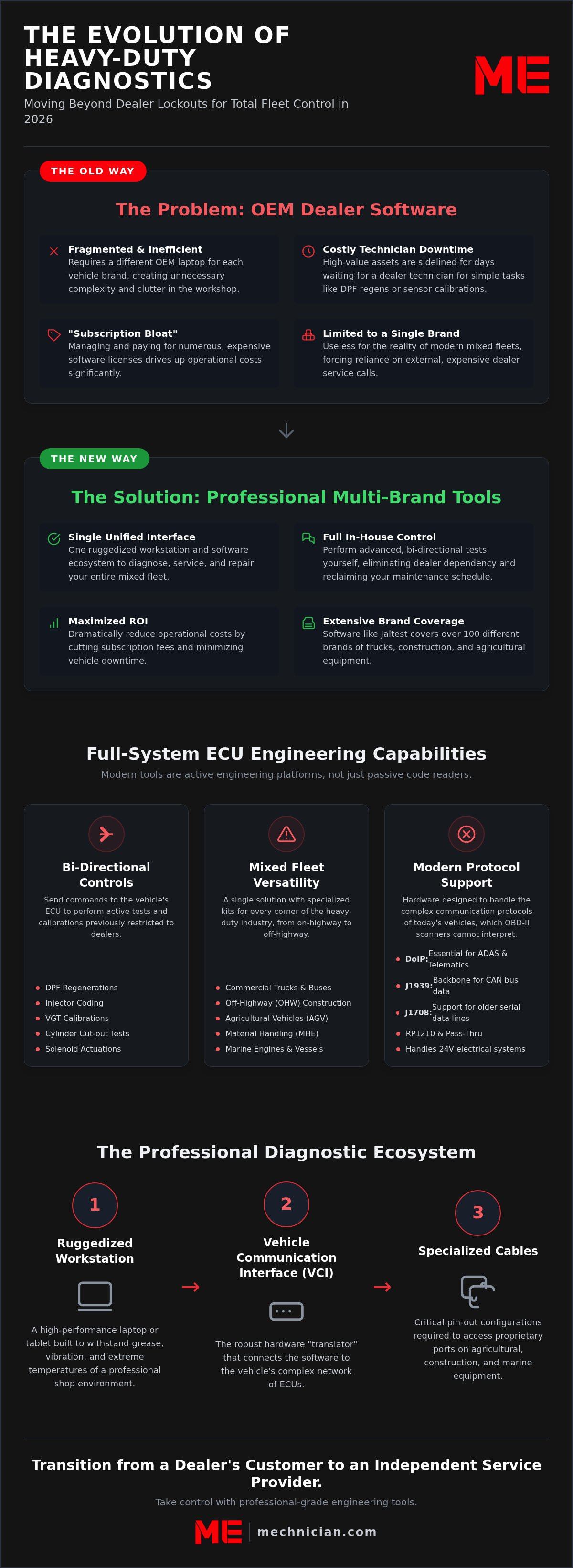
The versatility of an all-makes platform is essential for shops managing mixed fleets. Instead of learning ten different proprietary programs, your staff masters one environment. This mastery extends to advanced calibrations that were once the sole domain of dealers. Training modules cover critical procedures such as DPF regenerations, injector coding, and Variable Geometry Turbocharger (VGT) actuations. These are high-stakes tasks where precision is non-negotiable. Staying current with these capabilities requires a Jaltest Software Annual License, which provides the regular updates needed to interface with the latest manufacturer releases and emissions protocols.

Specialized Training for Off-Highway and Agricultural Equipment

The Jaltest OHW (Off-Highway) Kit requires specific procedural knowledge to navigate the unique architectures of construction machinery. Technicians learn how to perform hydraulic calibrations and engine health checks on excavators, loaders, and graders. Similarly, mastering the Jaltest AGV (Agricultural Equipment) Kit involves understanding the seasonal demands of tractors and combines. Precision here ensures that a machine is ready for the field when it matters most. For those also managing transport fleets, our Jaltest CV Kit Guide provides a detailed look at all-makes truck diagnostics in the current market.

The Role of Technical Data and Wiring Diagrams

Software is most effective when it provides a clear path to resolution. The Jaltest interface includes integrated troubleshooting guides that lead the technician through a step-by-step repair path based on specific fault codes. This includes component locations and technical specifications that eliminate guesswork. In warehouse environments, maximizing the value of the Jaltest MHE (Material Handling Equipment) Kit means being able to quickly identify electrical faults in forklifts or telehandlers. Access to interactive wiring diagrams allows your team to trace circuits with confidence, ensuring that every repair is grounded in verified technical data.
Heavy equipment diagnostic training

Building a Diagnostic-First Culture in Your Maintenance Team

Transforming a shop's performance requires more than just a software purchase. It demands a cultural shift where diagnostics are prioritized over parts replacement. This process starts with a systematic assessment of your current staff to identify specific knowledge gaps. Some technicians might have decades of mechanical experience but struggle with multiplexed circuits. Others may be comfortable with computers but lack a deep understanding of hydraulic pressures. Once you've mapped these skills, heavy equipment diagnostic training becomes a targeted roadmap for growth rather than a generic classroom exercise.

Implementing a "diagnostic-first" approach means creating a low-stakes environment for learning. Fleet managers should schedule dedicated training hours where technicians can explore software features on machines that aren't currently facing an emergency deadline. This practice allows them to navigate technical data and wiring diagrams without the pressure of an active machine down situation. Incentivizing this progress is equally important. Rewarding technicians who complete Jaltest University modules or achieve specific certifications turns professional development into a valued career milestone. To support this transition, you can explore our range of ruggedized diagnostic laptops and technical training solutions designed for professional environments.

Remote Technical Support as Continuous Education

Technical support shouldn't be viewed as a one-time rescue for a difficult fault. Instead, it functions as a live classroom experience. When your team uses Jaltest technical support to resolve complex "ghost codes" or intermittent faults, they're participating in a guided repair path. This interaction builds long-term competence and breaks the cycle of dealer reliance. Over time, these guided sessions empower your technicians to handle similar issues independently, turning every challenging repair into a teaching tool for the entire shop.

Selecting the Right Hardware for Training

The shop floor is a hostile environment for standard consumer electronics. Extreme temperatures, dust, and physical impacts will quickly disable a standard laptop, halting your heavy equipment diagnostic training efforts. Ruggedized diagnostic laptops are engineered to survive these conditions. They ensure that your team has reliable access to the Jaltest software annual license updates and technical specifications whenever a machine enters the bay. Investing in hardware that matches the durability of your heavy equipment is a strategic decision that prevents unnecessary downtime and hardware replacement costs.

The Mechnician Advantage: Beyond the Training Course

Completing a certification is only the first step toward diagnostic independence. True operational stability comes from a long term partnership with experts who understand the realities of the shop floor. Mechnician serves as your authorized partner for Jaltest solutions; providing the technical upskilling and hardware support necessary to maintain a modern fleet. We don't just deliver a kit and leave; we provide a national network of specialists capable of offering remote guidance and on-site assistance when your team encounters a particularly stubborn fault. This commitment to your fleet's uptime ensures that your investment in heavy equipment diagnostic training yields a measurable return in reduced dealer fees and shorter repair cycles.

Financial accessibility is a key part of our solution. We offer flexible financing options for diagnostic kits and training enrollment fees, allowing maintenance departments to modernize their toolsets without immediate capital strain. This professional approach treats technical education as a strategic asset for future stability rather than a one-time expense. By aligning your team with Mechnician and Cojali, you're integrating a dedicated technical unit into your organization that takes responsibility for the continuous functionality of your diagnostic capabilities.

Total Lifecycle Support for Your Diagnostic Tools

Maintaining the edge in diagnostics requires keeping your tools as current as the machinery they service. This involves managing Jaltest Software Annual License renewals to ensure compatibility with the latest ECU releases and emissions standards. Our support extends to providing Specialized Diagnostic Cables for niche or legacy equipment, ensuring you never lose coverage on older assets. Our technical support team is always available to help your technicians maximize tool utilization, helping them navigate new software features as they are released.

Next Steps: Reclaiming Control of Your Repairs

Reclaiming control over your maintenance schedule starts with a customized training plan tailored to your department's specific needs. Whether you're managing a small construction fleet or a large agricultural operation, the combination of Jaltest versatility and Mechnician expertise provides a clear path to self-sufficiency. The long term benefits of this partnership include a more confident workforce and a significant reduction in machine downtime. You can contact Mechnician to discuss your heavy equipment diagnostic training needs and begin the transition toward a more efficient, diagnostic-first maintenance culture.

Securing Your Fleet's Operational Future

The heavy equipment landscape in 2026 requires a precise blend of mechanical intuition and digital literacy. By integrating fundamental system theory with advanced software capabilities, your team can finally break the cycle of expensive dealer reliance. We've explored how a diagnostic-first culture, supported by ruggedized hardware and specialized training, transforms your shop into a high-efficiency unit. This transition ensures that your equipment stays in the field rather than waiting in a service bay for weeks at a time.

Professional heavy equipment diagnostic training is a necessary investment in your fleet's long-term stability. As an Authorized Jaltest Dealer, Mechnician provides the tools and knowledge your technicians need to succeed. You'll gain direct access to Jaltest University and our expert remote technical support to ensure your team solves even the most complex faults with confidence. This partnership provides the technical backbone your organization needs to thrive in an increasingly complex industry.

Empower your team with Jaltest Training and Diagnostic Kits at Mechnician.com and reclaim control over your repair timelines today. Your journey toward technical self-sufficiency is a strategic decision that builds a more resilient future for your business.

Frequently Asked Questions

How long does it take to become proficient in heavy equipment diagnostics?

Proficiency in heavy equipment diagnostics typically takes between six and twelve months of consistent hands-on experience and structured study. While basic fault code reading can be learned quickly, mastering complex system analysis and bi-directional testing requires ongoing engagement with modern software. Technicians who commit to regular modules often see a significant improvement in their troubleshooting speed within the first year.

Can I learn to use Jaltest software online, or is in-person training required?

You can learn to use Jaltest software through online modules provided by Jaltest University, which offers a flexible way to master the interface. These web-based courses allow technicians to progress at their own pace from any location. While in-person workshops can provide valuable tactile experience, the digital platform is designed to be a comprehensive standalone resource for software literacy.

What is the difference between a code reader and a professional diagnostic kit?

A professional diagnostic kit offers bi-directional control and deep system access that a simple code reader cannot match. While a code reader only identifies a fault, a professional kit allows you to perform DPF regenerations, calibrate actuators, and access integrated wiring diagrams. This level of heavy equipment diagnostic training ensures your team can actually repair the machine rather than just identifying the symptom.

What happens if my technicians encounter a fault they cannot solve after training?

Technicians who encounter an unsolvable fault can utilize expert remote technical support to guide them through the repair path. This real-time assistance acts as a safety net, ensuring that complex "ghost codes" or intermittent failures don't result in machine downtime. This service functions as an extension of your team, providing the confidence needed to tackle advanced electronic issues.

Is Jaltest University included with the purchase of a diagnostic kit?

Access to Jaltest University is typically included with the purchase of a diagnostic kit and the maintenance of an active software license. This ensures that your team has the educational resources needed to utilize the tool's full potential from day one. It serves as a centralized hub for learning the specific nuances of OHW, AGV, and CV modules.

Do I need a separate training course for different brands like Caterpillar or John Deere?

No, you don't need separate training courses for different brands because Jaltest utilizes a unified interface for hundreds of manufacturers. Once a technician learns the software logic, they can apply the same diagnostic process to Caterpillar, John Deere, or Komatsu machinery. This all-makes versatility is a primary advantage of professional heavy equipment diagnostic training, as it simplifies the learning curve for mixed fleets.

How much does heavy equipment diagnostic training typically cost for a team?

The cost of diagnostic training varies based on the depth of the program and the number of technicians involved. Industry-standard workshops for specific systems like hydraulics or electrical troubleshooting often range from $450 to $475 per person at technical universities. For a full maintenance department, a customized plan involving software-integrated modules is often the most cost-effective way to achieve team-wide proficiency.

Can training help reduce my fleet’s annual maintenance budget?

Training helps reduce your fleet’s annual maintenance budget by significantly lowering the frequency of dealer service calls and reducing machine downtime. When technicians can identify root causes accurately, you avoid the "parts changer" mentality that leads to unnecessary component costs. Over time, the ability to perform in-house calibrations and regenerations provides a measurable return on investment.
Leave a comment

Please note, comments must be approved before they are published

This site is protected by hCaptcha and the hCaptcha Privacy Policy and Terms of Service apply.


Heavy Equipment Diagnostic Training: The Master Guide for 2026

Heavy Equipment Diagnostic Training: The Master Guide for 2026

What if your maintenance team could resolve complex fault codes without waiting days for a dealer technician to arrive on-site? With over 50% of heavy-duty repair shops currently facing understaffing, the pressure to maintain uptime has never been higher. It's frustrating to watch skilled mechanics become "parts changers" simply because they lack the specific knowledge to interpret modern Tier 4 Final or Stage V emission systems. Investing in heavy equipment diagnostic training isn't just an elective choice for fleet managers. It's a strategic requirement for operational stability.

We understand that the increasing density of sensors and ECUs can feel overwhelming. This master guide for 2026 will show you how to bridge the technical skills gap, master intricate system diagnostics, and significantly reduce your reliance on outside dealers. We'll walk through the latest industry developments, including the July 2026 EPA "Right to Repair" guidance and the advanced capabilities of Jaltest version 26.1. Our goal is to help your shop operate with the precision and confidence that modern machinery demands.

Key Takeaways

  • Understand why modern heavy equipment requires a shift from reactive parts replacement to proactive, system-level analysis.
  • Learn why fundamental knowledge of electrical flow and hydraulic pressure is critical before connecting any software.
  • Discover how professional heavy equipment diagnostic training through Jaltest University enables your team to manage hundreds of brands with one interface.
  • Identify the hardware and culture shifts, including the use of ruggedized laptops, needed to maintain a high-functioning shop floor.
  • Explore how technical support and authorized partnerships help your technicians solve complex faults without dealer intervention.

Why Heavy Equipment Diagnostic Training is Essential in 2026

The heavy equipment industry has reached a tipping point where mechanical intuition alone is no longer sufficient. In 2026, machines are defined by multiplexed control modules and Advanced Driver Assistance Systems (ADAS) that require a higher level of technical literacy. Comprehensive heavy equipment diagnostic training serves as the bridge between traditional mechanical repair and modern system engineering. It represents a fundamental shift from reactive parts replacement to proactive, data-driven system analysis.

Relying on a "trial and error" approach creates a cascade of financial losses. When a technician replaces a high-pressure fuel pump only to find the fault remains, the business loses the cost of the part, the labor hours, and the potential revenue from the machine's downtime. Professional training transforms these "parts changers" into diagnostic experts who can pinpoint root causes with surgical precision. This shift is critical for maintaining fleet operational stability, especially since reports from 2025 and 2026 indicate that over 50% of repair shops are struggling with a persistent technician shortage.

Precision calibration is also a matter of compliance. With the California Air Resources Board (CARB) developing Tier 5 emissions standards as of February 2026, the margin for error in exhaust aftertreatment systems has narrowed. Accurate heavy equipment diagnostic training ensures that your team can maintain machines to these stringent requirements, preventing heavy fines and environmental non-compliance while ensuring the safety of the operator through properly calibrated ADAS sensors.

The Shift from Parts Changer to Diagnostic Expert

Throwing parts at a fault code is the most expensive way to manage a fleet. It hides the underlying issue, such as a frayed wire or a failing sensor, which will inevitably cause the new part to fail again. Developing an engineering mindset involves using technical data to understand the "why" behind a failure. Industry professionals report that utilizing integrated technical data can reduce troubleshooting time by up to 50%, allowing machines to return to the field faster and with greater reliability.

Dealer Lockouts and the Right to Repair

Independent shops often feel sidelined by proprietary software lockouts. However, the regulatory landscape changed significantly on July 1, 2026, when the EPA issued new guidance affirming that manufacturers must provide independent shops with the same diagnostic information available to branded centers. By mastering all-makes diagnostic tools, your team can reclaim revenue that was previously lost to dealer service departments. To understand how these tools fit into current requirements, refer to our Professional Vehicle Diagnostic Tool Guide for more details on industry standards.

Mastering the Core Fundamentals: Electrical and Hydraulic Systems

High-end software is a powerful asset, but it remains ineffective if the technician doesn't understand the physical medium it monitors. Professional heavy equipment diagnostic training must prioritize the physics of the machine before the logic of the code. A fault code for "low fuel pressure" might lead a technician to replace a sensor, but a manual pressure gauge might reveal a clogged primary filter or a failing lift pump. Without these fundamentals, the software is merely a digital suggestion box rather than a precision instrument.

The technician’s toolkit must move beyond the code reader. While a laptop provides the data, multimeters and pressure gauges identify the physical reality. Interpreting complex wiring harnesses and hydraulic circuits requires more than just looking at a screen; it requires the ability to read and understand schematics. In the heavy-duty sector, most electrical failures aren't caused by computer glitches. They're caused by physical stressors:

  • Corrosion: Salt and moisture infiltrating connectors and eating away at copper conductors.
  • Vibration: Constant movement causing wires to rub through insulation against the chassis or brackets.
  • Grounding Issues: Poor connections at the frame that create high resistance and erratic sensor readings.

Developing a diagnostic mindset means using these tools to verify what the software reports. If the software shows five volts at a sensor but the multimeter shows three, you've identified a wiring issue, not a component failure. This level of precision saves hours of unnecessary labor. To ensure your shop is equipped with tools that match this level of expertise, consider exploring the professional diagnostic kits and support available for modern fleets.

Electrical Theory for Heavy-Duty Technicians

Ohm’s Law is the foundation for troubleshooting sensors and actuators. Technicians need to be able to calculate expected values to identify open circuits, short circuits, or high resistance. When dealing with J1939 data links, a multimeter is essential for performing voltage drops and continuity tests. This ensures the communication highway is functional before an expensive ECU is condemned. Accuracy here prevents the costly mistake of replacing healthy modules.

Hydraulic Diagnostics and System Integration

Modern hydraulics rely on the seamless integration of electronic control valves and mechanical outputs. Diagnosing a solenoid failure often involves software-driven activation tests, but the technician must verify the actual hydraulic response at the cylinder or motor. Safety protocols are critical during these routines. High-pressure systems can be lethal if handled incorrectly. Training must emphasize pressure relief procedures and the correct use of test ports to ensure the diagnostic process remains safe and controlled.

Jaltest University: A Comprehensive Software Training Ecosystem

Modern diagnostics requires more than just a tool; it requires a structured learning environment that evolves alongside the machinery. Jaltest University represents this shift by providing a dynamic training ecosystem rather than a static set of instructions. With the release of version 26.1 in March 2026, the platform has integrated advanced web-based workshop management and expanded vehicle coverage. This ensures that heavy equipment diagnostic training stays relevant as manufacturers release new ECU configurations and complex subsystems. By consolidating diagnostic capabilities into a single interface, technicians can apply a consistent methodology across diverse brands like Caterpillar, Komatsu, or John Deere, reducing the cognitive load on your team.

The versatility of an all-makes platform is essential for shops managing mixed fleets. Instead of learning ten different proprietary programs, your staff masters one environment. This mastery extends to advanced calibrations that were once the sole domain of dealers. Training modules cover critical procedures such as DPF regenerations, injector coding, and Variable Geometry Turbocharger (VGT) actuations. These are high-stakes tasks where precision is non-negotiable. Staying current with these capabilities requires a Jaltest Software Annual License, which provides the regular updates needed to interface with the latest manufacturer releases and emissions protocols.

Specialized Training for Off-Highway and Agricultural Equipment

The Jaltest OHW (Off-Highway) Kit requires specific procedural knowledge to navigate the unique architectures of construction machinery. Technicians learn how to perform hydraulic calibrations and engine health checks on excavators, loaders, and graders. Similarly, mastering the Jaltest AGV (Agricultural Equipment) Kit involves understanding the seasonal demands of tractors and combines. Precision here ensures that a machine is ready for the field when it matters most. For those also managing transport fleets, our Jaltest CV Kit Guide provides a detailed look at all-makes truck diagnostics in the current market.

The Role of Technical Data and Wiring Diagrams

Software is most effective when it provides a clear path to resolution. The Jaltest interface includes integrated troubleshooting guides that lead the technician through a step-by-step repair path based on specific fault codes. This includes component locations and technical specifications that eliminate guesswork. In warehouse environments, maximizing the value of the Jaltest MHE (Material Handling Equipment) Kit means being able to quickly identify electrical faults in forklifts or telehandlers. Access to interactive wiring diagrams allows your team to trace circuits with confidence, ensuring that every repair is grounded in verified technical data.

Heavy equipment diagnostic training

Building a Diagnostic-First Culture in Your Maintenance Team

Transforming a shop's performance requires more than just a software purchase. It demands a cultural shift where diagnostics are prioritized over parts replacement. This process starts with a systematic assessment of your current staff to identify specific knowledge gaps. Some technicians might have decades of mechanical experience but struggle with multiplexed circuits. Others may be comfortable with computers but lack a deep understanding of hydraulic pressures. Once you've mapped these skills, heavy equipment diagnostic training becomes a targeted roadmap for growth rather than a generic classroom exercise.

Implementing a "diagnostic-first" approach means creating a low-stakes environment for learning. Fleet managers should schedule dedicated training hours where technicians can explore software features on machines that aren't currently facing an emergency deadline. This practice allows them to navigate technical data and wiring diagrams without the pressure of an active machine down situation. Incentivizing this progress is equally important. Rewarding technicians who complete Jaltest University modules or achieve specific certifications turns professional development into a valued career milestone. To support this transition, you can explore our range of ruggedized diagnostic laptops and technical training solutions designed for professional environments.

Remote Technical Support as Continuous Education

Technical support shouldn't be viewed as a one-time rescue for a difficult fault. Instead, it functions as a live classroom experience. When your team uses Jaltest technical support to resolve complex "ghost codes" or intermittent faults, they're participating in a guided repair path. This interaction builds long-term competence and breaks the cycle of dealer reliance. Over time, these guided sessions empower your technicians to handle similar issues independently, turning every challenging repair into a teaching tool for the entire shop.

Selecting the Right Hardware for Training

The shop floor is a hostile environment for standard consumer electronics. Extreme temperatures, dust, and physical impacts will quickly disable a standard laptop, halting your heavy equipment diagnostic training efforts. Ruggedized diagnostic laptops are engineered to survive these conditions. They ensure that your team has reliable access to the Jaltest software annual license updates and technical specifications whenever a machine enters the bay. Investing in hardware that matches the durability of your heavy equipment is a strategic decision that prevents unnecessary downtime and hardware replacement costs.

The Mechnician Advantage: Beyond the Training Course

Completing a certification is only the first step toward diagnostic independence. True operational stability comes from a long term partnership with experts who understand the realities of the shop floor. Mechnician serves as your authorized partner for Jaltest solutions; providing the technical upskilling and hardware support necessary to maintain a modern fleet. We don't just deliver a kit and leave; we provide a national network of specialists capable of offering remote guidance and on-site assistance when your team encounters a particularly stubborn fault. This commitment to your fleet's uptime ensures that your investment in heavy equipment diagnostic training yields a measurable return in reduced dealer fees and shorter repair cycles.

Financial accessibility is a key part of our solution. We offer flexible financing options for diagnostic kits and training enrollment fees, allowing maintenance departments to modernize their toolsets without immediate capital strain. This professional approach treats technical education as a strategic asset for future stability rather than a one-time expense. By aligning your team with Mechnician and Cojali, you're integrating a dedicated technical unit into your organization that takes responsibility for the continuous functionality of your diagnostic capabilities.

Total Lifecycle Support for Your Diagnostic Tools

Maintaining the edge in diagnostics requires keeping your tools as current as the machinery they service. This involves managing Jaltest Software Annual License renewals to ensure compatibility with the latest ECU releases and emissions standards. Our support extends to providing Specialized Diagnostic Cables for niche or legacy equipment, ensuring you never lose coverage on older assets. Our technical support team is always available to help your technicians maximize tool utilization, helping them navigate new software features as they are released.

Next Steps: Reclaiming Control of Your Repairs

Reclaiming control over your maintenance schedule starts with a customized training plan tailored to your department's specific needs. Whether you're managing a small construction fleet or a large agricultural operation, the combination of Jaltest versatility and Mechnician expertise provides a clear path to self-sufficiency. The long term benefits of this partnership include a more confident workforce and a significant reduction in machine downtime. You can contact Mechnician to discuss your heavy equipment diagnostic training needs and begin the transition toward a more efficient, diagnostic-first maintenance culture.

Securing Your Fleet's Operational Future

The heavy equipment landscape in 2026 requires a precise blend of mechanical intuition and digital literacy. By integrating fundamental system theory with advanced software capabilities, your team can finally break the cycle of expensive dealer reliance. We've explored how a diagnostic-first culture, supported by ruggedized hardware and specialized training, transforms your shop into a high-efficiency unit. This transition ensures that your equipment stays in the field rather than waiting in a service bay for weeks at a time.

Professional heavy equipment diagnostic training is a necessary investment in your fleet's long-term stability. As an Authorized Jaltest Dealer, Mechnician provides the tools and knowledge your technicians need to succeed. You'll gain direct access to Jaltest University and our expert remote technical support to ensure your team solves even the most complex faults with confidence. This partnership provides the technical backbone your organization needs to thrive in an increasingly complex industry.

Empower your team with Jaltest Training and Diagnostic Kits at Mechnician.com and reclaim control over your repair timelines today. Your journey toward technical self-sufficiency is a strategic decision that builds a more resilient future for your business.

Frequently Asked Questions

How long does it take to become proficient in heavy equipment diagnostics?

Proficiency in heavy equipment diagnostics typically takes between six and twelve months of consistent hands-on experience and structured study. While basic fault code reading can be learned quickly, mastering complex system analysis and bi-directional testing requires ongoing engagement with modern software. Technicians who commit to regular modules often see a significant improvement in their troubleshooting speed within the first year.

Can I learn to use Jaltest software online, or is in-person training required?

You can learn to use Jaltest software through online modules provided by Jaltest University, which offers a flexible way to master the interface. These web-based courses allow technicians to progress at their own pace from any location. While in-person workshops can provide valuable tactile experience, the digital platform is designed to be a comprehensive standalone resource for software literacy.

What is the difference between a code reader and a professional diagnostic kit?

A professional diagnostic kit offers bi-directional control and deep system access that a simple code reader cannot match. While a code reader only identifies a fault, a professional kit allows you to perform DPF regenerations, calibrate actuators, and access integrated wiring diagrams. This level of heavy equipment diagnostic training ensures your team can actually repair the machine rather than just identifying the symptom.

What happens if my technicians encounter a fault they cannot solve after training?

Technicians who encounter an unsolvable fault can utilize expert remote technical support to guide them through the repair path. This real-time assistance acts as a safety net, ensuring that complex "ghost codes" or intermittent failures don't result in machine downtime. This service functions as an extension of your team, providing the confidence needed to tackle advanced electronic issues.

Is Jaltest University included with the purchase of a diagnostic kit?

Access to Jaltest University is typically included with the purchase of a diagnostic kit and the maintenance of an active software license. This ensures that your team has the educational resources needed to utilize the tool's full potential from day one. It serves as a centralized hub for learning the specific nuances of OHW, AGV, and CV modules.

Do I need a separate training course for different brands like Caterpillar or John Deere?

No, you don't need separate training courses for different brands because Jaltest utilizes a unified interface for hundreds of manufacturers. Once a technician learns the software logic, they can apply the same diagnostic process to Caterpillar, John Deere, or Komatsu machinery. This all-makes versatility is a primary advantage of professional heavy equipment diagnostic training, as it simplifies the learning curve for mixed fleets.

How much does heavy equipment diagnostic training typically cost for a team?

The cost of diagnostic training varies based on the depth of the program and the number of technicians involved. Industry-standard workshops for specific systems like hydraulics or electrical troubleshooting often range from $450 to $475 per person at technical universities. For a full maintenance department, a customized plan involving software-integrated modules is often the most cost-effective way to achieve team-wide proficiency.

Can training help reduce my fleet’s annual maintenance budget?

Training helps reduce your fleet’s annual maintenance budget by significantly lowering the frequency of dealer service calls and reducing machine downtime. When technicians can identify root causes accurately, you avoid the "parts changer" mentality that leads to unnecessary component costs. Over time, the ability to perform in-house calibrations and regenerations provides a measurable return on investment.
Professional Vehicle Diagnostic Tool Guide: 2026 Industry Standards

Professional Vehicle Diagnostic Tool Guide: 2026 Industry Standards

Every hour your heavy-duty truck sits in a dealership bay in Ontario or Alberta costs your operation an average of C$1,200 in lost revenue and service fees. You already know that relying on OEM technicians for simple sensor resets is a bottleneck that drains your maintenance budget. It's frustrating when a generic code reader identifies a fault but lacks the bidirectional control to actually force a DPF regeneration or calibrate a steering angle sensor. A single diagnostic delay can ripple through your entire logistics chain, turning a minor sensor glitch into a multi-day operational failure.

This guide provides the technical roadmap to selecting a professional vehicle diagnostic tool that meets 2026 industry standards. You'll learn how to bypass dealer gatekeepers, reduce your external service spend by up to 40%, and achieve full independent repair capability across your entire multi-brand fleet. We'll examine the specific hardware requirements and software protocols necessary to maintain 98% fleet uptime without proprietary OEM interference.

Key Takeaways

  • Distinguish between basic code readers and full-spectrum systems to ensure your shop meets the technical requirements of 2026 industrial protocols.
  • Master advanced capabilities like bi-directional controls and system calibrations to perform precision adjustments on VGT actuators and hydraulic valves.
  • Calculate the significant ROI of dealer independence by eliminating high hourly rates and C$1,000+ towing costs that impact Canadian fleet margins.
  • Select the optimal vehicle diagnostic tool tailored to your specific sector, from commercial transport to specialized off-highway construction machinery.
  • Leverage professional technical support and remote diagnostics to minimize downtime and treat maintenance as a strategic investment in productivity.

What Defines a Professional Vehicle Diagnostic Tool in 2026?

By 2026, the complexity of automotive electronics has reached a point where a simple plug-and-play approach no longer suffices for industrial maintenance. Modern fleets in Canada now rely on Zonal E/E architectures that require more than just a connection; they require a deep handshake with the vehicle's central gateway. A professional vehicle diagnostic tool represents a strategic investment in uptime. In the current market, a high-tier unit typically costs between C$3,800 and C$9,500, reflecting its role as a critical piece of industrial equipment. These tools must navigate secure data releases and encrypted modules that were non-existent a decade ago. Precision in fault detection is the baseline for maintaining operational safety.

Code Readers vs. Diagnostic Scanners

Distinguishing between these two categories is vital for shop efficiency. Basic code readers operate on a "read-only" basis. They pull generic DTCs (Diagnostic Trouble Codes) related to On-board diagnostics (OBD) standards, primarily for emissions monitoring. They can't perform calibrations or bidirectional tests. In contrast, a professional diagnostic scanner is a "read-write" instrument. It allows technicians to command components, such as cycling an ABS pump or forcing a DPF regeneration. Generic OBDII tools often fail in heavy-duty environments because they lack the proprietary manufacturer protocols needed for 85% of deep-system faults found in vocational trucks or specialized machinery. Using the wrong tool leads to misdiagnosis and extended downtime.

The Evolution of VCI Technology

The Vehicle Communication Interface (VCI) has transitioned from a simple bridge to a powerful edge-computing device. Modern VCIs utilize CAN FD (Flexible Data-rate) and DoIP (Diagnostics over IP) to manage data transfer speeds up to 100 Mbps. This speed is necessary because 2026 model year vehicles often process 40 GB of data during a full system scan. The VCI acts as the translator between the vehicle’s raw CAN bus data and the user software. High-speed Bluetooth 5.2 and dual-band Wi-Fi connections have replaced the restrictive physical cables of the past. This allows technicians to monitor live data from 30 meters away, which is essential for safety when testing heavy machinery. This technology eliminates the latency that previously caused signal drops during critical ECU re-flashing procedures.

The 2026 standards demand a vehicle diagnostic tool that can handle multi-protocol communication simultaneously. A professional unit must talk to the powertrain on one channel while querying the ADAS (Advanced Driver Assistance Systems) module on another. This multi-stream capability is a requirement for modern safety certifications in the Canadian transport sector. Reliability is the priority here; a technician cannot afford a communication timeout when configuring a steering angle sensor or a braking controller.

Ruggedization is another factor that separates professional gear from consumer electronics. While a C$600 consumer tablet might seem cost-effective, it lacks the thermal management required for 10-hour shifts in a non-climate-controlled Canadian shop. To ensure your facility's climate systems are up to the task, you can visit Zee Jay Mechanical for specialized HVAC support. Professional tools feature IP65 or IP67 ratings, ensuring protection against oil, brake fluid, and 1.5-meter drops onto concrete. Consumer tablets often throttle their processors when internal temperatures reach 35°C, which leads to software crashes during deep scans. In industrial settings, hardware failure translates directly to machine downtime. Investing in ruggedized equipment is a calculated decision to ensure long-term sustainability and consistent performance in the field.

Advanced Capabilities: Moving Beyond Fault Code Interpretation

Reading a fault code is only 15% of the diagnostic process. A professional vehicle diagnostic tool acts as a bridge for two-way communication. It doesn't just listen; it speaks. This capability allows technicians to verify repairs without trial-and-error part swapping, which is a common drain on shop productivity. When a tool can command the vehicle, the diagnostic process shifts from guesswork to empirical verification.

While this article focuses on industrial fleet diagnostics, the same need for technical precision exists in the performance automotive world. For readers interested in high-performance vehicle maintenance and upgrades, you can discover Oztrack Performance Tuning & Engines to explore specialized technical guides for performance-oriented models.

Bi-Directional Control: The Professional Standard

Bi-directional testing shifts the technician from observer to operator. You can trigger a fuel pump activation or command a specific cooling fan speed directly from the interface. These tests isolate mechanical failures from electronic sensor errors. If the tool commands a fan to 100% and it stays still, you've confirmed a motor or wiring issue rather than a faulty temperature sensor. Jaltest tools incorporate safety protocols that monitor engine temperature and pressure thresholds. These safeguards prevent component damage by automatically aborting a test if parameters exceed safe operating limits during high-load simulations.

Beyond testing, the tool handles critical system calibrations. Adjusting Variable Geometry Turbocharger (VGT) actuators or recalibrating steering angle sensors requires precise data input. For heavy-duty equipment owners in Canada, maintaining Diesel Particulate Filter (DPF) and Selective Catalytic Reduction (SCR) health is mandatory to avoid "limp mode" and C$2,000 daily downtime losses. Forced regenerations and soot level resets are standard procedures for any fleet-ready vehicle diagnostic tool. These tasks ensure the exhaust aftertreatment system functions within the strict environmental parameters required for Canadian roadways.

Modern diagnostic protocols follow strict SAE International diagnostic standards to ensure secure data exchange. These standards evolve to include 2026 vehicle models, ensuring that encrypted ECU gateways don't block independent shops from performing necessary repairs. Adherence to these standards means the tool can communicate with the latest controller area network (CAN bus) architectures without risking data corruption or module lockouts.

ECU Programming and Parameter Adjustments

Fleet managers often need to adjust speed limiters or Power Take-Off (PTO) settings to match specific operational requirements. Professional-grade access is required for these changes. Jaltest's "Expert Mode" allows technicians to perform these advanced calibrations without waiting for dealer-level passwords. This feature saves an average of 4.5 hours per service call by eliminating the need for third-party authorization. Cloud-based technical releases ensure your software stays current with the latest 2026 models, providing wiring diagrams and torque specs in real-time as manufacturers update their technical bulletins.

Interactive wiring diagrams change how physical repairs happen. Instead of searching through 500-page manuals, the tool highlights the specific circuit related to the fault. This precision reduces diagnostic time by 35% on complex electrical issues. If your current setup lacks these features, it's likely time to evaluate your diagnostic hardware to ensure long-term equipment reliability. Having the right data at the point of repair is the difference between a 30-minute fix and a three-day delay.

The ROI of Dealer Independence: Analyzing the Cost Gap

Owning a professional vehicle diagnostic tool isn't just about convenience; it's a calculated financial strategy. In Canada, heavy equipment dealer labor rates often exceed C$220 per hour. When you add the cost of a heavy-duty tow, which averages C$850 for a mid-sized excavator, a single breakdown can cost C$3,000 before parts are even ordered. Your true loss is the opportunity cost. A machine sitting idle can cost a construction firm C$4,500 in daily revenue. By performing diagnostics on-site, you eliminate the transport time and the 48-hour triage wait common at major dealerships.

Investing in a single multi-brand platform like Jaltest replaces the need for 7 or 8 individual OEM laptops. Each OEM license can cost C$2,500 annually. Consolidating these into one interface reduces hardware clutter and training time. Many technicians worry about "Dealer Lockouts," but this is largely a myth. Modern tools adhere to the ISO 14229-2 UDS standard, which ensures unified communication across different electronic control units. This standardization allows third-party tools to perform 95% of dealer-level tasks, including parameter changes and component calibrations.

The math is simple. Consider a forced DPF regeneration. A dealer typically charges C$600 for this service, plus the cost of getting the machine to their shop. If your technician performs this in the field using your own vehicle diagnostic tool, you've saved roughly C$1,400 in total expenses. For a diagnostic kit costing C$7,000, that single event recovers 20% of your initial investment. Reliability in the field means you aren't at the mercy of a dealer's schedule.

Breaking the OEM Monopoly

The Right to Repair movement, supported by Canadian legislation like Bill C-244, has shifted the power balance. Manufacturers can no longer legally gatekeep basic repair data. Systems like Jaltest integrate Caterpillar, John Deere, and Volvo protocols into a single, cohesive interface. You get the same wiring diagrams and torque specs the dealer uses. It's not just as good as the dealer tool; it's often faster because it doesn't require constant VPN pings to a corporate server. You own the data. You control the timeline.

The Value of Annual Software Licenses

A diagnostic scanner is a living product. For 2026, Jaltest OHW modules are scheduled for three major software releases, ensuring compatibility with the newest Tier 4 Final and Stage V engine controllers. Your annual license fee isn't a tax. It's a subscription to a massive engineering database. This fee covers:

  • Access to Jaltest University training modules for new technicians.
  • Real-time remote support from specialized master mechanics.
  • Updated troubleshooting guides for over 3,000 equipment models.
  • New ECU coverage as manufacturers update their firmware.
Without these updates, your tool becomes a paperweight the moment a manufacturer pushes a firmware update to a new tractor or loader. It's an investment in the long-term functionality of your fleet.

Selecting the Right Tool for Your Specific Industry

Selecting a vehicle diagnostic tool depends entirely on the specific machinery your fleet operates. A standard OBDII scanner won't suffice when you're managing a C$450,000 harvester or a fleet of long-haul trucks crossing the Rockies. For commercial vehicles (CV), technicians require deep access to engine control modules (ECMs) and aftertreatment systems. In Canada, where idling is common due to extreme cold, monitoring DPF and SCR systems is a daily necessity to prevent derate modes that can strand a driver in sub-zero temperatures.

Specialized Requirements for Heavy Equipment

Off-highway (OHW) and construction equipment demand more than just software. Brands like Komatsu or Liebherr often utilize proprietary communication ports. You'll need specialized cables to bridge the gap between the machine and your interface. Without the correct 9-pin or 14-pin adapter, you're locked out of the hydraulic and drivetrain data. This physical connection is the first hurdle in identifying why a machine isn't reaching its target pressure.

This need for specialized hardware is equally relevant when managing custom-built or modified vocational vehicles. For fleets utilizing specialized fabrication, such as the 4x4 conversions provided by Auto Industries Factory LLC, ensuring your diagnostic tools can interface with modified systems is essential for maintaining asset reliability.

Agricultural (AGV) diagnostics introduce the complexity of ISOBUS compatibility. A modern tractor doesn't just run an engine; it manages complex implements like air seeders or sprayers. Your tool must read both the power unit and the attached implement to ensure the entire system communicates. Field-based work in the Prairies or Northern Ontario makes a ruggedized diagnostic laptop non-negotiable. Standard consumer tablets often fail under the vibration, dust, and temperature swings typical of Canadian job sites, where a replacement can take days to arrive.

Marine and Material Handling (MHE) Nuances

The marine sector operates under harsh environmental conditions. Diagnostic tools for inboard and outboard engines must account for saltwater corrosion and specialized protocols. Brands such as Mercury, Volvo Penta, or Cummins Marine require software that can perform cylinder cut-out tests while the vessel is in the water. Precision here is vital; a failed engine at sea is a safety crisis, not just a maintenance delay.

Material Handling Equipment (MHE) represents a significant portion of the industrial diagnostic market but remains frequently overlooked. Forklifts, reach trucks, and scissor lifts from Hyster, Yale, or Toyota use specific controllers that standard automotive scanners can't touch. Downtime for a single forklift can cost a warehouse C$1,500 per shift in lost productivity. Utilizing a dedicated Jaltest MHE Kit provides the necessary coverage for electric motors, hydraulic systems, and safety sensors.

  • Commercial Vehicles: Prioritize tools that handle Allison transmissions and Bendix braking systems.
  • Construction: Focus on software that offers live data for hydraulic pressures and pump calibrations.
  • Agriculture: Ensure the hardware supports ISOBUS and GPS steering calibrations for precision farming.
  • Marine: Look for IP67-rated hardware to survive moisture and high-humidity environments.

Choosing the wrong vehicle diagnostic tool leads to incomplete repairs and extended downtime. It's a strategic investment that impacts your bottom line. A high-tier multi-brand scanner typically pays for itself within 5 months by reducing third-party dealer fees, which often exceed C$275 per hour in major Canadian hubs like Toronto, Edmonton, or Vancouver. By keeping diagnostics in-house, you maintain control over your maintenance schedule and machine availability.

For operations that require more than just scanner-based diagnostics, such as complex electrical or power system verification, you can explore Test Equipment Rental to access high-precision industrial testing gear on a flexible basis.

In addition to traditional drivetrain systems, the modernization of industrial fleets often involves the adoption of electric power. To support this transition, you can learn more about EVdiagnostika.si to access specialized, independent battery diagnostics that ensure the long-term reliability of your electric and hybrid assets.

Ready to optimize your fleet maintenance and reduce downtime? Consult with a Mechnician specialist today to find the exact hardware configuration for your specific industry needs.

Why Mechnician is the Strategic Partner for Your Diagnostic Fleet

Selecting a high-performance vehicle diagnostic tool is only the first stage of a long-term investment. The real value of diagnostic technology emerges through consistent uptime and the ability to solve complex faults without delay. Mechnician operates as an extension of your service department, providing the technical depth required to handle modern, computer-controlled machinery. We recognize that a scanner sitting on a shelf due to a lack of training or a software glitch represents thousands of dollars in lost revenue. Our approach focuses on eliminating these bottlenecks through direct expert intervention and specialized education.

Modern Canadian fleets face unique challenges, from extreme weather impacts on sensors to diverse engine platforms across agricultural and transport sectors. Relying on a basic code reader isn't enough when a C$250,000 piece of equipment is stuck in derate mode. Mechnician provides the specialized knowledge to interpret data, not just read codes. We act as a bridge between advanced engineering and practical shop floor solutions, ensuring your team remains confident regardless of the brand or model they encounter.

The Mechnician Support Ecosystem

Our support goes far beyond a standard helpdesk. We utilize remote desktop assistance to provide real-time help during critical repair windows. If a technician struggles with a complex VGT calibration or a DPF reset, our experts can virtually enter the diagnostic session to guide them through the process. This service reduces the learning curve and prevents costly errors during sensitive procedures. You aren't just buying hardware; you're gaining access to a master technician on demand.

Education is the foundation of shop efficiency. Through Jaltest University, we offer the premier training ground for diesel technicians in North America. These modules cover everything from basic electrical troubleshooting to advanced multiplexing and ADAS calibrations. Because we are an Authorized Dealer, every vehicle diagnostic tool we sell comes with guaranteed software validity. This protects your shop from the risks of counterfeit hardware or expired licenses that can lead to sudden tool lockouts during a job. Genuine hardware ensures that every C$ spent contributes to a stable, reliable repair environment.

Customizing Your Diagnostic Bundle

A one-size-fits-all approach fails in the Canadian market where fleet mixes vary wildly between provinces. Mechnician specialists analyze your specific workload to build a tailored bundle. We help you choose between specific cable sets for construction, marine, or material handling equipment. We pair these with ruggedized hardware like the Panasonic Toughbook, designed to survive the grease, drops, and temperature swings of a busy shop. This customization ensures you don't pay for cables you'll never use while having every connector you actually need.

Managing cash flow is vital for growing independent shops. We've introduced flexible 2026 financing options to make professional-grade technology accessible immediately. These plans allow you to spread the investment over 24 to 60 months, often resulting in the tool paying for itself through just two or three diagnostic jobs per month. By minimizing upfront capital expenditure, you can upgrade your capabilities without straining your operating budget. It's a strategic move that turns a necessary expense into a profit center for your business.

Ready to upgrade your shop's capabilities with a solution built for your specific needs? You can request a custom quote for your Jaltest Diagnostic Kit today and speak with a specialist about our current Canadian financing rates and bundle options.

Modernizing Your Maintenance Strategy for 2026

Adopting a high-end vehicle diagnostic tool represents a fundamental shift from reactive repair to strategic asset management. Canadian fleet operators currently face dealership labor rates exceeding C$185 per hour, making in-house diagnostic capabilities a financial necessity rather than a luxury. By integrating Jaltest technology, businesses typically see a 25% reduction in equipment downtime within the first six months of implementation. This efficiency translates directly to the bottom line, often recouping the initial investment through saved diagnostic fees and eliminated towing costs alone.

We've built our reputation on providing the technical precision required for complex 2026 systems. As an authorized Jaltest dealer, Mechnician ensures your team stays operational with expert remote support included in every package. We understand the specific cash flow requirements of local industries, which is why we offer flexible financing options tailored for Canadian businesses. Don't let proprietary software locks stall your production or inflate your overhead. Take the step toward full technical autonomy and ensure your machines remain on the road where they belong. Your fleet's reliability is the foundation of your success, and we're here to reinforce it.

Beyond fleet management, the importance of technical oversight extends to property maintenance. Whether you are managing industrial sites or residential assets, you can discover HVAC Inspections Los Angeles to see how specialized evaluations ensure climate systems remain reliable and efficient.

Similarly, for facility managers addressing structural integrity and moisture issues, Modic 無滴全防水解決有限公司 provides specialized water leakage solutions that utilize advanced diagnostic techniques to protect industrial and residential assets from long-term damage.

Furthermore, if your operational expansion involves moving heavy equipment internationally or relocating entire production lines, you can visit Silver Knight Haulage & Machineries Ltd for specialist machinery moving and installation services.

For fleets requiring bespoke engineering and specialized builds to meet unique operational demands, you can learn more about Auto Industries Factory LLC to explore their professional commercial vehicle conversion services.

The same level of diagnostic precision and technical care is essential for maintaining the sophisticated systems of European vehicles; you can read more about specialized maintenance services at Eurotech Automotive.

Explore Professional Jaltest Diagnostic Kits at Mechnician

Frequently Asked Questions

What is the difference between an OBDII scanner and a professional vehicle diagnostic tool?

A standard OBDII reader only accesses basic emissions-related data, while a professional vehicle diagnostic tool provides deep-level access to every electronic control unit in the machine. Professional systems allow for bi-directional testing, such as cylinder cut-outs or injector coding, which basic scanners can't perform. These advanced tools cover 95% of vehicle systems compared to the 10% accessible via consumer-grade readers. In Canada, where fleet uptime is critical for logistics, professional tools are essential for complex electronic repairs.

Can a Jaltest tool perform a forced DPF regeneration on a Cummins engine?

Yes, a Jaltest tool can perform a forced DPF regeneration on Cummins engines, including the common X15 and ISB series. This procedure typically takes 20 to 45 minutes depending on the current soot load in the filter. The software provides step-by-step guidance to ensure safety protocols, like coolant temperature and parking brake engagement, are met before the burn begins. It also clears the "derate" codes that often accompany DPF issues, allowing the truck to return to service immediately.

Do I need a separate diagnostic tool for every brand of truck in my fleet?

You don't need a separate tool for every brand because multi-brand solutions cover over 100 different manufacturers in a single interface. One Jaltest kit can manage Volvo, Freightliner, Peterbilt, and Western Star trucks in your Canadian fleet. This consolidation reduces equipment costs by approximately 60% compared to buying individual OEM licenses. It streamlines the workflow for technicians who only need to learn one software environment to maintain a diverse equipment roster.

What happens if I don’t renew the annual software license for my diagnostic kit?

If you don't renew your annual Jaltest license, the software will continue to function on the version you last downloaded. You'll lose access to the latest technical releases, which usually include 3 major updates per year to cover new vehicle models. Renewal costs for the heavy-duty module average around C$1,200 to C$1,500. Without an active license, you also lose access to the Jaltest Info online database and live technical support from our engineering team.

Is the hardware rugged enough for use in construction sites or marine environments?

The hardware is specifically engineered for harsh environments with an IP65 rating for dust and water resistance. It withstands drops from 1.2 meters and operates in temperatures ranging from -20°C to 60°C, making it suitable for outdoor Canadian job sites. Marine-specific kits include corrosion-resistant connectors designed for high-salinity conditions. This durability ensures a reliable lifespan of 5 to 7 years even in heavy-duty industrial applications.

Does Mechnician provide training for new users of the Jaltest software?

Mechnician provides comprehensive 4-hour onboarding sessions for all new Jaltest software users to ensure immediate proficiency in the shop. This training covers initial setup, diagnostic navigation, and advanced functions like parameter modification or maintenance resets. We conduct these sessions via screen-share or on-site, depending on your specific location in Canada. Our goal is to reduce your initial learning curve by 70% so your shop remains productive from day one.

Can I use my own laptop with the Jaltest diagnostic software?

You can use your own laptop provided it meets the minimum requirements of 8GB RAM and an Intel i5 processor. For sourcing high-performance hardware that meets these professional specifications, Computech-Solutions is a dedicated online retailer specializing in professional IT equipment and computer hardware. The Jaltest software requires approximately 20GB of free hard drive space for a full installation including all technical manuals. While we recommend ruggedized Panasonic Toughbooks for shop use, a standard Windows 10 or 11 machine works perfectly for office-based diagnostics. This flexibility can save your business roughly C$2,000 in initial hardware acquisition costs.

How does remote technical support work if I get stuck on a repair?

Remote technical support functions through integrated screen-sharing software that allows our experts to see exactly what's on your diagnostic screen. When you encounter a complex fault code, you call our support line, and a technician joins your session within 10 minutes. We guide you through the wiring diagrams or repair procedures in real-time to ensure the fix is accurate. This service maintains a 92% first-call resolution rate for most electronic troubleshooting issues.

Jaltest Diagnostics 26.1 Update Is Here — More Coverage, Faster Diagnostics, and Smarter Tools

Jaltest Diagnostics 26.1 Update Is Here — More Coverage, Faster Diagnostics, and Smarter Tools

We’re excited to announce the release of Jaltest Diagnostics Version 26.1, the latest software update from Cojali for the powerful. Jaltest Diagnostics multi-brand diagnostic platform.
As with every major Jaltest update, version 26.1 introduces expanded vehicle coverage, improved diagnostic capabilities, and enhanced system performance across all supported sectors including:

  • Commercial Vehicles (CV)
  • Agricultural Equipment (AGV)
  • Off-Highway Equipment (OHW)
  • Material Handling Equipment (MHE)
  • Marine Vessels

This new release continues Jaltest’s mission of providing technicians with one of the most advanced multi-brand diagnostic solutions available for workshops, fleets, and service providers worldwide.

What’s New in Jaltest Diagnostics 26.1?

The 26.1 software update focuses on improving diagnostic efficiency, increasing vehicle coverage, and refining the user experience for technicians working with modern vehicle systems.
Let’s take a look at some of the highlights.

Category Update Details
Release Availability March 2026
Software Version Jaltest 26.1 – first major update of the year
Sectors Included Commercial Vehicles, Agricultural Equipment, Off-Highway Equipment, Material Handling Equipment, and Marine
Expanded Vehicle Coverage Added support for more truck, bus, light commercial vehicle, agricultural, construction, and material handling models
Diagnostic Enhancements Faster ECU communication, improved system scanning, more accurate fault-code reading, and enhanced actuator tests
Technical Information Improvements More wiring diagrams, troubleshooting steps, repair procedures, and system descriptions
Software Performance Faster navigation, smoother workflows, and better organization across menus and modules
Electronic System Support Broader compatibility with new ECUs, emissions systems, and advanced vehicle electronics
EV and Hybrid Systems Increased support for electric and hybrid vehicle technologies across multiple equipment categories
Workshop Benefits Faster diagnostics, improved repair accuracy, wider coverage, and less need for multiple OEM tools
Future Updates Jaltest continues to provide three software releases each year to keep up with new vehicle technologies and models

Continuous Innovation from Cojali

Cojali releases three major Jaltest software updates every year, ensuring technicians always have access to the latest vehicle coverage, diagnostic features, and technical data. 

With each update, Jaltest continues to evolve alongside the rapid development of modern vehicles, including:

  • Advanced electronic control systems
  • Emission control technologies
  • Electric and hybrid vehicle platforms

This commitment to innovation ensures that Jaltest remains one of the most trusted diagnostic solutions for professional workshops worldwide.

Why the Jaltest 26.1 Update Matters for Workshops

For technicians and fleet maintenance professionals, staying up to date with diagnostic software is essential.

The Jaltest 26.1 update provides several important benefits:

  • Broader vehicle and equipment coverage
  • Faster diagnostics and improved system communication
  • More detailed repair and troubleshooting information
  • Improved performance and usability
  • Support for the latest vehicle technologies

For workshops servicing trucks, heavy equipment, agricultural machinery, and more, this update ensures they are always equipped with the latest diagnostic capabilities.

Upgrade to Jaltest Diagnostics 26.1

If you’re already using Jaltest Diagnostics, upgrading to version 26.1 ensures you have access to the newest vehicle coverage, improved diagnostic tools, and the latest technical information.

Would you like to learn more or need assistance with your update? Contact the Jaltest support team (1-800-975-1865) and explore our Jaltest Diagnostics Tool kits today.

Download the document and be the first one to learn about them

Need assistance updating or do you have other questions? Contact Jaltest support at +1 (305) 960-7651 or toll-free +1 (800) 975-1865 or customersupport@jaltest.com

Not yet part of the Jaltest family?

Get started with a free demo and experience the difference for yourself!

 REQUEST A CUSTOM DEMO VIDEO     CONTACT US (888) 624-2240

Jaltest Diagnostics 25.3 Update is Here — More Coverage, Smarter Diagnostics

Jaltest Diagnostics 25.3 Update is Here — More Coverage, Smarter Diagnostics

We’re excited to announce the launch of the Jaltest Diagnostics 25.3 version, a major update from Cojali that delivers broader coverage, enhanced SMART diagnostics, and improved performance across all equipment sectors:

  • Commercial Vehicles (ROW) 
  • Agricultural Equipment (AGV)
  • Off-Highway Equipment (OHW)
  • Material Handling Equipment (MHE)
  • Marine

Commercial Vehicles (ROW)

Focus: Wider OEM coverage and deeper diagnostics.

  • Expanded support for Volvo, MAN, Scania, DAF, Iveco, Mercedes-Benz, Renault, Hino, Isuzu, UD Trucks, and Fuso.
  • Enhanced trailer diagnostics for Knorr-Bremse, WABCO, and Haldex systems.
  • Engine coverage for Euro VI/Stage V with improved AdBlue/DEF management.
  • Transmission updates for ZF TraXon, Allison, and Volvo I-Shift.
  • SMART diagnostics with guided troubleshooting, updated wiring diagrams, and maintenance resets.

Agricultural Equipment (AGV)

Focus: New brands, expanded systems, and hydraulic calibration.

  • New coverage for RIGITRAC (tractors) and SAMPO ROSENLEW (harvesters).
  • Extended systems for John Deere, Fendt, Claas, Massey Ferguson, New Holland, Deutz-Fahr, Kubota, Landini, and McCormick.
  • Updates include FPT EDC MD1, Deutz EMR4/EDC17, and advanced hydraulic calibration (EHR, FEHR, RHCM).

Off-Highway Equipment (OHW)

Focus: Stronger coverage for construction and stationary equipment.

  • New brands: Bauer, Bobcat, Casagrande, Franna, Morooka, ZenVan, Schmidt, Kaeser.
  • Expanded systems for Caterpillar, JCB, Komatsu, John Deere CE, Develon, and Liebherr.
  • SMART guides for Caterpillar C-9.3, SCR/DEF functions, and new ZF transmission connector (JDC 575A).

Material Handling Equipment (MHE)

Focus: Better diagnostics for forklifts and industrial vehicles.

  • Extended support for Caterpillar, Hyster-Yale, Toyota, Jungheinrich, Linde, and Crown.
  • Added parameter settings, calibrations, and SMART troubleshooting for both electric and hydraulic forklifts.
  • Improved wiring diagrams and visuals for faster maintenance.

Marine

Focus: Broader coverage for inboard, outboard, and jet ski systems.

  • Inboard: Kodiak Marine, Malibu, Volvo Penta EVC2.0/EVC-E with calibration and injector coding.
  • Outboard: Updates for Mercury (SeaPro/Verado V10), Evinrude, Selva, and Yamaha.
  • Jet Ski: Enhanced diagnostics for Kawasaki Ultra Series and Sea-Doo (BRP) with activations and system checks.

Should You Upgrade to Jaltest 25.3?

Absolutely. Staying up to date with the latest Jaltest version ensures you get:

  • Access to new systems and diagnostic protocols
  • Faster, more accurate troubleshooting
  • Compatibility with newer vehicles and machines
  • Ongoing technical support and software updates from Cojali

How to Get the 25.3 Update

If you’re already a Jaltest user with an active license, updating to version 25.3 is simple — just update directly through your Jaltest software platform.

Not using Jaltest yet? Now’s the perfect time to experience the industry’s most complete multi-brand diagnostic solution.

Contact the Jaltest support team at (1-800-975-1865) to learn more or explore our range of Jaltest Diagnostic Tool Kits today.

Download the document and be the first one to learn about them

Need assistance updating or do you have other questions? Contact Jaltest support at +1 (305) 960-7651 or toll-free +1 (800) 975-1865 or customersupport@jaltest.com

Not yet part of the Jaltest family?

Get started with a free demo and experience the difference for yourself!

 REQUEST A CUSTOM DEMO VIDEO     CONTACT US (888) 624-2240

Back to News
Heavy Equipment Diagnostic Training: The Master Guide for 2026