


What if the dreaded "countdown to shutdown" on your dashboard isn't a sign of mechanical failure, but a data validation error you can resolve without a dealer visit? It's a scenario every fleet owner and technician fears. An unpredictable emissions derate halts productivity and leads to expensive diagnostic fees. The confusion between a failing NOx sensor and poor DEF quality often results in unnecessary parts replacement and hours of lost time.
You deserve a more precise way to maintain your equipment. This guide will help you master professional SCR system troubleshooting by utilizing data-driven diagnostic protocols to identify the root cause of faults and clear derate conditions independently. We'll examine the latest EPA "Freedom to Fix" standards, technical SPN/FMI code interpretation, and the precise steps needed to validate NOx conversion efficiency using modern diagnostic software like Jaltest version 26.1. By shifting your focus from mechanical guesswork to systematic data analysis, you can ensure your fleet stays on the road and out of the service bay.
Key Takeaways
- Understand the critical role of Selective Catalytic Reduction in meeting 2026 Tier 4 Final and Stage V emissions standards.
- Learn to distinguish between fluid quality issues, sensor inaccuracies, and mechanical dosing failures to avoid replacing functional parts.
- Master the interpretation of SPN and FMI codes within the J1939 protocol to perform precise SCR system troubleshooting.
- Implement a structured diagnostic protocol that prioritizes full system scans and physical inspections to isolate root causes efficiently.
- Gain the technical independence to clear derate conditions and manage emissions faults using professional Jaltest diagnostic kits.
Navigating SCR System Troubleshooting in 2026 Engines
SCR system troubleshooting is the precise process of identifying and resolving failures within the Selective Catalytic Reduction loop. For 2026 engines, this task is no longer just about fixing physical leaks or clogged lines. It's about data integrity. With the implementation of 2026 Tier 4 Final and Stage V emissions standards, the legal pressure on manufacturers has increased significantly. This pressure translates directly to the operator through stricter software monitoring and more aggressive fault detection.
Modern engines treat the "Emissions Derate" as a non-negotiable legal obligation. It isn't a hardware protection feature designed to save the engine from physical damage; it's a compliance mechanism. 2026 models feature enhanced data validation protocols for NOx conversion that are far more sensitive than previous generations. These systems are designed to detect not just total sensor failures, but subtle inaccuracies that suggest the catalyst isn't meeting its targets. Following the EPA's July 1, 2026 guidance, owners have more rights to access this diagnostic data, but the systems remain technically demanding. If the data points don't align perfectly, the engine's control logic will initiate a shutdown sequence.
The SCR Logic Loop: How Your Engine Sees Emissions
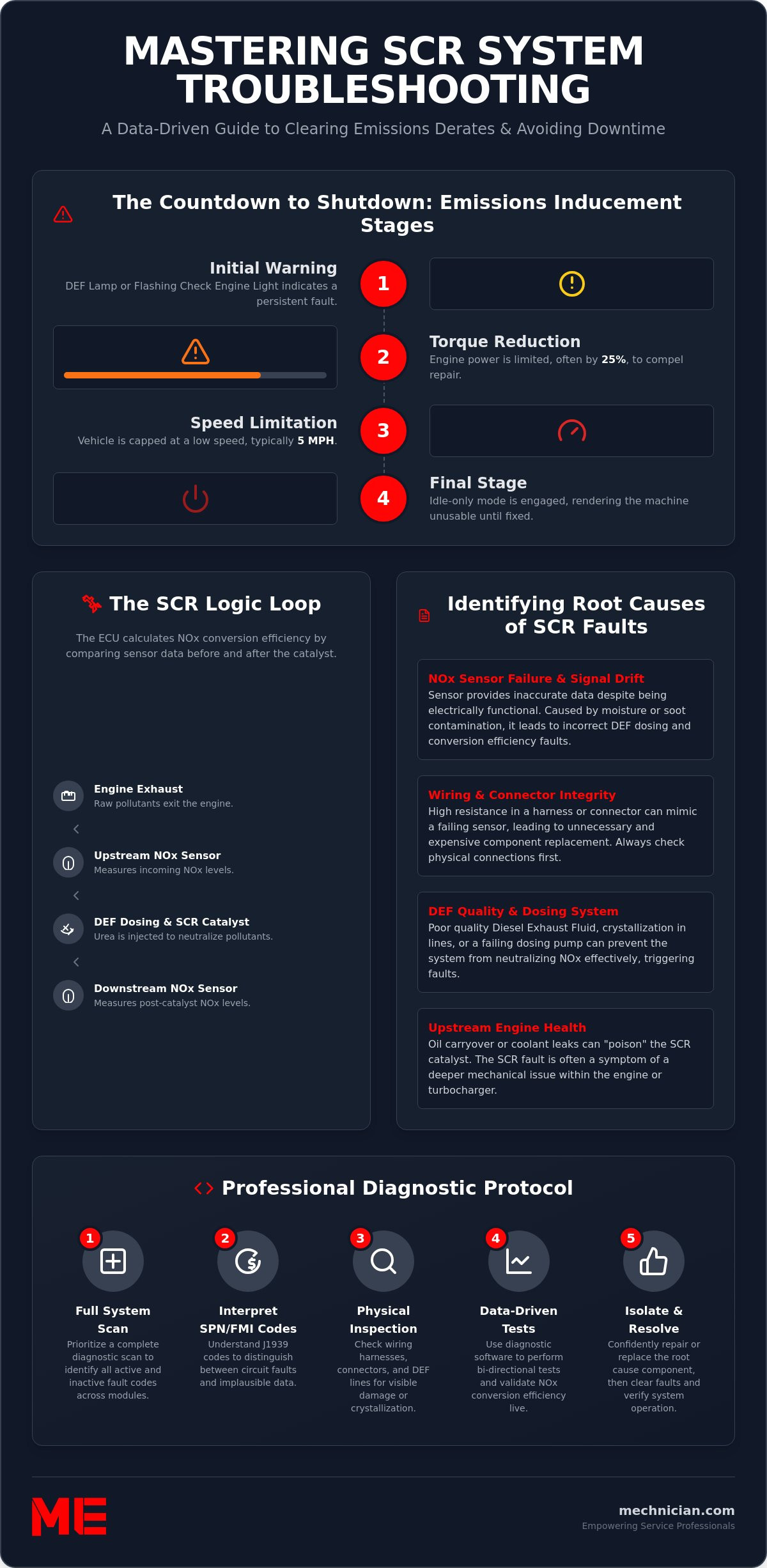
The engine views the SCR system as a continuous mathematical equation. An upstream NOx sensor measures the raw pollutants exiting the engine, while a downstream "cleanup" sensor measures the final output after the catalyst. By comparing these two data points, the ECU calculates the "Conversion Efficiency." If the downstream sensor reports high NOx levels despite active DEF injection, the system flags a fault. The DEF dosing control unit manages this stoichiometric balance. It must inject the exact amount of urea required to neutralize pollutants without leaving excess ammonia. When this balance fails, SCR system troubleshooting becomes necessary to determine if the fault lies in the fluid, the sensors, or the catalyst itself.
Warning Stages and the Countdown to Shutdown
The transition from a minor fault to a full shutdown follows a disciplined sequence. It usually starts with a DEF Lamp or a flashing Check Engine light. If the fault persists, the engine enters the three stages of derate. First, you'll experience a torque reduction, which often limits power by 25 percent. If the issue isn't resolved, the software applies a speed limitation, typically capping the vehicle at 5 miles per hour. The final stage is an idle-only mode that effectively renders the machine useless. Emissions Inducement is a programmed software strategy that progressively degrades engine performance to compel the operator to repair emissions-related faults. Understanding these stages is critical for maintaining operational stability and avoiding total downtime.
The Primary Culprits: Identifying the Root Cause of SCR Faults
Effective SCR system troubleshooting requires moving beyond simple part replacement. While a "circuit open" code points directly to a severed wire or a dead component, "implausible data" codes represent the real challenge for technicians. These faults occur when a sensor is electrically functional but reports values that don't align with the engine's operating logic. Distinguishing between a failed component and a wiring harness integrity issue is the first step in a professional diagnostic process. High resistance in a connector can mimic a failing sensor, leading many to replace expensive parts unnecessarily.
We must also consider the health of the engine upstream. The SCR catalyst is a sensitive chemical reactor. If the engine experiences oil carryover or internal coolant leaks, these fluids eventually reach the aftertreatment system. Oil soot can coat the catalyst substrate, while coolant can cause thermal shock or chemical "poisoning." In these cases, the SCR fault is merely a symptom of a deeper mechanical issue within the engine block or turbocharger. Success depends on viewing the exhaust stream as a continuous data set rather than a series of isolated parts.
NOx Sensor Failure and Signal Drift
The most common "invisible" failure is sensor drift. A drifted sensor provides a voltage signal that the ECU accepts as valid, but the data is inaccurate. For example, a sensor might report 50ppm of NOx when the actual output is 200ppm. This discrepancy causes the ECU to miscalculate the required DEF dose, eventually triggering a conversion efficiency fault. Moisture or soot contamination typically "poisons" the ceramic sensing element over time. To identify this, technicians should use specialized diagnostic cables and software to perform bi-directional response time tests, which reveal if a sensor has become "lazy" or unresponsive to exhaust changes.
DEF Quality and Contamination Issues
Diesel Exhaust Fluid is a precise mixture of 32.5 percent high-purity urea and deionized water. If this concentration shifts due to age or evaporation, the system's chemical balance fails. Even if the tank is full, the ECU will trigger a fault if the NOx reduction doesn't meet the expected map. Using a refractometer is the only reliable way to verify fluid integrity. Contamination is another critical factor. Even a few drops of diesel fuel or engine oil in the DEF tank can damage the urea quality sensor and destroy the dosing pump's internal seals.
Dosing System and DEF Pump Failures
Mechanical failures often center on the dosing valve and the supply pump. Crystallization, often called the "white death," occurs when DEF dries inside the injector or lines, creating stubborn blockages. This is frequently caused by a failed purge cycle, where the system fails to vacuum the lines empty after the engine stops. Monitoring pump pressure fluctuations during operation can help you identify a failing pump before it reaches a total shutdown state. In cold climates, verifying the heating circuit's integrity is essential to ensure fluid remains liquid and flows correctly through the system.
Interpreting SCR Diagnostic Data: SPN and FMI Codes
Professional SCR system troubleshooting requires a deep understanding of the J1939 communication protocol. Unlike passenger vehicles that rely on generic P-codes, heavy-duty and off-highway equipment use Suspect Parameter Numbers (SPN) and Failure Mode Identifiers (FMI). A generic OBD-II reader might tell you there's an emissions fault, but it won't provide the granularity needed to fix it. It might show a broad "NOx Sensor" error, whereas a professional tool identifies exactly which sensor is failing and whether the fault is electrical, mechanical, or data-driven.
The FMI is particularly critical because it defines the nature of the failure. For instance, an FMI 3 indicates voltage is above normal, while an FMI 10 suggests an abnormally high rate of change. Without this context, you're just guessing. To truly master the diagnostic process, you must also utilize "Freeze Frame" data. This captures the exact engine conditions at the moment the fault was triggered, such as engine load, exhaust temperature, and DEF pressure. This data is the only reliable way to identify intermittent electrical glitches that disappear as soon as the machine enters the shop.
Common SCR Fault Code Structures
Two specific codes appear frequently in modern aftertreatment systems. SPN 3226 relates to the downstream NOx sensor. If you see this with FMI 2 (erratic data), it often points to sensor "poisoning" or a wiring issue rather than a total sensor death. SPN 5394 identifies problems with the DEF dosing valve. In these cases, you must verify if the failure is electrical, such as a solenoid coil issue, or mechanical, like a crystallized blockage. For a deeper look at the protocols used in these systems, consult our Professional Vehicle Diagnostic Tool Guide, which outlines the 2026 industry standards for data communication.
Cross-Correlating Data Parameters
Diagnostic success isn't about reading one code; it's about correlating multiple data streams. For example, the ECU will only initiate DEF dosing when exhaust temperatures reach a specific threshold, typically around 200 degrees Celsius. If your software shows zero dosing, check the temperature sensors first. If the exhaust is too cool, the system is working correctly by inhibiting dosing to prevent crystallization. Similarly, compare the DEF tank header temperature against ambient air temperature. If the tank is reporting 50 degrees Celsius on a freezing day, the heater circuit is likely stuck on. Finally, always monitor the "NOx Conversion Efficiency" percentage. In a healthy 2026 engine, this should consistently stay above 80 percent during steady-state operation. If this number drops while dosing is active, you're looking at a degraded catalyst or poor fluid quality.
Professional SCR Troubleshooting Protocol: A Step-by-Step Guide
Executing a disciplined workflow is the only way to avoid the trap of "parts cannon" repairs. Professional SCR system troubleshooting begins with a full system scan to categorize codes as active or inactive. Active codes are your immediate priority; they represent the current roadblocks preventing normal operation. Inactive codes, however, provide a historical map of intermittent failures that might suggest a fraying wire or a loose connector. You can't fix what you haven't fully mapped.
Once you've scanned the system, move to a physical inspection. Look for white urea crystals around the dosing valve or pump, which indicate leaks or poor purge cycles. Check the aftertreatment harness for rub points against the chassis. Next, validate the DEF quality. A refractometer is essential here; the urea concentration must be exactly 32.5 percent. If the fluid is contaminated or degraded, no amount of sensor replacement will clear the fault. If the fluid passes, proceed to bi-directional tests to verify the pump and injector. The final step involves a system reset and a NOx sensor calibration via your software to ensure the ECU recognizes the new operating parameters.
The Importance of Bi-Directional Testing
Bi-directional testing allows you to command the DEF pump to build pressure without running the engine. This isolation is critical for identifying weak pumps or internal blockages. During a "Quantity Test," you'll measure the actual volume of fluid delivered by the injector into a graduated cylinder. A successful dosing test is the gold standard for hardware validation because it confirms the entire mechanical loop is physically capable of delivering fluid. If the hardware delivers the correct volume but the fault remains, your problem is likely electronic or chemical.
Clearing the Derate: The Software Handshake
Simply hitting "clear codes" won't exit a heavy-duty engine from an emissions derate. The ECU requires a successful "Efficiency Test" or a specific "Software Handshake" to prove the repair worked. Using the Jaltest CV Kit, you can initiate these forced system resets and monitor the progress in real time. Be aware of software inhibitors; the test won't start unless all "Interlock" conditions are met. This typically includes reaching a specific coolant temperature and ensuring the parking brake is set. To equip your shop with these professional capabilities, you can browse our complete range of diagnostic kits and ruggedized laptops designed for industrial environments.
Eliminating Dealer Dependency with Jaltest Diagnostic Solutions
Many fleet operators believe they're permanently locked into dealer service cycles for emissions repairs. This misconception often leads to unnecessary towing costs and days of lost productivity while waiting for a service slot. However, the EPA's July 1, 2026 "Freedom to Fix" guidance has reinforced the right for independent shops and owners to access the same level of diagnostic data as franchised dealers. Mechnician empowers your team by providing the tools necessary to perform advanced SCR system troubleshooting without external reliance. By using Jaltest version 26.1 software, you gain the ability to communicate with the engine control module just as a factory technician would.
The primary advantage of Jaltest OHW and CV kits is their multi-brand coverage. Whether you're managing a Cummins engine in a truck or a Volvo power unit in an excavator, a single interface handles the entire fleet. You don't need a dozen different OEM subscriptions or proprietary cables. The software integrates technical data, wiring diagrams, and component locations directly into the diagnostic flow. If you're looking for the DEF dosing valve or a specific NOx sensor connector, the software shows you exactly where it is on the chassis. This integrated approach allows you to perform SCR calibrations and efficiency tests on-site, immediately after the physical repair is complete.
The Mechnician Advantage: Beyond the Tool
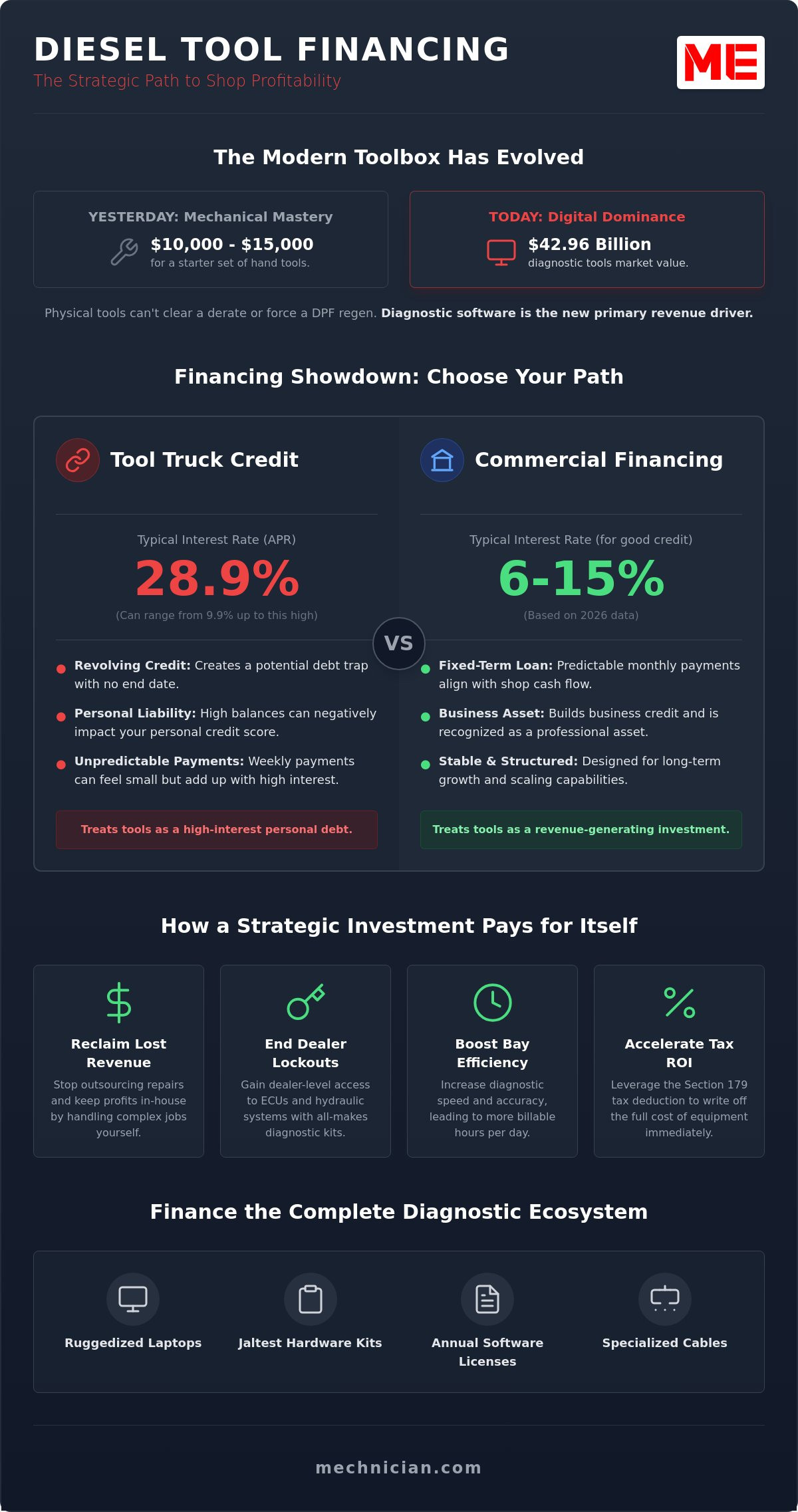
Owning the hardware is only half of the solution. Mechnician provides a professional support ecosystem to ensure your success in complex SCR system troubleshooting scenarios. If you encounter a fault code that doesn't follow standard logic, our remote technical support can assist in interpreting the data stream. We also prioritize professional development through Jaltest University training, which covers the nuances of modern Stage V and Tier 4 Final systems. For businesses looking to upgrade their shop capabilities, we offer flexible financing options for acquiring full ruggedized diagnostic bundles, including laptops and specialized cables.
Future-Proofing Your Fleet Maintenance
Transitioning to an all-makes diagnostic strategy is a conscious decision for long term stability. Instead of reacting to a "countdown to shutdown," you can use Jaltest software to monitor SCR health trends during routine maintenance. By checking NOx conversion percentages and pump pressure stability before a fault occurs, you can identify a failing component during scheduled downtime. This proactive stance transforms technical oversight from a recurring expense into a strategic asset. Stop paying for dealer lockouts and take control of your uptime. Explore Jaltest Diagnostic Kits at Mechnician to find the right solution for your equipment.
Mastering Your Fleet's Operational Stability
Transitioning to internal diagnostics is a strategic shift toward long-term sustainability and reduced downtime. You've learned that effective SCR system troubleshooting requires a move away from trial-and-error part replacement toward a rigorous data-driven validation process. By interpreting SPN and FMI codes and executing bi-directional dosing tests, you can resolve the complex "implausible data" faults that often baffle standard shops. This systematic approach ensures that every repair is backed by technical evidence rather than guesswork.
As an Authorized Jaltest Dealer, Mechnician provides the precise tools needed to maintain compliance with 2026 emissions standards. Our ruggedized diagnostic laptop bundles and expert remote technical support ensure your technicians have the resources to handle any aftertreatment challenge directly in your own facility. Investing in these capabilities doesn't just save on dealer fees; it secures your organization's operational independence.
Take control of your emissions repairs with a Jaltest Kit from Mechnician.
With the right data and professional-grade equipment, the "countdown to shutdown" becomes a manageable technical task rather than a financial crisis. Your fleet's continuous operation is now within your direct control.
Frequently Asked Questions
Why does my truck say 'SCR System Fault' but I have plenty of DEF?
An SCR System Fault indicates a chemical or data failure in the reduction loop, not necessarily a low fluid level. The ECU calculates the conversion efficiency by comparing upstream and downstream NOx readings. If the reduction is insufficient due to a degraded catalyst or a drifted sensor, the system flags a fault even if the DEF tank is completely full. Systematic SCR system troubleshooting is required to identify which sensor or component is reporting the mismatch.
Can a bad NOx sensor cause my engine to go into limp mode?
A malfunctioning NOx sensor is a primary trigger for emissions inducement, commonly known as limp mode. If the ECU receives erratic or out-of-range data from these sensors, it can't verify emissions compliance. To ensure the engine meets legal standards, the software will progressively reduce torque and vehicle speed until the sensor is replaced and the system is recalibrated. This is a legal requirement for 2026 engines to prevent excessive pollutants.
How do I know if my DEF fluid is contaminated or just old?
You can accurately determine fluid integrity by using a professional refractometer to measure the urea concentration. High-quality Diesel Exhaust Fluid must maintain a 32.5 percent urea concentration to function correctly. If the reading is lower, the fluid has aged and the water has evaporated. If the fluid appears cloudy or smells like diesel, it's contaminated and requires a complete system flush to prevent pump damage.
Is it possible to clear an SCR derate code with a basic code reader?
Basic code readers lack the bi-directional capabilities required to perform the software handshake needed to exit a derate. While a generic tool might clear the "Check Engine" light temporarily, the ECU won't lift the speed or torque limitations until it sees a successful efficiency test. Professional SCR system troubleshooting requires tools that can command the system to perform these specific reset and calibration procedures.
What is a 'dosing test' and why is it necessary for troubleshooting?
A dosing test is a manual command that forces the DEF pump to build pressure and the injector to spray a measured volume of fluid. It's necessary because it isolates the mechanical components from the engine's software logic. By measuring the output in a graduated cylinder, you can confirm if the pump and injector are physically capable of meeting the dosing requirements without the engine running.
Will a faulty DPF system cause an SCR system fault?
A failure in the DPF system can indirectly trigger SCR faults by altering exhaust temperatures or increasing soot loading. If the DPF is clogged, it may prevent the exhaust from reaching the 200 degree Celsius threshold required for SCR operation. This thermal imbalance often leads to crystallization in the dosing valve, which then requires extensive cleaning or component replacement to resolve the resulting emissions codes.
How much does it cost to replace a NOx sensor vs. repairing the harness?
Repairing a damaged wiring harness is significantly more cost-effective than replacing a functional NOx sensor. Technicians often find that "sensor failure" codes are actually caused by high resistance in a corroded connector or a pinched wire. Performing a continuity test on the harness before purchasing new components is a standard protocol that prevents unnecessary spending on expensive electronic parts that aren't actually broken.
Do I need a specific diagnostic cable for SCR troubleshooting on a Mack or Volvo truck?
Mack and Volvo trucks frequently utilize proprietary communication pins that require specialized diagnostic cables for full system access. While a standard 9-pin connector might provide basic engine data, you'll need the correct 8-pin or specialized OBD-II cable to perform SCR resets and calibrations. Jaltest kits are specifically designed to include these connectors so you aren't locked out of dealer-level functions on these specific brands.


Laissez un commentaire