


Maintaining a separate laptop for every OEM software isn't just a logistical headache; in 2026, it's an unnecessary drain on your fleet's operational efficiency. You've likely felt the frustration of being locked out of critical calibrations on a non-PACCAR engine or waiting days for a dealer-level software update while a truck sits idle. It's a common belief that proprietary tools are the only way to achieve deep-level bi-directional control, but recent shifts in Right to Repair legislation and diagnostic technology have changed the landscape. Finding a reliable electronic service analyst alternative is no longer about settling for less; it's about gaining the independence to service your entire mixed fleet without the burden of multiple expensive licenses.
In this guide, you'll discover how multi-brand diagnostic platforms provide the same dealer-level access you expect from Electronic Service Analyst while supporting a diverse range of equipment. We'll show you how to consolidate your diagnostic tools into a single, ruggedized laptop to perform complex calibrations independently. By moving beyond OEM-only restrictions, your shop can finally reduce downtime and eliminate the high costs associated with dealer-only repairs. This shift from brand-specific limitations to a unified diagnostic ecosystem ensures your operations remain stable, predictable, and fully under your control.
Key Takeaways
- Learn why moving beyond PACCAR-specific software is essential for maintaining operational efficiency in a modern mixed-fleet environment.
- Identify a professional-grade electronic service analyst alternative that provides dealer-level bi-directional tests and parameter adjustments across multiple engine brands.
- Understand how to consolidate your diagnostic equipment into a single ruggedized laptop while maintaining full access to chassis and body controller systems.
- Apply a 2026 selection framework to evaluate whether your shop requires the narrow depth of OEM software or the versatile coverage of an all-makes platform.
- Discover how the Jaltest CV Kit eliminates the need for multiple expensive OEM licenses while ensuring your technicians have the technical support needed for complex repairs.
What is Electronic Service Analyst (ESA) and Why Seek an Alternative?
Electronic Service Analyst (ESA) is the specialized diagnostic software designed specifically for PACCAR vehicles, including Kenworth and Peterbilt models. Technicians use it as a bridge to communicate with various vehicle control modules. Version 5.7.0 remains the standard for these interactions. Most shops utilize it for critical tasks like clearing fault codes, adjusting engine parameters, and managing aftertreatment diagnostics for DPF and SCR systems. While effective for its specific niche, its proprietary nature often leads to the "Dealer Lockout" challenge. This occurs when a technician can diagnose a fault but cannot complete the final calibration or reset because the software lacks the necessary permissions for independent users. This forced dependency on dealerships creates significant delays and increases operational costs.
Transitioning to an electronic service analyst alternative has become a strategic move for shops aiming for diagnostic efficiency in 2026. By shifting toward all-makes platforms, businesses can bypass the limitations of brand-specific software while maintaining the high level of precision required for modern heavy-duty repairs.
The Limitations of OEM-Specific Software
Operating with OEM-only tools presents several hurdles for a growing shop. The most immediate issue is the high annual licensing fee required for each individual brand. These costs multiply quickly when you service a mixed fleet. Beyond the financial burden, ESA is entirely incompatible with other major engine brands like Cummins, Detroit Diesel, or Volvo. This means your shop must maintain multiple laptops and software subscriptions, each with its own unique interface. The steep learning curve for these different systems reduces technician productivity and slows down the overall service flow. It is an inefficient way to manage a modern repair facility.
Defining the Professional Multi-Brand Alternative
A true dealer-level alternative must provide more than basic code reading. It requires full bi-directional control, allowing technicians to send specific commands to the vehicle's ECUs. This includes performing cylinder cutouts, injector coding, and DPF regenerations. In 2026, the gap between OEM and all-makes software has narrowed due to new industry standards. For instance, the EPA guidance issued on July 1, 2026, reinforces the legal obligation for manufacturers to provide the same diagnostic information to independent shops as they do to dealerships. A professional electronic service analyst alternative leverages these standards and the Motor Vehicle Modernization Act of 2026 to offer a unified, ruggedized solution that covers the entire fleet with one interface.
Comparing OEM Software vs. All-Makes Diagnostic Platforms
Choosing between proprietary OEM software and a multi-brand platform requires an objective look at functional parity. While ESA provides deep access to PACCAR systems, a professional electronic service analyst alternative now matches these capabilities across fault code management, live data monitoring, and system testing. The primary difference lies in how these tools handle the hardware interface. OEM software often mandates brand-specific adapters, whereas all-makes platforms utilize a universal Vehicle Communication Interface (VCI). This hardware flexibility means your technicians don't need to swap cables or adapters when moving from a Peterbilt to a Freightliner, which preserves the physical integrity of your diagnostic ports over time.
Parameter programming is another area where the gap has closed significantly. Many shop owners worry that an alternative tool won't allow them to adjust idle shutdown timers or cruise control limits. Modern professional-grade platforms now support these adjustments for PACCAR engines, providing the same level of control as the dealer software. Because these all-makes tools receive frequent updates to stay current with new ECU releases, they often provide a more responsive user experience than legacy OEM programs. Investing in a Jaltest CV Kit allows your team to maintain this consistency across every bay in your shop.
Bi-Directional Capability and System Tests
The true measure of a diagnostic tool is its ability to perform bi-directional tests. An effective electronic service analyst alternative must execute cylinder cutouts and actuator tests with the same precision as the OEM tool. Forced DPF regenerations are a critical requirement for any independent shop; without this capability, you're forced to send trucks back to the dealer for simple emissions maintenance. High-quality alternative platforms also allow for sensor calibrations across various chassis modules, ensuring that the entire vehicle, not just the engine, is operating within safe parameters. This level of access is essential for maintaining long-term vehicle stability.
Operational Efficiency in the Shop
Consolidating your diagnostic tools into a single interface significantly reduces "laptop clutter." Instead of managing five different software licenses and their respective updates, your technicians work within one standardized environment. This standardization simplifies training; once a technician masters the interface, they can apply that knowledge to Cummins, Detroit Diesel, or Volvo engines without learning a new system. Unified fault code descriptions also improve diagnostic speed. By providing clear, actionable information in a consistent format, these tools help your team identify the root cause of a problem faster, which directly reduces vehicle downtime and improves shop throughput.
Deep Diagnostics: Beyond PACCAR to Total Fleet Coverage
Modern fleet management requires more than just engine-level visibility. While PACCAR’s proprietary software focuses heavily on the power plant, a true electronic service analyst alternative must address the entire vehicle architecture. This includes seamless support for Cummins, Detroit Diesel, and Volvo/Mack engines, ensuring that a single tool can handle any truck that enters the bay. Beyond the engine block, these platforms provide access to chassis and body controllers, which are often the source of complex electrical faults that brand-specific tools might overlook.
Communication protocols have evolved significantly over the last decade. Technicians now encounter J1939 and legacy J1708 alongside the rapid shift to CAN-FD in newer 2026 models. A professional-grade electronic service analyst alternative handles these protocols automatically. This all-systems approach ensures that transmission and ABS diagnostics are performed with the same depth as engine checks. It provides a holistic view of the vehicle, which is essential for maintaining safety and operational uptime across a diverse fleet. When you can see every module on the network at once, you eliminate the guesswork often associated with intermittent communication errors.
Aftertreatment and Emissions Support
Emissions systems remain a primary cause of unplanned downtime. A versatile diagnostic tool allows technicians to manage SCR and DEF system checks for various manufacturers without switching software. You can reset ash accumulators and soot levels independently after a filter cleaning or replacement. Troubleshooting NOx sensors and temperature probes becomes a standardized process, regardless of the truck's brand. This independence is vital for meeting strict emissions regulations, such as the CARB Clean Truck Check, without relying on dealer schedules.
The Role of Technical Data and Wiring Diagrams
Diagnostic efficiency isn't just about reading codes; it's about finding the solution. Integrating interactive wiring harnesses directly into the software allows technicians to trace circuits without leaving the laptop. You can access component locations and specific torque specifications instantly. This eliminates the need to search through external service manuals, which often contain outdated or generalized information. By having technical data and diagnostics in one place, your shop ensures that repairs are performed to precise engineering standards every time, reducing the risk of repeat failures.
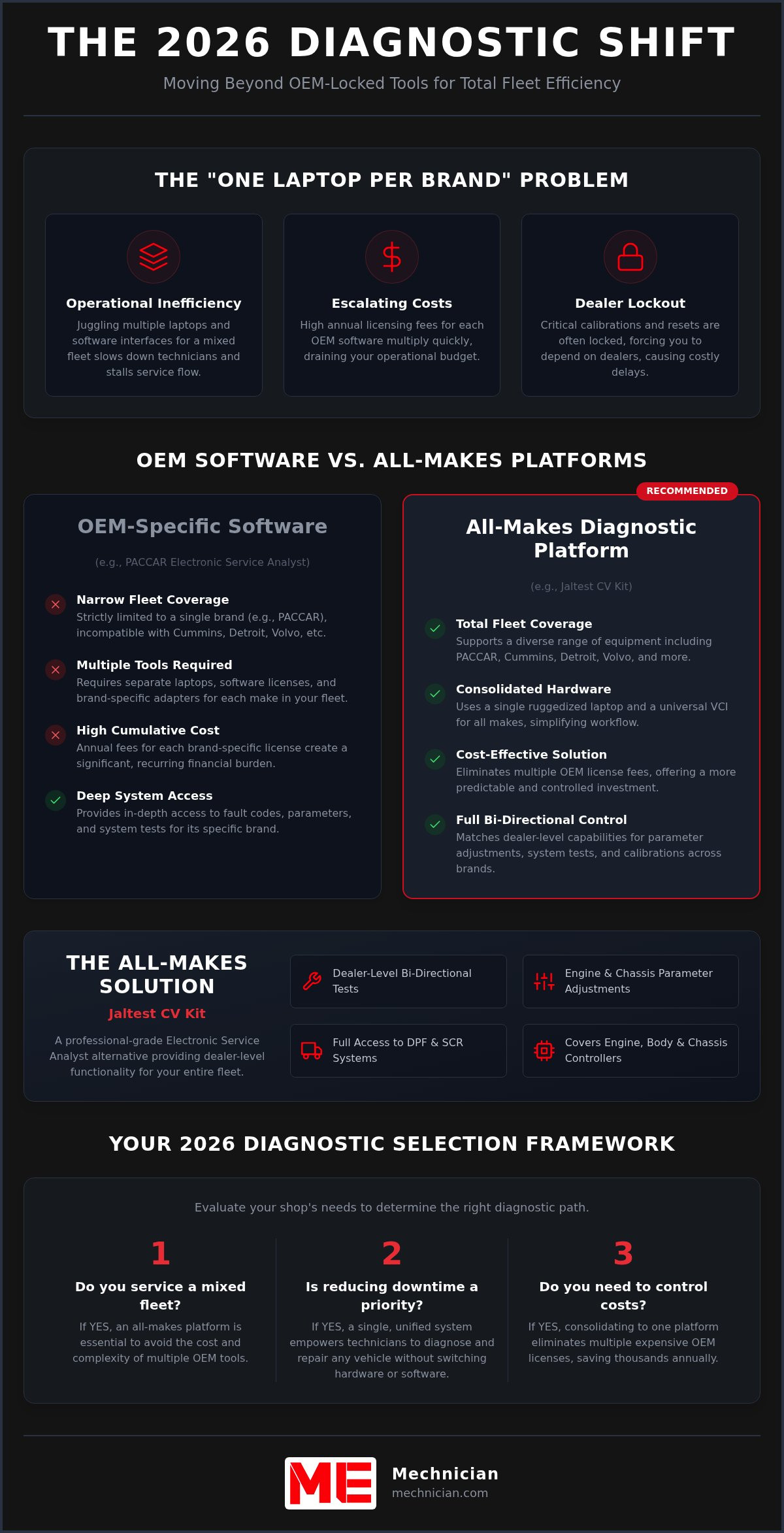
Evaluating Your Next Diagnostic Investment: A 2026 Selection Framework
Selecting a diagnostic tool requires a structured approach that prioritizes long-term shop stability. First, assess your fleet composition. If your yard consists exclusively of Peterbilt or Kenworth units, the proprietary software might meet your needs. However, for the millions of Class 8 trucks currently operating in North America, most belong to mixed fleets that demand more versatility. Choosing an electronic service analyst alternative is a strategic decision to gain independence. You must verify that the tool supports the specific bi-directional tests and calibrations your technicians perform daily. A tool that only clears codes won't help when a VGT actuator requires precise calibration or an injector needs coding after a replacement.
The support ecosystem is just as critical as the software itself. A provider should offer more than a simple license key; they should act as an extension of your technical team. You also need to consider the physical hardware. Shop floors are unforgiving environments where dust, grease, and vibrations are constant. Investing in ruggedized diagnostic laptops ensures your equipment survives these daily rigors. These devices provide a stable platform for your software, preventing the hardware failures that often lead to expensive downtime during a critical repair.
Total Cost of Ownership (TCO) Analysis
A thorough TCO analysis looks beyond the initial purchase price. You should compare the one-time hardware fees and recurring annual license renewals against the high cost of outsourced dealer repairs. By performing advanced diagnostics in-house, you directly improve your return on investment. The value of included software updates is also significant, as it ensures your tool remains compatible with new 2026 vehicle releases without additional hidden costs. This proactive financial perspective turns a technical expense into a long-term asset for your business.
Training and Onboarding for Technicians
Standardizing on a single software platform simplifies the onboarding process for new hires. They don't have to waste time learning five different interfaces to work on a mixed fleet. Enrolling your team in professional training courses ensures they can leverage the full bi-directional depth of your electronic service analyst alternative. Modern virtual training options allow your staff to stay current with evolving technology without the need for travel. This commitment to technician expertise ensures that your diagnostic processes remain precise, reliable, and efficient.
Ready to optimize your shop's workflow? Explore our complete diagnostic solutions to find the right fit for your fleet.
The Jaltest CV Solution: A Professional-Grade ESA Alternative
The Jaltest CV Kit stands as the definitive electronic service analyst alternative for shops that demand dealer-level precision without OEM limitations. It provides the same bi-directional depth required for Kenworth and Peterbilt trucks while extending that capability to every other major brand in your fleet. This unified platform eliminates the need for multiple proprietary licenses, allowing your technicians to focus on the repair rather than managing software updates. By integrating diagnostics, technical data, and parts information into one interface, the Jaltest ecosystem empowers independent shops to perform complex calibrations and troubleshooting that were previously reserved for franchised dealerships.
Mechnician enhances this hardware and software solution by providing a layer of professional technical expertise that goes beyond the standard license. We understand that a tool is only as effective as the support behind it. Our approach integrates Jaltest technical support directly into your shop's workflow, ensuring that your operations maintain a high level of stability. This partnership allows you to handle advanced repairs with confidence, knowing that a specialized external unit is ready to assist when needed. Investing in advanced diagnostic technology is a strategic decision, and exploring modern acquisition options can help your shop stay current with 2026 industry standards without compromising cash flow.
Real-Time Troubleshooting with Remote Support
Mechnician technicians provide remote desktop assistance to help your team navigate complex repairs that go beyond standard automated routines. If a specific calibration proves difficult or a fault code requires deeper analysis, our experts can log in directly to your laptop. This direct line to diagnostic specialists provides the peace of mind necessary for maintaining a fast-paced shop environment. It ensures that no truck sits idle simply because of a software hurdle or a confusing diagnostic path. This proactive service model turns technical challenges into predictable, manageable processes.
Customized Bundles for Your Specific Needs
Every shop has different requirements based on their fleet composition and service volume. We provide Ruggedized Diagnostic Laptops pre-configured with the Jaltest software for immediate use on the shop floor. These bundles include Specialized Diagnostic Cables for PACCAR, Cummins, and other major manufacturers, ensuring you have the physical connection needed for any vehicle. Beyond commercial trucks, the Jaltest ecosystem can be expanded to include OHW (Off-Highway), MHE (Material Handling), and Marine applications. This scalability makes it a future-proof investment for businesses looking to grow their service capabilities while maintaining a single, unified diagnostic interface.
Future-Proofing Your Shop’s Diagnostic Capabilities
Transitioning to a unified diagnostic ecosystem is a conscious decision to prioritize long-term stability and shop efficiency. By adopting a professional electronic service analyst alternative, your facility gains the independence to perform dealer-level calibrations and bi-directional tests across every truck in the yard. This shift eliminates the logistical burden of multiple OEM licenses while ensuring your technicians have the technical data needed for precise repairs. You no longer have to wait for dealer schedules to complete simple resets or emissions maintenance.
As an Authorized Jaltest Dealer, Mechnician provides more than just software. We offer remote diagnostic specialist support to guide your team through complex troubleshooting and flexible business financing to make advanced technology accessible. Our goal is to serve as a reliable partner that integrates into your organization to ensure continuous, trouble-free operation. Explore the Jaltest CV Kit: The Ultimate Professional Alternative today and take full control of your fleet's maintenance schedule.
Frequently Asked Questions
Can an alternative to Electronic Service Analyst perform a forced DPF regen?
Yes, a professional-grade electronic service analyst alternative like the Jaltest CV Kit can perform forced DPF regenerations on PACCAR engines. This capability includes resetting soot levels and ash accumulators after a filter cleaning or replacement. These bi-directional functions ensure that independent shops can complete emissions-related maintenance without relying on dealer software, which directly reduces vehicle downtime and operational costs.
Will I lose my Kenworth/Peterbilt warranty if I use a multi-brand diagnostic tool?
No, using a multi-brand diagnostic tool for maintenance and troubleshooting does not void your vehicle's warranty. Federal regulations, including the Motor Vehicle Modernization Act of 2026, protect your right to use third-party tools for service. As long as the tool is used according to professional standards and doesn't cause physical damage to the electronic control units, your factory warranty remains intact.
Does the Jaltest CV Kit support parameter changes like road speed limits?
Yes, the Jaltest CV Kit allows technicians to adjust various engine parameters, including road speed limits and cruise control settings. These adjustments are critical for fleet managers who need to standardize performance and safety across a mixed fleet. This level of access ensures that you can manage your fleet's fuel efficiency and operational safety standards independently without scheduled dealer appointments.
What is the main difference between an OBD scanner and a professional diagnostic kit?
The primary difference lies in the depth of system access and bi-directional control. A basic OBD scanner typically only reads and clears generic engine codes. In contrast, a professional diagnostic kit provides dealer-level access to every module on the vehicle, including the transmission, ABS, and body controllers. It allows for complex calibrations, injector coding, and real-time system tests that a standard scanner cannot perform.
How often do I need to renew the software license for an alternative tool?
Professional diagnostic platforms generally require a Jaltest Software Annual License renewal to maintain access to the latest updates. These updates are essential for staying current with new ECU releases and the 2026 vehicle models entering the market. While the hardware remains yours, the annual subscription ensures your technical data and diagnostic capabilities remain precise and compatible with evolving truck technology.
Can I use my existing laptop for multi-brand diagnostic software?
Technically, you can install the software on a standard laptop if it meets the minimum system requirements. However, we strongly recommend using Ruggedized Diagnostic Laptops for a repair shop environment. These devices are specifically engineered to withstand the dust, vibrations, and accidental drops that occur in a heavy-duty bay, providing a much more stable platform for your diagnostic software than a consumer-grade laptop.
Does Mechnician provide training for the Jaltest diagnostic system?
Yes, Mechnician offers dedicated Jaltest training to ensure your technicians can leverage the full potential of the software. This training focuses on practical applications, such as performing advanced bi-directional tests and navigating technical wiring diagrams. Proper training reduces the learning curve for your team, allowing them to perform complex diagnostics more efficiently and accurately from the first day of use.
Is remote technical support included with the diagnostic hardware purchase?
Mechnician provides specialized Jaltest technical support to assist our partners with complex diagnostic challenges. This service includes remote desktop assistance, where our experts can connect to your diagnostic laptop to help troubleshoot difficult faults or interpret complex data. This direct line to technical expertise ensures your shop can maintain a steady workflow even when facing the most challenging electrical or mechanical issues.



Laissez un commentaire