Lun - Sáb, 7:30 a.m. - 7:30 p.m.

Ventas y Soporte- service@mechnician.com

Teléfono- (888) 641-6324

Professional SCR System Troubleshooting: A Data-Driven Diagnostic Guide

Professional SCR System Troubleshooting: A Data-Driven Diagnostic Guide

What if the dreaded "countdown to shutdown" on your dashboard isn't a sign of mechanical failure, but a data validation error you can resolve without a dealer visit? It's a scenario every fleet owner and technician fears. An unpredictable emissions derate halts productivity and leads to expensive diagnostic fees. The confusion between a failing NOx sensor and poor DEF quality often results in unnecessary parts replacement and hours of lost time.

You deserve a more precise way to maintain your equipment. This guide will help you master professional SCR system troubleshooting by utilizing data-driven diagnostic protocols to identify the root cause of faults and clear derate conditions independently. We'll examine the latest EPA "Freedom to Fix" standards, technical SPN/FMI code interpretation, and the precise steps needed to validate NOx conversion efficiency using modern diagnostic software like Jaltest version 26.1. By shifting your focus from mechanical guesswork to systematic data analysis, you can ensure your fleet stays on the road and out of the service bay.

Key Takeaways

  • Understand the critical role of Selective Catalytic Reduction in meeting 2026 Tier 4 Final and Stage V emissions standards.
  • Learn to distinguish between fluid quality issues, sensor inaccuracies, and mechanical dosing failures to avoid replacing functional parts.
  • Master the interpretation of SPN and FMI codes within the J1939 protocol to perform precise SCR system troubleshooting.
  • Implement a structured diagnostic protocol that prioritizes full system scans and physical inspections to isolate root causes efficiently.
  • Gain the technical independence to clear derate conditions and manage emissions faults using professional Jaltest diagnostic kits.

SCR system troubleshooting is the precise process of identifying and resolving failures within the Selective Catalytic Reduction loop. For 2026 engines, this task is no longer just about fixing physical leaks or clogged lines. It's about data integrity. With the implementation of 2026 Tier 4 Final and Stage V emissions standards, the legal pressure on manufacturers has increased significantly. This pressure translates directly to the operator through stricter software monitoring and more aggressive fault detection.

Modern engines treat the "Emissions Derate" as a non-negotiable legal obligation. It isn't a hardware protection feature designed to save the engine from physical damage; it's a compliance mechanism. 2026 models feature enhanced data validation protocols for NOx conversion that are far more sensitive than previous generations. These systems are designed to detect not just total sensor failures, but subtle inaccuracies that suggest the catalyst isn't meeting its targets. Following the EPA's July 1, 2026 guidance, owners have more rights to access this diagnostic data, but the systems remain technically demanding. If the data points don't align perfectly, the engine's control logic will initiate a shutdown sequence.

The SCR Logic Loop: How Your Engine Sees Emissions

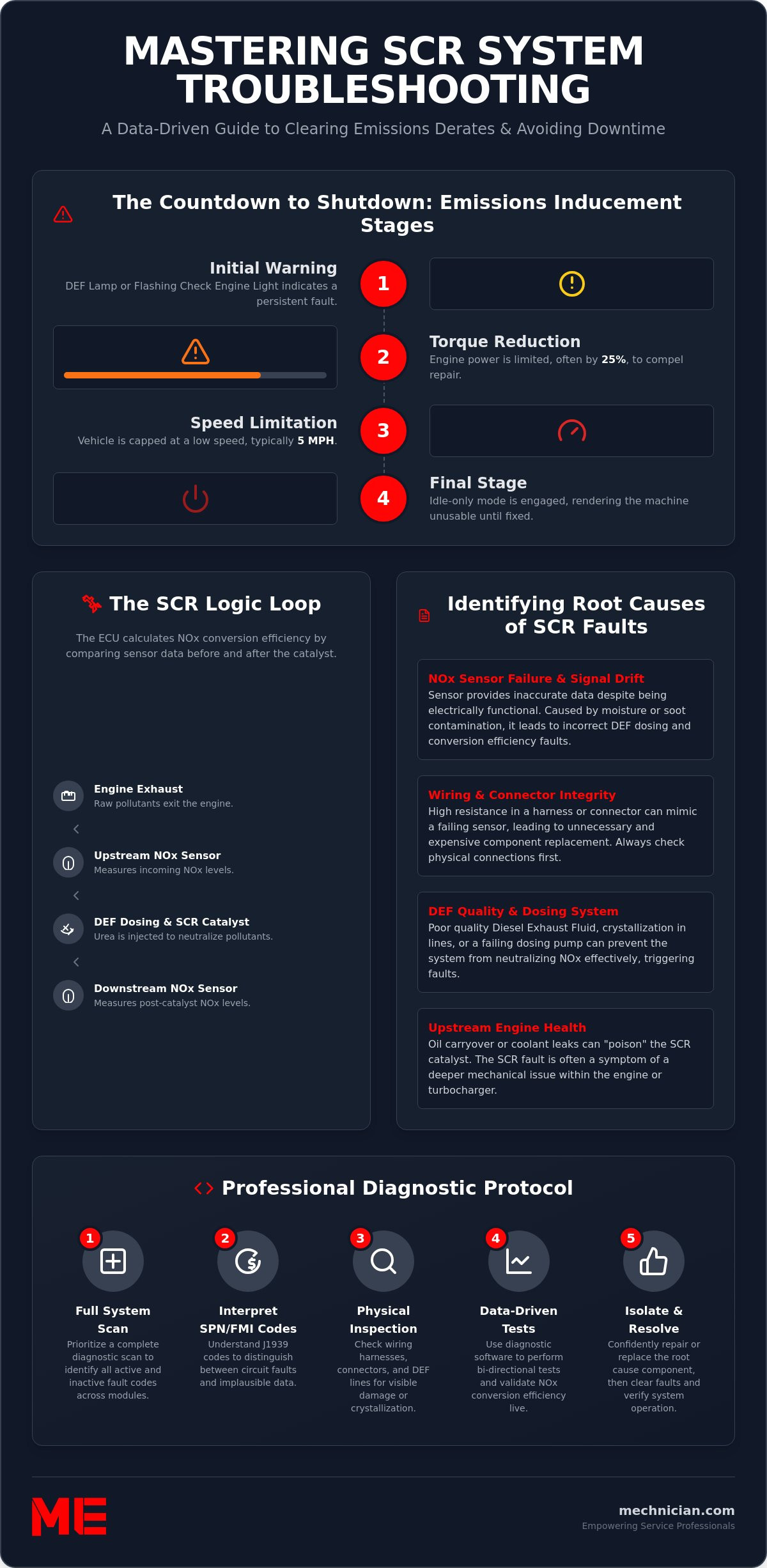
The engine views the SCR system as a continuous mathematical equation. An upstream NOx sensor measures the raw pollutants exiting the engine, while a downstream "cleanup" sensor measures the final output after the catalyst. By comparing these two data points, the ECU calculates the "Conversion Efficiency." If the downstream sensor reports high NOx levels despite active DEF injection, the system flags a fault. The DEF dosing control unit manages this stoichiometric balance. It must inject the exact amount of urea required to neutralize pollutants without leaving excess ammonia. When this balance fails, SCR system troubleshooting becomes necessary to determine if the fault lies in the fluid, the sensors, or the catalyst itself.

Warning Stages and the Countdown to Shutdown

The transition from a minor fault to a full shutdown follows a disciplined sequence. It usually starts with a DEF Lamp or a flashing Check Engine light. If the fault persists, the engine enters the three stages of derate. First, you'll experience a torque reduction, which often limits power by 25 percent. If the issue isn't resolved, the software applies a speed limitation, typically capping the vehicle at 5 miles per hour. The final stage is an idle-only mode that effectively renders the machine useless. Emissions Inducement is a programmed software strategy that progressively degrades engine performance to compel the operator to repair emissions-related faults. Understanding these stages is critical for maintaining operational stability and avoiding total downtime.

The Primary Culprits: Identifying the Root Cause of SCR Faults

Effective SCR system troubleshooting requires moving beyond simple part replacement. While a "circuit open" code points directly to a severed wire or a dead component, "implausible data" codes represent the real challenge for technicians. These faults occur when a sensor is electrically functional but reports values that don't align with the engine's operating logic. Distinguishing between a failed component and a wiring harness integrity issue is the first step in a professional diagnostic process. High resistance in a connector can mimic a failing sensor, leading many to replace expensive parts unnecessarily.

We must also consider the health of the engine upstream. The SCR catalyst is a sensitive chemical reactor. If the engine experiences oil carryover or internal coolant leaks, these fluids eventually reach the aftertreatment system. Oil soot can coat the catalyst substrate, while coolant can cause thermal shock or chemical "poisoning." In these cases, the SCR fault is merely a symptom of a deeper mechanical issue within the engine block or turbocharger. Success depends on viewing the exhaust stream as a continuous data set rather than a series of isolated parts.

NOx Sensor Failure and Signal Drift

The most common "invisible" failure is sensor drift. A drifted sensor provides a voltage signal that the ECU accepts as valid, but the data is inaccurate. For example, a sensor might report 50ppm of NOx when the actual output is 200ppm. This discrepancy causes the ECU to miscalculate the required DEF dose, eventually triggering a conversion efficiency fault. Moisture or soot contamination typically "poisons" the ceramic sensing element over time. To identify this, technicians should use specialized diagnostic cables and software to perform bi-directional response time tests, which reveal if a sensor has become "lazy" or unresponsive to exhaust changes.

DEF Quality and Contamination Issues

Diesel Exhaust Fluid is a precise mixture of 32.5 percent high-purity urea and deionized water. If this concentration shifts due to age or evaporation, the system's chemical balance fails. Even if the tank is full, the ECU will trigger a fault if the NOx reduction doesn't meet the expected map. Using a refractometer is the only reliable way to verify fluid integrity. Contamination is another critical factor. Even a few drops of diesel fuel or engine oil in the DEF tank can damage the urea quality sensor and destroy the dosing pump's internal seals.

Dosing System and DEF Pump Failures

Mechanical failures often center on the dosing valve and the supply pump. Crystallization, often called the "white death," occurs when DEF dries inside the injector or lines, creating stubborn blockages. This is frequently caused by a failed purge cycle, where the system fails to vacuum the lines empty after the engine stops. Monitoring pump pressure fluctuations during operation can help you identify a failing pump before it reaches a total shutdown state. In cold climates, verifying the heating circuit's integrity is essential to ensure fluid remains liquid and flows correctly through the system.

Interpreting SCR Diagnostic Data: SPN and FMI Codes

Professional SCR system troubleshooting requires a deep understanding of the J1939 communication protocol. Unlike passenger vehicles that rely on generic P-codes, heavy-duty and off-highway equipment use Suspect Parameter Numbers (SPN) and Failure Mode Identifiers (FMI). A generic OBD-II reader might tell you there's an emissions fault, but it won't provide the granularity needed to fix it. It might show a broad "NOx Sensor" error, whereas a professional tool identifies exactly which sensor is failing and whether the fault is electrical, mechanical, or data-driven.

The FMI is particularly critical because it defines the nature of the failure. For instance, an FMI 3 indicates voltage is above normal, while an FMI 10 suggests an abnormally high rate of change. Without this context, you're just guessing. To truly master the diagnostic process, you must also utilize "Freeze Frame" data. This captures the exact engine conditions at the moment the fault was triggered, such as engine load, exhaust temperature, and DEF pressure. This data is the only reliable way to identify intermittent electrical glitches that disappear as soon as the machine enters the shop.

Common SCR Fault Code Structures

Two specific codes appear frequently in modern aftertreatment systems. SPN 3226 relates to the downstream NOx sensor. If you see this with FMI 2 (erratic data), it often points to sensor "poisoning" or a wiring issue rather than a total sensor death. SPN 5394 identifies problems with the DEF dosing valve. In these cases, you must verify if the failure is electrical, such as a solenoid coil issue, or mechanical, like a crystallized blockage. For a deeper look at the protocols used in these systems, consult our Professional Vehicle Diagnostic Tool Guide, which outlines the 2026 industry standards for data communication.

Cross-Correlating Data Parameters

Diagnostic success isn't about reading one code; it's about correlating multiple data streams. For example, the ECU will only initiate DEF dosing when exhaust temperatures reach a specific threshold, typically around 200 degrees Celsius. If your software shows zero dosing, check the temperature sensors first. If the exhaust is too cool, the system is working correctly by inhibiting dosing to prevent crystallization. Similarly, compare the DEF tank header temperature against ambient air temperature. If the tank is reporting 50 degrees Celsius on a freezing day, the heater circuit is likely stuck on. Finally, always monitor the "NOx Conversion Efficiency" percentage. In a healthy 2026 engine, this should consistently stay above 80 percent during steady-state operation. If this number drops while dosing is active, you're looking at a degraded catalyst or poor fluid quality.
SCR system troubleshooting

Professional SCR Troubleshooting Protocol: A Step-by-Step Guide

Executing a disciplined workflow is the only way to avoid the trap of "parts cannon" repairs. Professional SCR system troubleshooting begins with a full system scan to categorize codes as active or inactive. Active codes are your immediate priority; they represent the current roadblocks preventing normal operation. Inactive codes, however, provide a historical map of intermittent failures that might suggest a fraying wire or a loose connector. You can't fix what you haven't fully mapped.

Once you've scanned the system, move to a physical inspection. Look for white urea crystals around the dosing valve or pump, which indicate leaks or poor purge cycles. Check the aftertreatment harness for rub points against the chassis. Next, validate the DEF quality. A refractometer is essential here; the urea concentration must be exactly 32.5 percent. If the fluid is contaminated or degraded, no amount of sensor replacement will clear the fault. If the fluid passes, proceed to bi-directional tests to verify the pump and injector. The final step involves a system reset and a NOx sensor calibration via your software to ensure the ECU recognizes the new operating parameters.

The Importance of Bi-Directional Testing

Bi-directional testing allows you to command the DEF pump to build pressure without running the engine. This isolation is critical for identifying weak pumps or internal blockages. During a "Quantity Test," you'll measure the actual volume of fluid delivered by the injector into a graduated cylinder. A successful dosing test is the gold standard for hardware validation because it confirms the entire mechanical loop is physically capable of delivering fluid. If the hardware delivers the correct volume but the fault remains, your problem is likely electronic or chemical.

Clearing the Derate: The Software Handshake

Simply hitting "clear codes" won't exit a heavy-duty engine from an emissions derate. The ECU requires a successful "Efficiency Test" or a specific "Software Handshake" to prove the repair worked. Using the Jaltest CV Kit, you can initiate these forced system resets and monitor the progress in real time. Be aware of software inhibitors; the test won't start unless all "Interlock" conditions are met. This typically includes reaching a specific coolant temperature and ensuring the parking brake is set. To equip your shop with these professional capabilities, you can browse our complete range of diagnostic kits and ruggedized laptops designed for industrial environments.

Eliminating Dealer Dependency with Jaltest Diagnostic Solutions

Many fleet operators believe they're permanently locked into dealer service cycles for emissions repairs. This misconception often leads to unnecessary towing costs and days of lost productivity while waiting for a service slot. However, the EPA's July 1, 2026 "Freedom to Fix" guidance has reinforced the right for independent shops and owners to access the same level of diagnostic data as franchised dealers. Mechnician empowers your team by providing the tools necessary to perform advanced SCR system troubleshooting without external reliance. By using Jaltest version 26.1 software, you gain the ability to communicate with the engine control module just as a factory technician would.

The primary advantage of Jaltest OHW and CV kits is their multi-brand coverage. Whether you're managing a Cummins engine in a truck or a Volvo power unit in an excavator, a single interface handles the entire fleet. You don't need a dozen different OEM subscriptions or proprietary cables. The software integrates technical data, wiring diagrams, and component locations directly into the diagnostic flow. If you're looking for the DEF dosing valve or a specific NOx sensor connector, the software shows you exactly where it is on the chassis. This integrated approach allows you to perform SCR calibrations and efficiency tests on-site, immediately after the physical repair is complete.

The Mechnician Advantage: Beyond the Tool

Owning the hardware is only half of the solution. Mechnician provides a professional support ecosystem to ensure your success in complex SCR system troubleshooting scenarios. If you encounter a fault code that doesn't follow standard logic, our remote technical support can assist in interpreting the data stream. We also prioritize professional development through Jaltest University training, which covers the nuances of modern Stage V and Tier 4 Final systems. For businesses looking to upgrade their shop capabilities, we offer flexible financing options for acquiring full ruggedized diagnostic bundles, including laptops and specialized cables.

Future-Proofing Your Fleet Maintenance

Transitioning to an all-makes diagnostic strategy is a conscious decision for long term stability. Instead of reacting to a "countdown to shutdown," you can use Jaltest software to monitor SCR health trends during routine maintenance. By checking NOx conversion percentages and pump pressure stability before a fault occurs, you can identify a failing component during scheduled downtime. This proactive stance transforms technical oversight from a recurring expense into a strategic asset. Stop paying for dealer lockouts and take control of your uptime. Explore Jaltest Diagnostic Kits at Mechnician to find the right solution for your equipment.

Mastering Your Fleet's Operational Stability

Transitioning to internal diagnostics is a strategic shift toward long-term sustainability and reduced downtime. You've learned that effective SCR system troubleshooting requires a move away from trial-and-error part replacement toward a rigorous data-driven validation process. By interpreting SPN and FMI codes and executing bi-directional dosing tests, you can resolve the complex "implausible data" faults that often baffle standard shops. This systematic approach ensures that every repair is backed by technical evidence rather than guesswork.

As an Authorized Jaltest Dealer, Mechnician provides the precise tools needed to maintain compliance with 2026 emissions standards. Our ruggedized diagnostic laptop bundles and expert remote technical support ensure your technicians have the resources to handle any aftertreatment challenge directly in your own facility. Investing in these capabilities doesn't just save on dealer fees; it secures your organization's operational independence.

Take control of your emissions repairs with a Jaltest Kit from Mechnician.

With the right data and professional-grade equipment, the "countdown to shutdown" becomes a manageable technical task rather than a financial crisis. Your fleet's continuous operation is now within your direct control.

Frequently Asked Questions

Why does my truck say 'SCR System Fault' but I have plenty of DEF?

An SCR System Fault indicates a chemical or data failure in the reduction loop, not necessarily a low fluid level. The ECU calculates the conversion efficiency by comparing upstream and downstream NOx readings. If the reduction is insufficient due to a degraded catalyst or a drifted sensor, the system flags a fault even if the DEF tank is completely full. Systematic SCR system troubleshooting is required to identify which sensor or component is reporting the mismatch.

Can a bad NOx sensor cause my engine to go into limp mode?

A malfunctioning NOx sensor is a primary trigger for emissions inducement, commonly known as limp mode. If the ECU receives erratic or out-of-range data from these sensors, it can't verify emissions compliance. To ensure the engine meets legal standards, the software will progressively reduce torque and vehicle speed until the sensor is replaced and the system is recalibrated. This is a legal requirement for 2026 engines to prevent excessive pollutants.

How do I know if my DEF fluid is contaminated or just old?

You can accurately determine fluid integrity by using a professional refractometer to measure the urea concentration. High-quality Diesel Exhaust Fluid must maintain a 32.5 percent urea concentration to function correctly. If the reading is lower, the fluid has aged and the water has evaporated. If the fluid appears cloudy or smells like diesel, it's contaminated and requires a complete system flush to prevent pump damage.

Is it possible to clear an SCR derate code with a basic code reader?

Basic code readers lack the bi-directional capabilities required to perform the software handshake needed to exit a derate. While a generic tool might clear the "Check Engine" light temporarily, the ECU won't lift the speed or torque limitations until it sees a successful efficiency test. Professional SCR system troubleshooting requires tools that can command the system to perform these specific reset and calibration procedures.

What is a 'dosing test' and why is it necessary for troubleshooting?

A dosing test is a manual command that forces the DEF pump to build pressure and the injector to spray a measured volume of fluid. It's necessary because it isolates the mechanical components from the engine's software logic. By measuring the output in a graduated cylinder, you can confirm if the pump and injector are physically capable of meeting the dosing requirements without the engine running.

Will a faulty DPF system cause an SCR system fault?

A failure in the DPF system can indirectly trigger SCR faults by altering exhaust temperatures or increasing soot loading. If the DPF is clogged, it may prevent the exhaust from reaching the 200 degree Celsius threshold required for SCR operation. This thermal imbalance often leads to crystallization in the dosing valve, which then requires extensive cleaning or component replacement to resolve the resulting emissions codes.

How much does it cost to replace a NOx sensor vs. repairing the harness?

Repairing a damaged wiring harness is significantly more cost-effective than replacing a functional NOx sensor. Technicians often find that "sensor failure" codes are actually caused by high resistance in a corroded connector or a pinched wire. Performing a continuity test on the harness before purchasing new components is a standard protocol that prevents unnecessary spending on expensive electronic parts that aren't actually broken.

Do I need a specific diagnostic cable for SCR troubleshooting on a Mack or Volvo truck?

Mack and Volvo trucks frequently utilize proprietary communication pins that require specialized diagnostic cables for full system access. While a standard 9-pin connector might provide basic engine data, you'll need the correct 8-pin or specialized OBD-II cable to perform SCR resets and calibrations. Jaltest kits are specifically designed to include these connectors so you aren't locked out of dealer-level functions on these specific brands.
Dejar un comentario

Por favor tenga en cuenta que los comentarios deben ser aprobados antes de ser publicados

Este sitio está protegido por hCaptcha y se aplican la Política de privacidad de hCaptcha y los Términos del servicio.


Professional SCR System Troubleshooting: A Data-Driven Diagnostic Guide

Professional SCR System Troubleshooting: A Data-Driven Diagnostic Guide

What if the dreaded "countdown to shutdown" on your dashboard isn't a sign of mechanical failure, but a data validation error you can resolve without a dealer visit? It's a scenario every fleet owner and technician fears. An unpredictable emissions derate halts productivity and leads to expensive diagnostic fees. The confusion between a failing NOx sensor and poor DEF quality often results in unnecessary parts replacement and hours of lost time.

You deserve a more precise way to maintain your equipment. This guide will help you master professional SCR system troubleshooting by utilizing data-driven diagnostic protocols to identify the root cause of faults and clear derate conditions independently. We'll examine the latest EPA "Freedom to Fix" standards, technical SPN/FMI code interpretation, and the precise steps needed to validate NOx conversion efficiency using modern diagnostic software like Jaltest version 26.1. By shifting your focus from mechanical guesswork to systematic data analysis, you can ensure your fleet stays on the road and out of the service bay.

Key Takeaways

  • Understand the critical role of Selective Catalytic Reduction in meeting 2026 Tier 4 Final and Stage V emissions standards.
  • Learn to distinguish between fluid quality issues, sensor inaccuracies, and mechanical dosing failures to avoid replacing functional parts.
  • Master the interpretation of SPN and FMI codes within the J1939 protocol to perform precise SCR system troubleshooting.
  • Implement a structured diagnostic protocol that prioritizes full system scans and physical inspections to isolate root causes efficiently.
  • Gain the technical independence to clear derate conditions and manage emissions faults using professional Jaltest diagnostic kits.

SCR system troubleshooting is the precise process of identifying and resolving failures within the Selective Catalytic Reduction loop. For 2026 engines, this task is no longer just about fixing physical leaks or clogged lines. It's about data integrity. With the implementation of 2026 Tier 4 Final and Stage V emissions standards, the legal pressure on manufacturers has increased significantly. This pressure translates directly to the operator through stricter software monitoring and more aggressive fault detection.

Modern engines treat the "Emissions Derate" as a non-negotiable legal obligation. It isn't a hardware protection feature designed to save the engine from physical damage; it's a compliance mechanism. 2026 models feature enhanced data validation protocols for NOx conversion that are far more sensitive than previous generations. These systems are designed to detect not just total sensor failures, but subtle inaccuracies that suggest the catalyst isn't meeting its targets. Following the EPA's July 1, 2026 guidance, owners have more rights to access this diagnostic data, but the systems remain technically demanding. If the data points don't align perfectly, the engine's control logic will initiate a shutdown sequence.

The SCR Logic Loop: How Your Engine Sees Emissions

The engine views the SCR system as a continuous mathematical equation. An upstream NOx sensor measures the raw pollutants exiting the engine, while a downstream "cleanup" sensor measures the final output after the catalyst. By comparing these two data points, the ECU calculates the "Conversion Efficiency." If the downstream sensor reports high NOx levels despite active DEF injection, the system flags a fault. The DEF dosing control unit manages this stoichiometric balance. It must inject the exact amount of urea required to neutralize pollutants without leaving excess ammonia. When this balance fails, SCR system troubleshooting becomes necessary to determine if the fault lies in the fluid, the sensors, or the catalyst itself.

Warning Stages and the Countdown to Shutdown

The transition from a minor fault to a full shutdown follows a disciplined sequence. It usually starts with a DEF Lamp or a flashing Check Engine light. If the fault persists, the engine enters the three stages of derate. First, you'll experience a torque reduction, which often limits power by 25 percent. If the issue isn't resolved, the software applies a speed limitation, typically capping the vehicle at 5 miles per hour. The final stage is an idle-only mode that effectively renders the machine useless. Emissions Inducement is a programmed software strategy that progressively degrades engine performance to compel the operator to repair emissions-related faults. Understanding these stages is critical for maintaining operational stability and avoiding total downtime.

The Primary Culprits: Identifying the Root Cause of SCR Faults

Effective SCR system troubleshooting requires moving beyond simple part replacement. While a "circuit open" code points directly to a severed wire or a dead component, "implausible data" codes represent the real challenge for technicians. These faults occur when a sensor is electrically functional but reports values that don't align with the engine's operating logic. Distinguishing between a failed component and a wiring harness integrity issue is the first step in a professional diagnostic process. High resistance in a connector can mimic a failing sensor, leading many to replace expensive parts unnecessarily.

We must also consider the health of the engine upstream. The SCR catalyst is a sensitive chemical reactor. If the engine experiences oil carryover or internal coolant leaks, these fluids eventually reach the aftertreatment system. Oil soot can coat the catalyst substrate, while coolant can cause thermal shock or chemical "poisoning." In these cases, the SCR fault is merely a symptom of a deeper mechanical issue within the engine block or turbocharger. Success depends on viewing the exhaust stream as a continuous data set rather than a series of isolated parts.

NOx Sensor Failure and Signal Drift

The most common "invisible" failure is sensor drift. A drifted sensor provides a voltage signal that the ECU accepts as valid, but the data is inaccurate. For example, a sensor might report 50ppm of NOx when the actual output is 200ppm. This discrepancy causes the ECU to miscalculate the required DEF dose, eventually triggering a conversion efficiency fault. Moisture or soot contamination typically "poisons" the ceramic sensing element over time. To identify this, technicians should use specialized diagnostic cables and software to perform bi-directional response time tests, which reveal if a sensor has become "lazy" or unresponsive to exhaust changes.

DEF Quality and Contamination Issues

Diesel Exhaust Fluid is a precise mixture of 32.5 percent high-purity urea and deionized water. If this concentration shifts due to age or evaporation, the system's chemical balance fails. Even if the tank is full, the ECU will trigger a fault if the NOx reduction doesn't meet the expected map. Using a refractometer is the only reliable way to verify fluid integrity. Contamination is another critical factor. Even a few drops of diesel fuel or engine oil in the DEF tank can damage the urea quality sensor and destroy the dosing pump's internal seals.

Dosing System and DEF Pump Failures

Mechanical failures often center on the dosing valve and the supply pump. Crystallization, often called the "white death," occurs when DEF dries inside the injector or lines, creating stubborn blockages. This is frequently caused by a failed purge cycle, where the system fails to vacuum the lines empty after the engine stops. Monitoring pump pressure fluctuations during operation can help you identify a failing pump before it reaches a total shutdown state. In cold climates, verifying the heating circuit's integrity is essential to ensure fluid remains liquid and flows correctly through the system.

Interpreting SCR Diagnostic Data: SPN and FMI Codes

Professional SCR system troubleshooting requires a deep understanding of the J1939 communication protocol. Unlike passenger vehicles that rely on generic P-codes, heavy-duty and off-highway equipment use Suspect Parameter Numbers (SPN) and Failure Mode Identifiers (FMI). A generic OBD-II reader might tell you there's an emissions fault, but it won't provide the granularity needed to fix it. It might show a broad "NOx Sensor" error, whereas a professional tool identifies exactly which sensor is failing and whether the fault is electrical, mechanical, or data-driven.

The FMI is particularly critical because it defines the nature of the failure. For instance, an FMI 3 indicates voltage is above normal, while an FMI 10 suggests an abnormally high rate of change. Without this context, you're just guessing. To truly master the diagnostic process, you must also utilize "Freeze Frame" data. This captures the exact engine conditions at the moment the fault was triggered, such as engine load, exhaust temperature, and DEF pressure. This data is the only reliable way to identify intermittent electrical glitches that disappear as soon as the machine enters the shop.

Common SCR Fault Code Structures

Two specific codes appear frequently in modern aftertreatment systems. SPN 3226 relates to the downstream NOx sensor. If you see this with FMI 2 (erratic data), it often points to sensor "poisoning" or a wiring issue rather than a total sensor death. SPN 5394 identifies problems with the DEF dosing valve. In these cases, you must verify if the failure is electrical, such as a solenoid coil issue, or mechanical, like a crystallized blockage. For a deeper look at the protocols used in these systems, consult our Professional Vehicle Diagnostic Tool Guide, which outlines the 2026 industry standards for data communication.

Cross-Correlating Data Parameters

Diagnostic success isn't about reading one code; it's about correlating multiple data streams. For example, the ECU will only initiate DEF dosing when exhaust temperatures reach a specific threshold, typically around 200 degrees Celsius. If your software shows zero dosing, check the temperature sensors first. If the exhaust is too cool, the system is working correctly by inhibiting dosing to prevent crystallization. Similarly, compare the DEF tank header temperature against ambient air temperature. If the tank is reporting 50 degrees Celsius on a freezing day, the heater circuit is likely stuck on. Finally, always monitor the "NOx Conversion Efficiency" percentage. In a healthy 2026 engine, this should consistently stay above 80 percent during steady-state operation. If this number drops while dosing is active, you're looking at a degraded catalyst or poor fluid quality.

SCR system troubleshooting

Professional SCR Troubleshooting Protocol: A Step-by-Step Guide

Executing a disciplined workflow is the only way to avoid the trap of "parts cannon" repairs. Professional SCR system troubleshooting begins with a full system scan to categorize codes as active or inactive. Active codes are your immediate priority; they represent the current roadblocks preventing normal operation. Inactive codes, however, provide a historical map of intermittent failures that might suggest a fraying wire or a loose connector. You can't fix what you haven't fully mapped.

Once you've scanned the system, move to a physical inspection. Look for white urea crystals around the dosing valve or pump, which indicate leaks or poor purge cycles. Check the aftertreatment harness for rub points against the chassis. Next, validate the DEF quality. A refractometer is essential here; the urea concentration must be exactly 32.5 percent. If the fluid is contaminated or degraded, no amount of sensor replacement will clear the fault. If the fluid passes, proceed to bi-directional tests to verify the pump and injector. The final step involves a system reset and a NOx sensor calibration via your software to ensure the ECU recognizes the new operating parameters.

The Importance of Bi-Directional Testing

Bi-directional testing allows you to command the DEF pump to build pressure without running the engine. This isolation is critical for identifying weak pumps or internal blockages. During a "Quantity Test," you'll measure the actual volume of fluid delivered by the injector into a graduated cylinder. A successful dosing test is the gold standard for hardware validation because it confirms the entire mechanical loop is physically capable of delivering fluid. If the hardware delivers the correct volume but the fault remains, your problem is likely electronic or chemical.

Clearing the Derate: The Software Handshake

Simply hitting "clear codes" won't exit a heavy-duty engine from an emissions derate. The ECU requires a successful "Efficiency Test" or a specific "Software Handshake" to prove the repair worked. Using the Jaltest CV Kit, you can initiate these forced system resets and monitor the progress in real time. Be aware of software inhibitors; the test won't start unless all "Interlock" conditions are met. This typically includes reaching a specific coolant temperature and ensuring the parking brake is set. To equip your shop with these professional capabilities, you can browse our complete range of diagnostic kits and ruggedized laptops designed for industrial environments.

Eliminating Dealer Dependency with Jaltest Diagnostic Solutions

Many fleet operators believe they're permanently locked into dealer service cycles for emissions repairs. This misconception often leads to unnecessary towing costs and days of lost productivity while waiting for a service slot. However, the EPA's July 1, 2026 "Freedom to Fix" guidance has reinforced the right for independent shops and owners to access the same level of diagnostic data as franchised dealers. Mechnician empowers your team by providing the tools necessary to perform advanced SCR system troubleshooting without external reliance. By using Jaltest version 26.1 software, you gain the ability to communicate with the engine control module just as a factory technician would.

The primary advantage of Jaltest OHW and CV kits is their multi-brand coverage. Whether you're managing a Cummins engine in a truck or a Volvo power unit in an excavator, a single interface handles the entire fleet. You don't need a dozen different OEM subscriptions or proprietary cables. The software integrates technical data, wiring diagrams, and component locations directly into the diagnostic flow. If you're looking for the DEF dosing valve or a specific NOx sensor connector, the software shows you exactly where it is on the chassis. This integrated approach allows you to perform SCR calibrations and efficiency tests on-site, immediately after the physical repair is complete.

The Mechnician Advantage: Beyond the Tool

Owning the hardware is only half of the solution. Mechnician provides a professional support ecosystem to ensure your success in complex SCR system troubleshooting scenarios. If you encounter a fault code that doesn't follow standard logic, our remote technical support can assist in interpreting the data stream. We also prioritize professional development through Jaltest University training, which covers the nuances of modern Stage V and Tier 4 Final systems. For businesses looking to upgrade their shop capabilities, we offer flexible financing options for acquiring full ruggedized diagnostic bundles, including laptops and specialized cables.

Future-Proofing Your Fleet Maintenance

Transitioning to an all-makes diagnostic strategy is a conscious decision for long term stability. Instead of reacting to a "countdown to shutdown," you can use Jaltest software to monitor SCR health trends during routine maintenance. By checking NOx conversion percentages and pump pressure stability before a fault occurs, you can identify a failing component during scheduled downtime. This proactive stance transforms technical oversight from a recurring expense into a strategic asset. Stop paying for dealer lockouts and take control of your uptime. Explore Jaltest Diagnostic Kits at Mechnician to find the right solution for your equipment.

Mastering Your Fleet's Operational Stability

Transitioning to internal diagnostics is a strategic shift toward long-term sustainability and reduced downtime. You've learned that effective SCR system troubleshooting requires a move away from trial-and-error part replacement toward a rigorous data-driven validation process. By interpreting SPN and FMI codes and executing bi-directional dosing tests, you can resolve the complex "implausible data" faults that often baffle standard shops. This systematic approach ensures that every repair is backed by technical evidence rather than guesswork.

As an Authorized Jaltest Dealer, Mechnician provides the precise tools needed to maintain compliance with 2026 emissions standards. Our ruggedized diagnostic laptop bundles and expert remote technical support ensure your technicians have the resources to handle any aftertreatment challenge directly in your own facility. Investing in these capabilities doesn't just save on dealer fees; it secures your organization's operational independence.

Take control of your emissions repairs with a Jaltest Kit from Mechnician.

With the right data and professional-grade equipment, the "countdown to shutdown" becomes a manageable technical task rather than a financial crisis. Your fleet's continuous operation is now within your direct control.

Frequently Asked Questions

Why does my truck say 'SCR System Fault' but I have plenty of DEF?

An SCR System Fault indicates a chemical or data failure in the reduction loop, not necessarily a low fluid level. The ECU calculates the conversion efficiency by comparing upstream and downstream NOx readings. If the reduction is insufficient due to a degraded catalyst or a drifted sensor, the system flags a fault even if the DEF tank is completely full. Systematic SCR system troubleshooting is required to identify which sensor or component is reporting the mismatch.

Can a bad NOx sensor cause my engine to go into limp mode?

A malfunctioning NOx sensor is a primary trigger for emissions inducement, commonly known as limp mode. If the ECU receives erratic or out-of-range data from these sensors, it can't verify emissions compliance. To ensure the engine meets legal standards, the software will progressively reduce torque and vehicle speed until the sensor is replaced and the system is recalibrated. This is a legal requirement for 2026 engines to prevent excessive pollutants.

How do I know if my DEF fluid is contaminated or just old?

You can accurately determine fluid integrity by using a professional refractometer to measure the urea concentration. High-quality Diesel Exhaust Fluid must maintain a 32.5 percent urea concentration to function correctly. If the reading is lower, the fluid has aged and the water has evaporated. If the fluid appears cloudy or smells like diesel, it's contaminated and requires a complete system flush to prevent pump damage.

Is it possible to clear an SCR derate code with a basic code reader?

Basic code readers lack the bi-directional capabilities required to perform the software handshake needed to exit a derate. While a generic tool might clear the "Check Engine" light temporarily, the ECU won't lift the speed or torque limitations until it sees a successful efficiency test. Professional SCR system troubleshooting requires tools that can command the system to perform these specific reset and calibration procedures.

What is a 'dosing test' and why is it necessary for troubleshooting?

A dosing test is a manual command that forces the DEF pump to build pressure and the injector to spray a measured volume of fluid. It's necessary because it isolates the mechanical components from the engine's software logic. By measuring the output in a graduated cylinder, you can confirm if the pump and injector are physically capable of meeting the dosing requirements without the engine running.

Will a faulty DPF system cause an SCR system fault?

A failure in the DPF system can indirectly trigger SCR faults by altering exhaust temperatures or increasing soot loading. If the DPF is clogged, it may prevent the exhaust from reaching the 200 degree Celsius threshold required for SCR operation. This thermal imbalance often leads to crystallization in the dosing valve, which then requires extensive cleaning or component replacement to resolve the resulting emissions codes.

How much does it cost to replace a NOx sensor vs. repairing the harness?

Repairing a damaged wiring harness is significantly more cost-effective than replacing a functional NOx sensor. Technicians often find that "sensor failure" codes are actually caused by high resistance in a corroded connector or a pinched wire. Performing a continuity test on the harness before purchasing new components is a standard protocol that prevents unnecessary spending on expensive electronic parts that aren't actually broken.

Do I need a specific diagnostic cable for SCR troubleshooting on a Mack or Volvo truck?

Mack and Volvo trucks frequently utilize proprietary communication pins that require specialized diagnostic cables for full system access. While a standard 9-pin connector might provide basic engine data, you'll need the correct 8-pin or specialized OBD-II cable to perform SCR resets and calibrations. Jaltest kits are specifically designed to include these connectors so you aren't locked out of dealer-level functions on these specific brands.
Diesel Mechanic Tool Financing: A Strategic Guide to Diagnostic Equipment Investment

Diesel Mechanic Tool Financing: A Strategic Guide to Diagnostic Equipment Investment

The most expensive tool in your bay isn't the one you've already paid for; it's the one you haven't bought yet because of dealer lockouts and proprietary software barriers. While traditional tool truck credit often carries interest rates as high as 28.9%, treating your diagnostic suite as a strategic asset rather than a personal debt changes the math entirely. Smart diesel mechanic tool financing allows you to bypass the massive upfront costs of ruggedized laptops and software licenses, turning a heavy capital expenditure into a manageable monthly operating cost.

It's frustrating to watch billable hours vanish because you lack dealer-level access to a specific ECU or hydraulic system. You understand that diagnostic speed is the foundation of shop efficiency, yet the high entry price of all-makes systems like Jaltest kits can feel like a barrier to growth. Discover how to leverage specialized financing to acquire dealer-level diagnostic technology and maximize your shop’s revenue potential. We'll explore how to lower your monthly overhead through commercial lending and use the Section 179 tax deduction to accelerate your return on investment.

Key Takeaways

  • Learn why fixed-term commercial equipment financing offers superior stability and lower interest rates compared to traditional revolving tool truck credit.
  • Discover how to reclaim lost revenue by investing in all-makes diagnostic kits that eliminate the high cost of dealer lockouts and outsourced repairs.
  • Understand the specific eligibility and credit requirements for diesel mechanic tool financing to ensure your shop qualifies for the latest 2026 technology.
  • See how a strategic investment in Jaltest hardware and software licenses can generate significant ROI by increasing bay efficiency and billable hours.
  • Explore flexible options for financing a complete diagnostic ecosystem, including ruggedized laptops, specialized cables, and annual software renewals.

In the current industrial landscape, the definition of a complete toolkit has undergone a fundamental transformation. For years, diesel mechanic tool financing focused almost exclusively on physical assets like impact wrenches, torque multipliers, and heavy-duty lift equipment. As of July 2026, the market has shifted. Modern heavy-duty vehicles operate on complex interconnected subsystems and dozens of Electronic Control Units (ECUs), making diagnostic software the primary revenue driver for any independent shop. Financing is no longer just a way to fill a cabinet; it's a strategic bridge to dealer-level repair capabilities that were previously out of reach for smaller operations.

The Evolution of the Diesel Technician’s Toolbox

The transition from mechanical troubleshooting to digital interfacing is complete. While a starter set of hand tools still costs between $10,000 and $15,000 according to 2025 estimates, these physical tools cannot clear a derate or force a DPF regeneration. Diagnostic kits have become the highest-priority investment because they dictate which jobs a shop can actually accept. With the diagnostic scan tools market valued at approximately $42.96 billion this year, the pressure to maintain all-makes coverage across commercial vehicles, agricultural machinery, and off-highway equipment is intense. Financing allows shops to acquire this coverage without depleting the cash reserves needed for daily operations.

Why Traditional Credit Often Fails Diesel Techs

Standard consumer credit products are rarely designed for the unique lifecycle of professional diagnostic equipment. Many technicians rely on personal credit cards or high-interest tool truck lines, but these options often carry heavy burdens. Research indicates that some tool truck credit rates can reach as high as 28.9% in the US, while representative APRs in other regions sit around 16.04%. These rates are particularly punishing when applied to software-heavy kits that require annual license renewals.

Industry-specific commercial lending offers a more logical structure for the following reasons:

  • Fixed Terms: Unlike revolving credit, commercial loans provide predictable monthly payments that align with the shop's cash flow.
  • Asset Recognition: Specialized lenders understand that a Jaltest CV Kit or a ruggedized diagnostic laptop is a professional asset with a measurable return on investment.
  • Full Ecosystem Coverage: Financing can cover the hardware, specialized diagnostic cables, and the initial Jaltest Software Annual License simultaneously.

Relying on the wrong type of credit creates a debt trap that limits a shop's ability to upgrade when new software versions or hardware standards emerge. Choosing professional diesel mechanic tool financing ensures that the technology remains an asset that generates billable hours rather than a liability that drains profits.

Commercial Financing vs. Tool Truck Credit: A Comparison

Choosing the right vehicle for diesel mechanic tool financing is as critical as choosing the diagnostic software itself. Many technicians default to the familiar tool truck credit model, yet this revolving line of credit is often ill-suited for high-value diagnostic ecosystems. While a tool truck account works for a single hand tool, it becomes a significant financial burden when applied to professional grade diagnostic suites. Commercial equipment financing offers a structured alternative that treats diagnostic tools as a business investment rather than a personal expense.

The "Tool Truck" Debt Trap

Revolving credit lines from mobile distributors often carry high interest rates that can range from 9.9% to 28.9%. These programs prioritize weekly payment cycles, which can create a misleading sense of affordability. For a technician, the psychological pressure of a weekly visit can lead to payment focused buying rather than ROI focused investing. Because these are often personal credit lines, high utilization can negatively impact your personal credit score, making it harder to secure home or auto loans later. This model lacks the long term stability needed for a shop looking to scale its diagnostic capabilities.

Advantages of Commercial Equipment Loans

Commercial equipment financing provides a more disciplined approach to growth. For borrowers with strong credit, rates in 2026 typically sit between 6% and 15% from traditional banks. These are fixed term loans with predictable monthly payments, allowing for precise cash flow forecasting. One of the primary benefits is the ability to bundle the entire ecosystem into a single agreement. You can include the Jaltest OHW Kit, specialized diagnostic cables, and even your initial Jaltest training into one manageable payment plan. This ensures your team is ready to use the equipment immediately without additional out of pocket costs.

The tax implications also favor the commercial route. Under Section 179, businesses in 2026 may be able to expense up to $1,160,000 of qualifying equipment in the year of purchase. This allows you to deduct the full cost of your diagnostic suite from your gross income, significantly lowering the effective cost of the investment. By keeping these assets on a business credit profile, you protect your personal financial health while building a professional credit history for your shop. If you are ready to move beyond the limitations of revolving credit, you can explore structured financing options for your next diagnostic kit.

Calculating ROI: How Diagnostic Tools Pay for Their Own Financing

The primary hurdle for many shop owners is viewing advanced equipment as a sunk cost. However, professional diesel mechanic tool financing shifts the perspective toward asset utilization and long term stability. When you calculate the Return on Investment (ROI), the focus moves from the monthly payment to the revenue generated by each diagnostic session. Every time a vehicle is towed to a dealer for a simple fault code clearance or a DPF regeneration, your shop loses both the service fee and the potential labor hours. By keeping these tasks in-house, independent shops can capture a growth opportunity estimated at 40% simply by eliminating the "dealer lockout" phenomenon.

Eliminating Third-Party Diagnostic Fees

Outsourcing diagnostics introduces hidden costs that extend far beyond the line item on a dealer's invoice. You have to account for towing fees, the administrative burden of coordinating with another facility, and the multi-day wait times that keep a bay occupied with a non-performing vehicle. Industry data suggests that a single dealer diagnostic hookup can cost between $150 and $350 per instance, excluding labor or repairs. Performing your own calibrations and parameter changes means these funds stay within your business. In many cases, performing just two or three advanced diagnostic procedures per month generates enough revenue to cover the entire cost of the financing installment.

Increasing Shop Throughput with Jaltest

Efficiency is the only way to scale a repair business. Using a Jaltest CV or OHW kit allows your technicians to identify fault codes across multiple brands using a single interface, which drastically reduces the time spent switching between OEM tools. When a technician encounters a complex system error, they can leverage Jaltest technical support to resolve the issue without second-guessing the data. This speed translates directly into higher shop throughput.

By reducing the time spent on each diagnostic phase, you increase the number of billable hours your team can generate each week. A shop that previously handled five major diagnostic jobs a week might find they can now manage seven or eight with the same headcount. This increased capacity is what makes diesel mechanic tool financing a strategic move; the equipment effectively pays for itself by unlocking revenue streams that were previously blocked by technical limitations.

Diesel mechanic tool financing

Qualifying for Financing: Requirements for Technicians and Shops

Securing diesel mechanic tool financing requires a methodical approach similar to troubleshooting a complex hydraulic system. Lenders in the industrial sector prioritize stability and the revenue-generating potential of the asset over simple consumer credit metrics. While traditional banks might look for a credit score above 700, many equipment-backed lenders offer approvals for scores as low as 600. This is because the diagnostic kit itself serves as collateral, reducing the lender's risk. You'll generally need to provide three to six months of bank statements and a professional equipment quote to begin the process.

The distinction between time-in-business and individual experience is a critical factor. Established shops with over two years of operation often qualify for the lowest interest rates, which typically range from 6% to 15% for strong borrowers in 2026. However, individual technicians with a documented work history can still access competitive financing through programs that recognize the high demand for skilled diagnostic labor. If your credit is less than perfect, providing a larger down payment or showing a consistent history of shop revenue can help bridge the gap and secure an approval.

Preparing Your Financing Application

Lenders prefer to finance complete, functional solutions rather than piecemeal components. When you request a quote for a Jaltest MHE or AGV kit, ensure it includes all necessary peripherals. Including a ruggedized diagnostic laptop in your financing package demonstrates to the lender that the equipment is ready for immediate field use. This "turnkey" approach makes the loan more attractive because it guarantees the tool can start generating billable hours the moment it arrives at your shop. A clear, itemized quote that includes the Jaltest Software Annual License shows professional foresight and a plan for long term sustainability.

Financing for New Shops and Independent Contractors

Starting a new LLC shouldn't prevent you from accessing dealer-level technology. Startup financing options exist specifically for newly formed businesses, though they may require a down payment of 10% to 20% to offset the lack of business credit history. In these cases, the diagnostic equipment acts as the primary security for the loan. Using the equipment as collateral allows you to preserve your personal lines of credit for other operational needs. To streamline your path to ownership, you can view the full range of diagnostic kits available for financing and select the package that fits your specific service niche.

Documentation is the final piece of the puzzle. Have your most recent tax returns and a summary of your shop’s average monthly throughput ready. When you can prove that a single DPF regeneration or a complex calibration will cover a significant portion of your monthly payment, lenders view your application as a calculated business move rather than a risky debt. This level of preparation ensures you get the best possible terms for your investment.

Mechnician’s Flexible Financing for Jaltest Diagnostic Kits

Mechnician approaches diagnostic technology with a focus on operational continuity rather than simple hardware sales. Instead of providing a generic loan for a single tool, our model for diesel mechanic tool financing encompasses the entire ecosystem required to perform dealer-level repairs. We understand that a diagnostic kit is only as effective as the software driving it and the cables connecting it to the machine. By financing the full package, including the Jaltest CV Kit, ruggedized diagnostic laptops, and specialized diagnostic cables, shops can avoid the frustration of missing components during a critical repair.

A significant advantage of this structured approach is the ability to bundle Jaltest training and technical support directly into the monthly payment. Diagnostic speed depends on the technician's proficiency with the interface. Including Jaltest University training ensures your team can utilize the full depth of the software from day one. Additionally, our financing plans can cover the initial Jaltest Software Annual License, ensuring that you have access to the three yearly updates that keep your equipment compatible with the latest vehicle models and emissions standards.

Tailored Solutions for Every Industry

Every shop has a unique service niche that dictates its equipment needs. Mechnician provides customized financing paths for specialized kits, including the Jaltest OHW (Off-Highway) Kit for construction and the Jaltest AGV Kit for agricultural machinery. Specialists in material handling can finance the Jaltest MHE Kit, while those working in the shipping sector can acquire the Jaltest Marine Kit. This flexibility allows you to build a diagnostic suite that matches your specific fleet requirements. You don't have to pay for passenger car coverage you don't use; instead, you invest in the precise modules that generate revenue in your bays.

The Mechnician Advantage: Support Beyond the Sale

The value of a diagnostic tool is maintained through consistent uptime and expert assistance. Our investment packages often include access to Jaltest technical support, providing a safety net for complex troubleshooting scenarios. This remote support functions as an external professional unit, helping your technicians navigate difficult wiring diagrams or system calibrations. Planning for the future is also a core part of our philosophy. We help shops manage the long term costs of technology by offering clear paths for financing future software renewals, ensuring your shop never faces a "digital lockout" due to an expired license.

Choosing the right partner for your equipment needs is a decision that impacts your shop's stability for years to come. Contact Mechnician to discuss your custom financing plan today. Our team will help you identify the hardware, software, and training bundle that best serves your operational goals while maintaining a manageable monthly overhead.

Securing Your Shop’s Competitive Edge

The shift toward digital diagnostics is a permanent evolution in the heavy-duty repair sector. Transitioning from high-interest revolving credit to structured diesel mechanic tool financing allows you to treat diagnostic equipment as a primary revenue driver rather than a financial burden. By securing dealer-level capabilities in-house, your shop eliminates the high cost of third-party outsourcing and significantly improves bay throughput. This strategic approach ensures that your technical infrastructure remains a stable foundation for growth.

Success in this complex landscape requires more than just hardware. It demands a partnership that provides the training and technical depth necessary to handle modern vehicle complexity. As an Authorized Jaltest Dealer, Mechnician offers a complete ecosystem including expert remote technical support and comprehensive training via Jaltest University. These resources ensure your investment remains productive and your team stays ahead of proprietary software barriers. Your shop’s growth depends on the stability and precision of your tools.

Take the next step toward reclaiming your billable hours and expanding your service range. View Jaltest Diagnostic Bundles and Financing Options to find a solution tailored to your operational needs. Secure your shop’s future with the professional support your expertise deserves.

Frequently Asked Questions

Can I finance a used diagnostic kit or just new equipment?

Commercial lenders primarily focus on new equipment because it includes a manufacturer warranty and a predictable service life. Financing used diagnostic hardware is often more complex because the software licenses may not be easily transferable or the hardware may be near obsolescence. Investing in new equipment through diesel mechanic tool financing ensures you have the latest processor speeds and interface standards required for modern ECUs.

How does financing a Jaltest kit differ from a tool truck account?

Commercial financing provides a fixed-term loan with a set end date and lower interest rates than revolving tool truck credit. While mobile distributor credit can carry interest rates as high as 28.9%, professional commercial loans for established shops in 2026 typically range from 6% to 15%. This structure allows for better long-term financial planning and protects your personal credit score by keeping the debt on a business profile.

Is the annual software license renewal fee eligible for financing?

You can bundle the initial Jaltest Software Annual License into your primary financing agreement. This allows you to spread the cost of the software across your monthly payments rather than paying a large sum upfront. For subsequent years, many shops use a small equipment line of credit to manage renewals, ensuring their diagnostic tools never face a "digital lockout" due to an expired license.

What is the typical interest rate for diesel mechanic tool financing in 2026?

Interest rates for strong borrowers in 2026 generally sit between 6% and 15% through traditional banks and specialized industrial lenders. These rates are significantly more favorable than the 16.04% representative APR often found in hire purchase programs from tool manufacturers. Your specific rate will depend on your shop's time-in-business, your credit history, and the total value of the diagnostic ecosystem you are acquiring.

Do I need a business license to qualify for commercial tool financing?

Most lenders require a valid business license or proof of a legal entity, such as an LLC, to approve a commercial loan. This documentation proves that the equipment is a professional asset intended for revenue generation. Independent contractors who don't own a shop can often qualify by providing tax returns that demonstrate a consistent history of self-employment in the heavy-duty repair industry.

Can I bundle training and technical support into my monthly tool payment?

You can include Jaltest training and remote technical support packages in your total financed amount. Lenders often prefer these bundled "turnkey" solutions because they guarantee the technician has the expertise to generate revenue with the tool immediately. Including these services ensures that your shop has the necessary professional backing to resolve complex diagnostic faults without additional out-of-pocket costs.

What happens if I want to upgrade my diagnostic laptop before the loan is paid off?

Many commercial equipment agreements allow for "mid-term" upgrades through a lease addendum or a loan restructure. This flexibility allows you to trade in your current hardware for a more powerful ruggedized diagnostic laptop while rolling the remaining balance into a new agreement. This ensures your hardware performance always matches the requirements of the latest software updates and vehicle communication protocols.

Are there tax benefits to leasing my diagnostic equipment instead of buying it?

Leasing provides substantial tax advantages, particularly through the Section 179 deduction. In 2026, qualifying businesses can expense up to $1,160,000 of equipment in the year of purchase, which applies to many lease-to-own structures. This allows you to deduct the full cost of your Jaltest CV or OHW kit from your gross income, significantly reducing the effective cost of your investment while preserving your working capital.

Heavy Equipment Diagnostic Training: The Master Guide for 2026

Heavy Equipment Diagnostic Training: The Master Guide for 2026

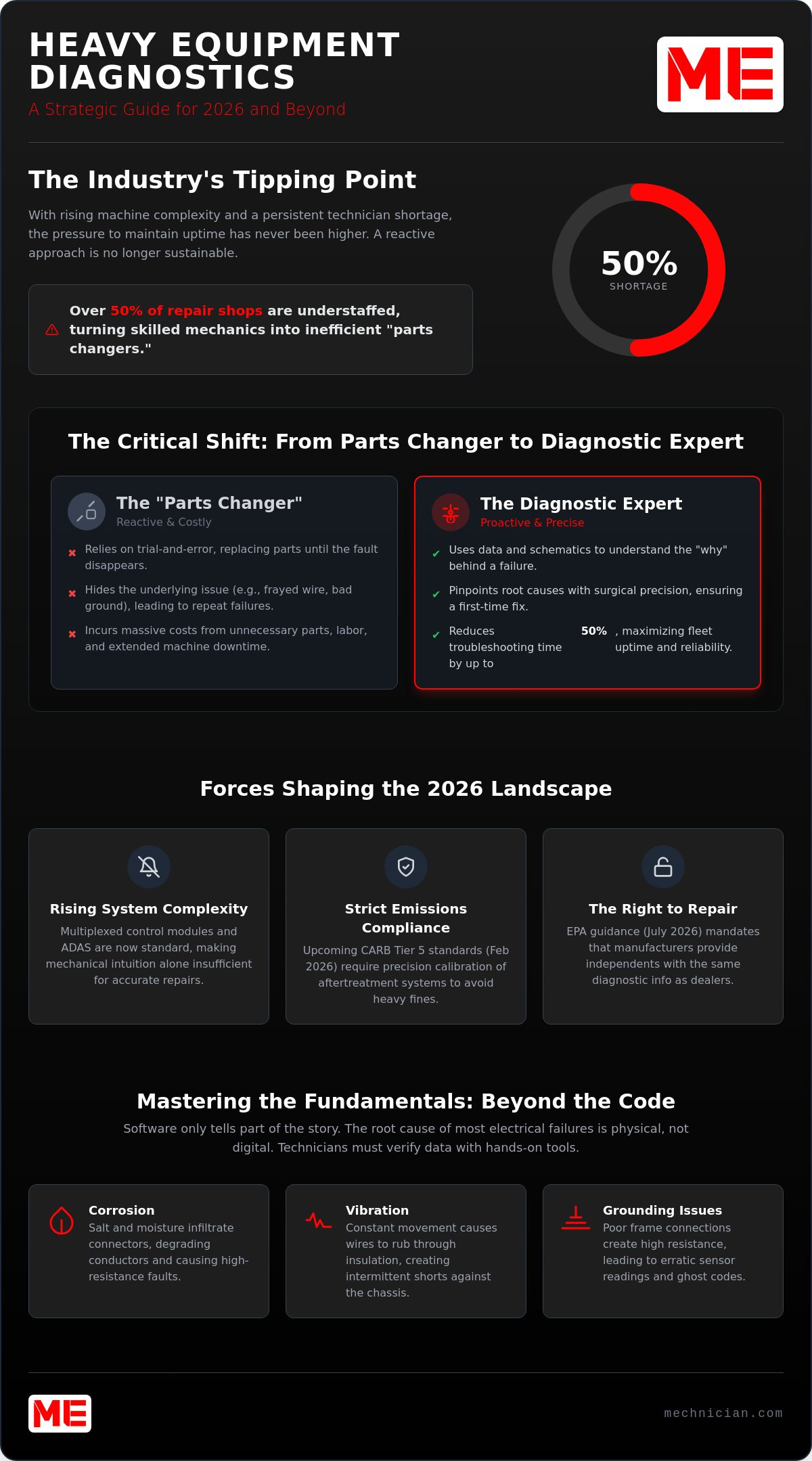
What if your maintenance team could resolve complex fault codes without waiting days for a dealer technician to arrive on-site? With over 50% of heavy-duty repair shops currently facing understaffing, the pressure to maintain uptime has never been higher. It's frustrating to watch skilled mechanics become "parts changers" simply because they lack the specific knowledge to interpret modern Tier 4 Final or Stage V emission systems. Investing in heavy equipment diagnostic training isn't just an elective choice for fleet managers. It's a strategic requirement for operational stability.

We understand that the increasing density of sensors and ECUs can feel overwhelming. This master guide for 2026 will show you how to bridge the technical skills gap, master intricate system diagnostics, and significantly reduce your reliance on outside dealers. We'll walk through the latest industry developments, including the July 2026 EPA "Right to Repair" guidance and the advanced capabilities of Jaltest version 26.1. Our goal is to help your shop operate with the precision and confidence that modern machinery demands.

Key Takeaways

  • Understand why modern heavy equipment requires a shift from reactive parts replacement to proactive, system-level analysis.
  • Learn why fundamental knowledge of electrical flow and hydraulic pressure is critical before connecting any software.
  • Discover how professional heavy equipment diagnostic training through Jaltest University enables your team to manage hundreds of brands with one interface.
  • Identify the hardware and culture shifts, including the use of ruggedized laptops, needed to maintain a high-functioning shop floor.
  • Explore how technical support and authorized partnerships help your technicians solve complex faults without dealer intervention.

Why Heavy Equipment Diagnostic Training is Essential in 2026

The heavy equipment industry has reached a tipping point where mechanical intuition alone is no longer sufficient. In 2026, machines are defined by multiplexed control modules and Advanced Driver Assistance Systems (ADAS) that require a higher level of technical literacy. Comprehensive heavy equipment diagnostic training serves as the bridge between traditional mechanical repair and modern system engineering. It represents a fundamental shift from reactive parts replacement to proactive, data-driven system analysis.

Relying on a "trial and error" approach creates a cascade of financial losses. When a technician replaces a high-pressure fuel pump only to find the fault remains, the business loses the cost of the part, the labor hours, and the potential revenue from the machine's downtime. Professional training transforms these "parts changers" into diagnostic experts who can pinpoint root causes with surgical precision. This shift is critical for maintaining fleet operational stability, especially since reports from 2025 and 2026 indicate that over 50% of repair shops are struggling with a persistent technician shortage.

Precision calibration is also a matter of compliance. With the California Air Resources Board (CARB) developing Tier 5 emissions standards as of February 2026, the margin for error in exhaust aftertreatment systems has narrowed. Accurate heavy equipment diagnostic training ensures that your team can maintain machines to these stringent requirements, preventing heavy fines and environmental non-compliance while ensuring the safety of the operator through properly calibrated ADAS sensors.

The Shift from Parts Changer to Diagnostic Expert

Throwing parts at a fault code is the most expensive way to manage a fleet. It hides the underlying issue, such as a frayed wire or a failing sensor, which will inevitably cause the new part to fail again. Developing an engineering mindset involves using technical data to understand the "why" behind a failure. Industry professionals report that utilizing integrated technical data can reduce troubleshooting time by up to 50%, allowing machines to return to the field faster and with greater reliability.

Dealer Lockouts and the Right to Repair

Independent shops often feel sidelined by proprietary software lockouts. However, the regulatory landscape changed significantly on July 1, 2026, when the EPA issued new guidance affirming that manufacturers must provide independent shops with the same diagnostic information available to branded centers. By mastering all-makes diagnostic tools, your team can reclaim revenue that was previously lost to dealer service departments. To understand how these tools fit into current requirements, refer to our Professional Vehicle Diagnostic Tool Guide for more details on industry standards.

Mastering the Core Fundamentals: Electrical and Hydraulic Systems

High-end software is a powerful asset, but it remains ineffective if the technician doesn't understand the physical medium it monitors. Professional heavy equipment diagnostic training must prioritize the physics of the machine before the logic of the code. A fault code for "low fuel pressure" might lead a technician to replace a sensor, but a manual pressure gauge might reveal a clogged primary filter or a failing lift pump. Without these fundamentals, the software is merely a digital suggestion box rather than a precision instrument.

The technician’s toolkit must move beyond the code reader. While a laptop provides the data, multimeters and pressure gauges identify the physical reality. Interpreting complex wiring harnesses and hydraulic circuits requires more than just looking at a screen; it requires the ability to read and understand schematics. In the heavy-duty sector, most electrical failures aren't caused by computer glitches. They're caused by physical stressors:

  • Corrosion: Salt and moisture infiltrating connectors and eating away at copper conductors.
  • Vibration: Constant movement causing wires to rub through insulation against the chassis or brackets.
  • Grounding Issues: Poor connections at the frame that create high resistance and erratic sensor readings.

Developing a diagnostic mindset means using these tools to verify what the software reports. If the software shows five volts at a sensor but the multimeter shows three, you've identified a wiring issue, not a component failure. This level of precision saves hours of unnecessary labor. To ensure your shop is equipped with tools that match this level of expertise, consider exploring the professional diagnostic kits and support available for modern fleets.

Electrical Theory for Heavy-Duty Technicians

Ohm’s Law is the foundation for troubleshooting sensors and actuators. Technicians need to be able to calculate expected values to identify open circuits, short circuits, or high resistance. When dealing with J1939 data links, a multimeter is essential for performing voltage drops and continuity tests. This ensures the communication highway is functional before an expensive ECU is condemned. Accuracy here prevents the costly mistake of replacing healthy modules.

Hydraulic Diagnostics and System Integration

Modern hydraulics rely on the seamless integration of electronic control valves and mechanical outputs. Diagnosing a solenoid failure often involves software-driven activation tests, but the technician must verify the actual hydraulic response at the cylinder or motor. Safety protocols are critical during these routines. High-pressure systems can be lethal if handled incorrectly. Training must emphasize pressure relief procedures and the correct use of test ports to ensure the diagnostic process remains safe and controlled.

Jaltest University: A Comprehensive Software Training Ecosystem

Modern diagnostics requires more than just a tool; it requires a structured learning environment that evolves alongside the machinery. Jaltest University represents this shift by providing a dynamic training ecosystem rather than a static set of instructions. With the release of version 26.1 in March 2026, the platform has integrated advanced web-based workshop management and expanded vehicle coverage. This ensures that heavy equipment diagnostic training stays relevant as manufacturers release new ECU configurations and complex subsystems. By consolidating diagnostic capabilities into a single interface, technicians can apply a consistent methodology across diverse brands like Caterpillar, Komatsu, or John Deere, reducing the cognitive load on your team.

The versatility of an all-makes platform is essential for shops managing mixed fleets. Instead of learning ten different proprietary programs, your staff masters one environment. This mastery extends to advanced calibrations that were once the sole domain of dealers. Training modules cover critical procedures such as DPF regenerations, injector coding, and Variable Geometry Turbocharger (VGT) actuations. These are high-stakes tasks where precision is non-negotiable. Staying current with these capabilities requires a Jaltest Software Annual License, which provides the regular updates needed to interface with the latest manufacturer releases and emissions protocols.

Specialized Training for Off-Highway and Agricultural Equipment

The Jaltest OHW (Off-Highway) Kit requires specific procedural knowledge to navigate the unique architectures of construction machinery. Technicians learn how to perform hydraulic calibrations and engine health checks on excavators, loaders, and graders. Similarly, mastering the Jaltest AGV (Agricultural Equipment) Kit involves understanding the seasonal demands of tractors and combines. Precision here ensures that a machine is ready for the field when it matters most. For those also managing transport fleets, our Jaltest CV Kit Guide provides a detailed look at all-makes truck diagnostics in the current market.

The Role of Technical Data and Wiring Diagrams

Software is most effective when it provides a clear path to resolution. The Jaltest interface includes integrated troubleshooting guides that lead the technician through a step-by-step repair path based on specific fault codes. This includes component locations and technical specifications that eliminate guesswork. In warehouse environments, maximizing the value of the Jaltest MHE (Material Handling Equipment) Kit means being able to quickly identify electrical faults in forklifts or telehandlers. Access to interactive wiring diagrams allows your team to trace circuits with confidence, ensuring that every repair is grounded in verified technical data.

Heavy equipment diagnostic training

Building a Diagnostic-First Culture in Your Maintenance Team

Transforming a shop's performance requires more than just a software purchase. It demands a cultural shift where diagnostics are prioritized over parts replacement. This process starts with a systematic assessment of your current staff to identify specific knowledge gaps. Some technicians might have decades of mechanical experience but struggle with multiplexed circuits. Others may be comfortable with computers but lack a deep understanding of hydraulic pressures. Once you've mapped these skills, heavy equipment diagnostic training becomes a targeted roadmap for growth rather than a generic classroom exercise.

Implementing a "diagnostic-first" approach means creating a low-stakes environment for learning. Fleet managers should schedule dedicated training hours where technicians can explore software features on machines that aren't currently facing an emergency deadline. This practice allows them to navigate technical data and wiring diagrams without the pressure of an active machine down situation. Incentivizing this progress is equally important. Rewarding technicians who complete Jaltest University modules or achieve specific certifications turns professional development into a valued career milestone. To support this transition, you can explore our range of ruggedized diagnostic laptops and technical training solutions designed for professional environments.

Remote Technical Support as Continuous Education

Technical support shouldn't be viewed as a one-time rescue for a difficult fault. Instead, it functions as a live classroom experience. When your team uses Jaltest technical support to resolve complex "ghost codes" or intermittent faults, they're participating in a guided repair path. This interaction builds long-term competence and breaks the cycle of dealer reliance. Over time, these guided sessions empower your technicians to handle similar issues independently, turning every challenging repair into a teaching tool for the entire shop.

Selecting the Right Hardware for Training

The shop floor is a hostile environment for standard consumer electronics. Extreme temperatures, dust, and physical impacts will quickly disable a standard laptop, halting your heavy equipment diagnostic training efforts. Ruggedized diagnostic laptops are engineered to survive these conditions. They ensure that your team has reliable access to the Jaltest software annual license updates and technical specifications whenever a machine enters the bay. Investing in hardware that matches the durability of your heavy equipment is a strategic decision that prevents unnecessary downtime and hardware replacement costs.

The Mechnician Advantage: Beyond the Training Course

Completing a certification is only the first step toward diagnostic independence. True operational stability comes from a long term partnership with experts who understand the realities of the shop floor. Mechnician serves as your authorized partner for Jaltest solutions; providing the technical upskilling and hardware support necessary to maintain a modern fleet. We don't just deliver a kit and leave; we provide a national network of specialists capable of offering remote guidance and on-site assistance when your team encounters a particularly stubborn fault. This commitment to your fleet's uptime ensures that your investment in heavy equipment diagnostic training yields a measurable return in reduced dealer fees and shorter repair cycles.

Financial accessibility is a key part of our solution. We offer flexible financing options for diagnostic kits and training enrollment fees, allowing maintenance departments to modernize their toolsets without immediate capital strain. This professional approach treats technical education as a strategic asset for future stability rather than a one-time expense. By aligning your team with Mechnician and Cojali, you're integrating a dedicated technical unit into your organization that takes responsibility for the continuous functionality of your diagnostic capabilities.

Total Lifecycle Support for Your Diagnostic Tools

Maintaining the edge in diagnostics requires keeping your tools as current as the machinery they service. This involves managing Jaltest Software Annual License renewals to ensure compatibility with the latest ECU releases and emissions standards. Our support extends to providing Specialized Diagnostic Cables for niche or legacy equipment, ensuring you never lose coverage on older assets. Our technical support team is always available to help your technicians maximize tool utilization, helping them navigate new software features as they are released.

Next Steps: Reclaiming Control of Your Repairs

Reclaiming control over your maintenance schedule starts with a customized training plan tailored to your department's specific needs. Whether you're managing a small construction fleet or a large agricultural operation, the combination of Jaltest versatility and Mechnician expertise provides a clear path to self-sufficiency. The long term benefits of this partnership include a more confident workforce and a significant reduction in machine downtime. You can contact Mechnician to discuss your heavy equipment diagnostic training needs and begin the transition toward a more efficient, diagnostic-first maintenance culture.

Securing Your Fleet's Operational Future

The heavy equipment landscape in 2026 requires a precise blend of mechanical intuition and digital literacy. By integrating fundamental system theory with advanced software capabilities, your team can finally break the cycle of expensive dealer reliance. We've explored how a diagnostic-first culture, supported by ruggedized hardware and specialized training, transforms your shop into a high-efficiency unit. This transition ensures that your equipment stays in the field rather than waiting in a service bay for weeks at a time.

Professional heavy equipment diagnostic training is a necessary investment in your fleet's long-term stability. As an Authorized Jaltest Dealer, Mechnician provides the tools and knowledge your technicians need to succeed. You'll gain direct access to Jaltest University and our expert remote technical support to ensure your team solves even the most complex faults with confidence. This partnership provides the technical backbone your organization needs to thrive in an increasingly complex industry.

Empower your team with Jaltest Training and Diagnostic Kits at Mechnician.com and reclaim control over your repair timelines today. Your journey toward technical self-sufficiency is a strategic decision that builds a more resilient future for your business.

Frequently Asked Questions

How long does it take to become proficient in heavy equipment diagnostics?

Proficiency in heavy equipment diagnostics typically takes between six and twelve months of consistent hands-on experience and structured study. While basic fault code reading can be learned quickly, mastering complex system analysis and bi-directional testing requires ongoing engagement with modern software. Technicians who commit to regular modules often see a significant improvement in their troubleshooting speed within the first year.

Can I learn to use Jaltest software online, or is in-person training required?

You can learn to use Jaltest software through online modules provided by Jaltest University, which offers a flexible way to master the interface. These web-based courses allow technicians to progress at their own pace from any location. While in-person workshops can provide valuable tactile experience, the digital platform is designed to be a comprehensive standalone resource for software literacy.

What is the difference between a code reader and a professional diagnostic kit?

A professional diagnostic kit offers bi-directional control and deep system access that a simple code reader cannot match. While a code reader only identifies a fault, a professional kit allows you to perform DPF regenerations, calibrate actuators, and access integrated wiring diagrams. This level of heavy equipment diagnostic training ensures your team can actually repair the machine rather than just identifying the symptom.

What happens if my technicians encounter a fault they cannot solve after training?

Technicians who encounter an unsolvable fault can utilize expert remote technical support to guide them through the repair path. This real-time assistance acts as a safety net, ensuring that complex "ghost codes" or intermittent failures don't result in machine downtime. This service functions as an extension of your team, providing the confidence needed to tackle advanced electronic issues.

Is Jaltest University included with the purchase of a diagnostic kit?

Access to Jaltest University is typically included with the purchase of a diagnostic kit and the maintenance of an active software license. This ensures that your team has the educational resources needed to utilize the tool's full potential from day one. It serves as a centralized hub for learning the specific nuances of OHW, AGV, and CV modules.

Do I need a separate training course for different brands like Caterpillar or John Deere?

No, you don't need separate training courses for different brands because Jaltest utilizes a unified interface for hundreds of manufacturers. Once a technician learns the software logic, they can apply the same diagnostic process to Caterpillar, John Deere, or Komatsu machinery. This all-makes versatility is a primary advantage of professional heavy equipment diagnostic training, as it simplifies the learning curve for mixed fleets.

How much does heavy equipment diagnostic training typically cost for a team?

The cost of diagnostic training varies based on the depth of the program and the number of technicians involved. Industry-standard workshops for specific systems like hydraulics or electrical troubleshooting often range from $450 to $475 per person at technical universities. For a full maintenance department, a customized plan involving software-integrated modules is often the most cost-effective way to achieve team-wide proficiency.

Can training help reduce my fleet’s annual maintenance budget?

Training helps reduce your fleet’s annual maintenance budget by significantly lowering the frequency of dealer service calls and reducing machine downtime. When technicians can identify root causes accurately, you avoid the "parts changer" mentality that leads to unnecessary component costs. Over time, the ability to perform in-house calibrations and regenerations provides a measurable return on investment.

Professional Vehicle Diagnostic Tool Guide: 2026 Industry Standards

Professional Vehicle Diagnostic Tool Guide: 2026 Industry Standards

Cada hora que tu camión pesado permanece en un área de servicio de un concesionario en Ontario o Alberta le cuesta a tu operación un promedio de C$1,200 en ingresos y tarifas de servicio perdidos. Ya sabes que depender de técnicos OEM para reinicios simples de sensores es un cuello de botella que agota tu presupuesto de mantenimiento. Es frustrante cuando un lector de códigos genérico identifica una falla pero no tiene el control bidireccional para forzar realmente una regeneración del DPF o calibrar un sensor de ángulo de dirección. Un solo retraso en el diagnóstico puede propagarse por toda tu cadena logística, convirtiendo un pequeño fallo de sensor en una avería operativa de varios días.

Esta guía ofrece la hoja de ruta técnica para seleccionar una herramienta profesional de diagnóstico vehicular que cumpla con los estándares de la industria de 2026. Aprenderás a sortear a los intermediarios del concesionario, reducir tus gastos externos de servicio hasta en un 40% y lograr capacidad total de reparación independiente en toda tu flota multimarca. Examinaremos los requisitos de hardware específicos y los protocolos de software necesarios para mantener un 98% de tiempo de actividad de la flota sin interferencias propietarias de OEM.

Puntos clave

  • Distingue entre lectores de códigos básicos y sistemas de espectro completo para asegurar que tu taller cumpla con los requisitos técnicos de los protocolos industriales de 2026.
  • Domina capacidades avanzadas como controles bidireccionales y calibraciones de sistemas para realizar ajustes de precisión en actuadores VGT y válvulas hidráulicas.
  • Calcula el importante ROI de la independencia del concesionario eliminando las elevadas tarifas por hora y los costos de remolque de C$1,000+ que afectan los márgenes de las flotas canadienses.
  • Selecciona la herramienta profesional de diagnóstico vehicular óptima adaptada a tu sector específico, desde transporte comercial hasta maquinaria de construcción especializada fuera de carretera.
  • Aprovecha el soporte técnico profesional y el diagnóstico remoto para minimizar el tiempo de inactividad y tratar el mantenimiento como una inversión estratégica en productividad.

¿Qué define una herramienta profesional de diagnóstico vehicular en 2026?

Para 2026, la complejidad de la electrónica automotriz ha llegado a un punto en el que un enfoque simple de conectar y usar ya no es suficiente para el mantenimiento industrial. Las flotas modernas en Canadá ahora dependen de arquitecturas Zonal E/E que requieren más que una simple conexión; requieren un intercambio profundo con la pasarela central del vehículo. Una herramienta profesional de diagnóstico vehicular representa una inversión estratégica en tiempo de actividad. En el mercado actual, una unidad de gama alta suele costar entre C$3,800 y C$9,500, reflejando su papel como pieza crítica de equipo industrial. Estas herramientas deben navegar liberaciones de datos seguras y módulos cifrados que no existían hace una década. La precisión en la detección de fallas es la base para mantener la seguridad operativa.

Lectores de códigos vs. escáneres de diagnóstico

Distinguir entre estas dos categorías es vital para la eficiencia del taller. Los lectores de códigos básicos operan en modo de "solo lectura". Extraen DTC genéricos (Códigos de Diagnóstico de Fallas) relacionados con los estándares de diagnóstico a bordo (OBD), principalmente para el monitoreo de emisiones. No pueden realizar calibraciones ni pruebas bidireccionales. En cambio, un escáner de diagnóstico profesional es un instrumento de "lectura y escritura". Permite a los técnicos comandar componentes, como activar una bomba ABS o forzar una regeneración del DPF. Las herramientas OBDII genéricas suelen fallar en entornos de trabajo pesado porque carecen de los protocolos propietarios del fabricante necesarios para el 85% de las fallas de sistemas profundos que se encuentran en camiones de trabajo o maquinaria especializada. Usar la herramienta incorrecta conduce a diagnósticos erróneos y a un tiempo de inactividad prolongado.

La evolución de la tecnología VCI

La Interfaz de Comunicación del Vehículo (VCI) ha pasado de ser un puente simple a un potente dispositivo de computación en el borde. Las VCI modernas utilizan CAN FD (Flexible Data-rate) y DoIP (Diagnósticos sobre IP) para gestionar velocidades de transferencia de datos de hasta 100 Mbps. Esta velocidad es necesaria porque los vehículos del año modelo 2026 suelen procesar 40 GB de datos durante un escaneo completo del sistema. La VCI actúa como traductor entre los datos sin procesar del bus CAN del vehículo y el software del usuario. Las conexiones Bluetooth 5.2 de alta velocidad y Wi‑Fi de doble banda han reemplazado los cables físicos restrictivos del pasado. Esto permite a los técnicos monitorear datos en vivo desde 30 metros de distancia, lo cual es esencial para la seguridad al probar maquinaria pesada. Esta tecnología elimina la latencia que antes provocaba caídas de señal durante procedimientos críticos de reprogramación de la ECU.

Los estándares de 2026 exigen una herramienta profesional de diagnóstico vehicular que pueda manejar comunicación multiprotocolo simultáneamente. Una unidad profesional debe hablar con el tren motriz en un canal mientras consulta el módulo ADAS (Sistemas Avanzados de Asistencia al Conductor) en otro. Esta capacidad multistream es un requisito para las certificaciones de seguridad modernas en el sector del transporte canadiense. Aquí la prioridad es la confiabilidad; un técnico no puede permitirse un tiempo de espera de comunicación al configurar un sensor de ángulo de dirección o un controlador de frenado.

La robustez es otro factor que separa el equipo profesional de la electrónica de consumo. Aunque una tableta de consumo de C$600 pueda parecer rentable, carece de la gestión térmica necesaria para turnos de 10 horas en un taller canadiense sin clima controlado. Para asegurarte de que los sistemas climáticos de tu instalación estén a la altura, puedes visit Zee Jay Mechanical para obtener soporte especializado en HVAC. Las herramientas profesionales cuentan con clasificaciones IP65 o IP67, lo que garantiza protección contra aceite, líquido de frenos y caídas de 1.5 metros sobre concreto. Las tabletas de consumo a menudo reducen el rendimiento de sus procesadores cuando las temperaturas internas alcanzan los 35°C, lo que provoca fallos de software durante escaneos profundos. En entornos industriales, la falla del hardware se traduce directamente en tiempo de inactividad de la máquina. Invertir en equipos reforzados es una decisión calculada para garantizar sostenibilidad a largo plazo y rendimiento constante en campo.

Capacidades avanzadas: ir más allá de la interpretación de códigos de falla

Leer un código de falla es solo el 15% del proceso de diagnóstico. Una herramienta profesional de diagnóstico vehicular actúa como un puente para la comunicación bidireccional. No solo escucha; también habla. Esta capacidad permite a los técnicos verificar reparaciones sin intercambiar piezas a ciegas, una práctica que suele mermar la productividad del taller. Cuando una herramienta puede comandar el vehículo, el proceso de diagnóstico pasa de la especulación a la verificación empírica.

Aunque este artículo se centra en el diagnóstico de flotas industriales, la misma necesidad de precisión técnica existe en el mundo automotriz de alto rendimiento. Para los lectores interesados en el mantenimiento y las mejoras de vehículos de alto desempeño, puedes discover Oztrack Performance Tuning & Engines para explorar guías técnicas especializadas para modelos orientados al rendimiento.

Control bidireccional: el estándar profesional

Las pruebas bidireccionales convierten al técnico de observador en operador. Puedes activar la bomba de combustible o mandar una velocidad específica del ventilador de refrigeración directamente desde la interfaz. Estas pruebas aíslan fallas mecánicas de errores electrónicos de sensores. Si la herramienta manda el ventilador al 100% y no se mueve, has confirmado un problema del motor o del cableado, no un sensor de temperatura defectuoso. Las herramientas Jaltest incorporan protocolos de seguridad que monitorean los umbrales de temperatura y presión del motor. Estas salvaguardas evitan daños en componentes al abortar automáticamente una prueba si los parámetros superan los límites operativos seguros durante simulaciones de alta carga.

Más allá de las pruebas, la herramienta maneja calibraciones críticas del sistema. Ajustar actuadores del Turbocompresor de Geometría Variable (VGT) o recalibrar sensores de ángulo de dirección requiere una entrada de datos precisa. Para los propietarios de equipos pesados en Canadá, mantener en buen estado el Filtro de Partículas Diésel (DPF) y la Reducción Catalítica Selectiva (SCR) es obligatorio para evitar el "modo limitado" y pérdidas de C$2,000 diarios por tiempo de inactividad. Las regeneraciones forzadas y los reinicios del nivel de hollín son procedimientos estándar para cualquier herramienta profesional de diagnóstico vehicular preparada para flotas. Estas tareas garantizan que el sistema de postratamiento de gases de escape funcione dentro de los estrictos parámetros ambientales requeridos para las carreteras canadienses.

Los protocolos de diagnóstico modernos siguen estrictos estándares de diagnóstico de SAE International para garantizar un intercambio seguro de datos. Estos estándares evolucionan para incluir los modelos de vehículos de 2026, asegurando que las pasarelas cifradas de la ECU no bloqueen a los talleres independientes para realizar las reparaciones necesarias. Cumplir con estos estándares significa que la herramienta puede comunicarse con las arquitecturas más recientes de la red de área del controlador (bus CAN) sin arriesgar corrupción de datos o bloqueos de módulos.

Programación de la ECU y ajustes de parámetros

Los gestores de flotas suelen necesitar ajustar limitadores de velocidad o configuraciones de Toma de Fuerza (PTO) para que coincidan con requisitos operativos específicos. Para estos cambios se requiere acceso de nivel profesional. El "Modo Experto" de Jaltest permite a los técnicos realizar estas calibraciones avanzadas sin esperar contraseñas de nivel concesionario. Esta función ahorra un promedio de 4.5 horas por llamada de servicio al eliminar la necesidad de autorización de terceros. Las liberaciones técnicas basadas en la nube garantizan que tu software se mantenga actualizado con los últimos modelos de 2026, proporcionando diagramas de cableado y especificaciones de torque en tiempo real a medida que los fabricantes actualizan sus boletines técnicos.

Los diagramas de cableado interactivos cambian la forma en que ocurren las reparaciones físicas. En lugar de buscar entre manuales de 500 páginas, la herramienta resalta el circuito específico relacionado con la falla. Esta precisión reduce el tiempo de diagnóstico en un 35% en problemas eléctricos complejos. Si tu configuración actual carece de estas funciones, probablemente sea el momento de evaluar tu hardware de diagnóstico para garantizar la fiabilidad del equipo a largo plazo. Tener los datos correctos en el punto de reparación es la diferencia entre una solución de 30 minutos y un retraso de tres días.

El ROI de la independencia del concesionario: análisis de la brecha de costos

Poseer una herramienta profesional de diagnóstico vehicular no se trata solo de comodidad; es una estrategia financiera calculada. En Canadá, las tarifas por hora de los concesionarios de equipos pesados a menudo superan los C$220 por hora. Cuando sumas el costo de un remolque para trabajo pesado, que promedia C$850 para una excavadora de tamaño mediano, una sola avería puede costar C$3,000 antes de que siquiera se pidan las piezas. Tu verdadera pérdida es el costo de oportunidad. Una máquina detenida puede costarle a una empresa de construcción C$4,500 en ingresos diarios. Al realizar diagnósticos en el sitio, eliminas el tiempo de transporte y la espera de triage de 48 horas común en los grandes concesionarios.

Invertir en una sola plataforma multimarca como Jaltest reemplaza la necesidad de 7 u 8 portátiles OEM individuales. Cada licencia OEM puede costar C$2,500 al año. Consolidarlas en una sola interfaz reduce el desorden de hardware y el tiempo de capacitación. Muchos técnicos se preocupan por los "bloqueos del concesionario", pero en gran medida esto es un mito. Las herramientas modernas se adhieren al estándar UDS ISO 14229-2, que garantiza una comunicación unificada entre diferentes unidades de control electrónico. Esta estandarización permite que herramientas de terceros realicen el 95% de las tareas a nivel concesionario, incluidos cambios de parámetros y calibraciones de componentes.

Las matemáticas son simples. Considera una regeneración forzada del DPF. Un concesionario suele cobrar C$600 por este servicio, más el costo de llevar la máquina a su taller. Si tu técnico lo hace en campo usando tu propia herramienta profesional de diagnóstico vehicular, habrás ahorrado aproximadamente C$1,400 en gastos totales. Para un kit de diagnóstico que cuesta C$7,000, ese único evento recupera el 20% de tu inversión inicial. La confiabilidad en el campo significa que no estás a merced del calendario de un concesionario.

Rompiendo el monopolio OEM

El movimiento Right to Repair, respaldado por legislación canadiense como el Proyecto de Ley C-244, ha cambiado el equilibrio de poder. Los fabricantes ya no pueden legalmente restringir los datos básicos de reparación. Sistemas como Jaltest integran los protocolos de Caterpillar, John Deere y Volvo en una interfaz única y cohesionada. Obtienes los mismos diagramas de cableado y especificaciones de torque que usa el concesionario. No solo es tan bueno como la herramienta del concesionario; a menudo es más rápido porque no requiere ping constante por VPN a un servidor corporativo. Tú posees los datos. Tú controlas el cronograma.

El valor de las licencias de software anuales

Un escáner de diagnóstico es un producto vivo. Para 2026, los módulos Jaltest OHW tienen programadas tres grandes actualizaciones de software, lo que garantiza compatibilidad con los controladores de motor Tier 4 Final y Stage V más nuevos. Tu cuota anual de licencia no es un impuesto. Es una suscripción a una enorme base de datos de ingeniería. Esta cuota cubre:

  • Acceso a módulos de capacitación de Jaltest University para nuevos técnicos.
  • Soporte remoto en tiempo real de mecánicos maestros especializados.
  • Guías de resolución de problemas actualizadas para más de 3,000 modelos de equipos.
  • Nueva cobertura de ECU a medida que los fabricantes actualizan su firmware.
Sin estas actualizaciones, tu herramienta se convierte en un pisapapeles en el momento en que un fabricante lanza una actualización de firmware para un nuevo tractor o cargador. Es una inversión en la funcionalidad a largo plazo de tu flota.

Seleccionar la herramienta adecuada para tu sector específico

Seleccionar una herramienta profesional de diagnóstico vehicular depende por completo de la maquinaria específica que opera tu flota. Un escáner OBDII estándar no será suficiente cuando administras una cosechadora de C$450,000 o una flota de camiones de larga distancia que cruzan las Rocosas. Para vehículos comerciales (CV), los técnicos requieren acceso profundo a módulos de control del motor (ECM) y a sistemas de postratamiento. En Canadá, donde el ralentí es común debido al frío extremo, monitorear los sistemas DPF y SCR es una necesidad diaria para prevenir modos de reducción de potencia que pueden dejar a un conductor varado en temperaturas bajo cero.

Requisitos especializados para equipos pesados

Los equipos fuera de carretera (OHW) y de construcción demandan más que solo software. Marcas como Komatsu o Liebherr suelen utilizar puertos de comunicación propietarios. Necesitarás cables especializados para conectar la máquina con tu interfaz. Sin el adaptador correcto de 9 o 14 pines, quedas fuera de los datos hidráulicos y del tren motriz. Esta conexión física es el primer obstáculo para identificar por qué una máquina no alcanza la presión objetivo.

Esta necesidad de hardware especializado es igual de relevante al gestionar vehículos de trabajo personalizados o modificados. Para flotas que utilizan fabricación especializada, como las conversiones 4x4 proporcionadas por Auto Industries Factory LLC, asegurar que tus herramientas de diagnóstico puedan interactuar con sistemas modificados es esencial para mantener la fiabilidad del activo.

El diagnóstico agrícola (AGV) introduce la complejidad de la compatibilidad ISOBUS. Un tractor moderno no solo mueve un motor; gestiona implementos complejos como sembradoras neumáticas o pulverizadoras. Tu herramienta debe leer tanto la unidad motriz como el implemento conectado para asegurar que todo el sistema se comunique. El trabajo en campo en las Praderas o en el norte de Ontario hace que un portátil de diagnóstico reforzado no sea negociable. Las tabletas de consumo estándar a menudo fallan bajo la vibración, el polvo y los cambios de temperatura típicos de los sitios de trabajo canadienses, donde un reemplazo puede tardar días en llegar.

Matices marinos y de manejo de materiales (MHE)

El sector marino opera bajo condiciones ambientales severas. Las herramientas de diagnóstico para motores internos y externos deben tener en cuenta la corrosión por agua salada y protocolos especializados. Marcas como Mercury, Volvo Penta o Cummins Marine requieren software que pueda realizar pruebas de corte de cilindros mientras la embarcación está en el agua. La precisión aquí es vital; un motor fallando en el mar es una crisis de seguridad, no solo un retraso de mantenimiento.

El equipo de manejo de materiales (MHE) representa una parte significativa del mercado de diagnóstico industrial, pero sigue siendo frecuentemente pasado por alto. Montacargas, order pickers y plataformas de tijera de Hyster, Yale o Toyota usan controladores específicos a los que los escáneres automotrices estándar no pueden acceder. El tiempo de inactividad de un solo montacargas puede costarle a un almacén C$1,500 por turno en productividad perdida. Utilizar un Kit Jaltest MHE dedicado proporciona la cobertura necesaria para motores eléctricos, sistemas hidráulicos y sensores de seguridad.

  • Vehículos comerciales: Prioriza herramientas que manejen transmisiones Allison y sistemas de frenado Bendix.
  • Construcción: Enfócate en software que ofrezca datos en vivo de presiones hidráulicas y calibraciones de bombas.
  • Agricultura: Asegúrate de que el hardware admita ISOBUS y calibraciones de dirección GPS para agricultura de precisión.
  • Marino: Busca hardware con clasificación IP67 para resistir la humedad y los entornos de alta humedad.

Elegir la herramienta profesional de diagnóstico vehicular incorrecta conduce a reparaciones incompletas y tiempo de inactividad prolongado. Es una inversión estratégica que impacta tu resultado final. Un escáner multimarca de gama alta normalmente se paga solo en 5 meses al reducir las tarifas de terceros del concesionario, que a menudo superan los C$275 por hora en grandes centros canadienses como Toronto, Edmonton o Vancouver. Al mantener el diagnóstico internamente, conservas el control sobre tu calendario de mantenimiento y la disponibilidad de las máquinas.

Para operaciones que requieren más que diagnósticos basados en escáner, como la verificación compleja de sistemas eléctricos o de potencia, puedes explore Test Equipment Rental para acceder a equipos industriales de prueba de alta precisión de forma flexible.

Además de los sistemas tradicionales del tren motriz, la modernización de las flotas industriales suele implicar la adopción de energía eléctrica. Para respaldar esta transición, puedes learn more about EVdiagnostika.si para acceder a diagnósticos de baterías especializados e independientes que garantizan la fiabilidad a largo plazo de tus activos eléctricos e híbridos.

¿Listo para optimizar el mantenimiento de tu flota y reducir el tiempo de inactividad? Consulta hoy con un especialista de Mechnician para encontrar la configuración exacta de hardware para las necesidades específicas de tu sector.

Por qué Mechnician es el socio estratégico para tu flota de diagnóstico

Seleccionar una herramienta profesional de diagnóstico vehicular de alto rendimiento es solo la primera etapa de una inversión a largo plazo. El verdadero valor de la tecnología de diagnóstico surge a través de un tiempo de actividad constante y la capacidad de resolver fallas complejas sin demora. Mechnician opera como una extensión de tu departamento de servicio, proporcionando la profundidad técnica necesaria para manejar maquinaria moderna controlada por computadora. Reconocemos que un escáner en una repisa por falta de capacitación o por un fallo de software representa miles de dólares en ingresos perdidos. Nuestro enfoque se centra en eliminar estos cuellos de botella mediante intervención directa de expertos y educación especializada.

Las flotas canadienses modernas enfrentan desafíos únicos, desde los impactos del clima extremo en los sensores hasta plataformas de motor diversas en los sectores agrícola y de transporte. Depender de un lector de códigos básico no es suficiente cuando un equipo de C$250,000 está atascado en modo de reducción de potencia. Mechnician proporciona el conocimiento especializado para interpretar datos, no solo leer códigos. Actuamos como un puente entre la ingeniería avanzada y soluciones prácticas de taller, asegurando que tu equipo se mantenga seguro sin importar la marca o el modelo que encuentre.

El ecosistema de soporte de Mechnician

Nuestro soporte va mucho más allá de un servicio de asistencia estándar. Utilizamos asistencia remota de escritorio para brindar ayuda en tiempo real durante ventanas críticas de reparación. Si un técnico tiene dificultades con una calibración VGT compleja o un reinicio del DPF, nuestros expertos pueden ingresar virtualmente a la sesión de diagnóstico para guiarlos durante el proceso. Este servicio reduce la curva de aprendizaje y evita errores costosos durante procedimientos delicados. No solo compras hardware; obtienes acceso a un técnico maestro bajo demanda.

La educación es la base de la eficiencia del taller. A través de Jaltest University, ofrecemos el programa de formación principal para técnicos diésel en Norteamérica. Estos módulos cubren desde resolución básica de problemas eléctricos hasta multiplexación avanzada y calibraciones ADAS. Como distribuidor autorizado, cada herramienta profesional de diagnóstico vehicular que vendemos incluye validez de software garantizada. Esto protege tu taller de los riesgos de hardware falsificado o licencias vencidas que pueden provocar bloqueos repentinos de la herramienta durante un trabajo. El hardware genuino garantiza que cada C$ gastado contribuya a un entorno de reparación estable y confiable.

Personalización de tu paquete de diagnóstico

Un enfoque único para todos falla en el mercado canadiense, donde la mezcla de flotas varía enormemente entre provincias. Los especialistas de Mechnician analizan tu carga de trabajo específica para crear un paquete a medida. Te ayudamos a elegir entre conjuntos de cables específicos para equipos de construcción, marinos o de manejo de materiales. Los combinamos con hardware reforzado como el Panasonic Toughbook, diseñado para sobrevivir a la grasa, las caídas y los cambios de temperatura de un taller ocupado. Esta personalización garantiza que no pagues por cables que nunca usarás y que, al mismo tiempo, tengas todos los conectores que realmente necesitas.

Gestionar el flujo de caja es vital para los talleres independientes en crecimiento. Hemos introducido opciones flexibles de financiamiento para 2026 para hacer accesible de inmediato la tecnología de nivel profesional. Estos planes te permiten distribuir la inversión entre 24 y 60 meses, lo que a menudo hace que la herramienta se pague sola con solo dos o tres trabajos de diagnóstico al mes. Al minimizar el gasto de capital inicial, puedes mejorar tus capacidades sin tensionar tu presupuesto operativo. Es un movimiento estratégico que convierte un gasto necesario en un centro de ganancias para tu negocio.

¿Listo para mejorar las capacidades de tu taller con una solución diseñada para tus necesidades específicas? Puedes solicitar hoy un presupuesto personalizado para tu Kit de Diagnóstico Jaltest y hablar con un especialista sobre nuestras tarifas de financiamiento actuales en Canadá y las opciones de paquete.

Modernizar tu estrategia de mantenimiento para 2026

Adoptar una herramienta profesional de diagnóstico vehicular de gama alta representa un cambio fundamental del mantenimiento reactivo a la gestión estratégica de activos. Los operadores de flotas canadienses actualmente enfrentan tarifas de mano de obra de concesionarios que superan los C$185 por hora, lo que hace que la capacidad de diagnóstico interna sea una necesidad financiera más que un lujo. Al integrar la tecnología Jaltest, las empresas suelen ver una reducción del 25% en el tiempo de inactividad de los equipos durante los primeros seis meses de implementación. Esta eficiencia se traduce directamente en el resultado final, recuperando a menudo la inversión inicial solo con los ahorros en tarifas de diagnóstico y la eliminación de costos de remolque.

Hemos construido nuestra reputación ofreciendo la precisión técnica necesaria para sistemas complejos de 2026. Como distribuidor autorizado de Jaltest, Mechnician garantiza que tu equipo se mantenga operativo con soporte remoto de expertos incluido en cada paquete. Entendemos los requisitos específicos de flujo de caja de las industrias locales, por eso ofrecemos opciones de financiamiento flexibles adaptadas a las empresas canadienses. No dejes que los bloqueos de software propietario detengan tu producción o inflen tus gastos generales. Da el paso hacia la autonomía técnica total y asegúrate de que tus máquinas permanezcan en la carretera donde pertenecen. La fiabilidad de tu flota es la base de tu éxito, y estamos aquí para reforzarla.

Más allá de la gestión de flotas, la importancia de la supervisión técnica se extiende al mantenimiento de propiedades. Ya sea que estés administrando sitios industriales o activos residenciales, puedes discover HVAC Inspections Los Angeles para ver cómo las evaluaciones especializadas garantizan que los sistemas de climatización sigan siendo confiables y eficientes.

De igual manera, para los administradores de instalaciones que abordan la integridad estructural y los problemas de humedad, Modic 無滴全防水解決有限公司 ofrece soluciones especializadas contra filtraciones de agua que utilizan técnicas de diagnóstico avanzadas para proteger activos industriales y residenciales de daños a largo plazo.

Además, si tu expansión operativa implica mover equipos pesados internacionalmente o reubicar líneas de producción completas, puedes visit Silver Knight Haulage & Machineries Ltd para servicios especializados de movimiento e instalación de maquinaria.

Para flotas que requieren ingeniería a medida y construcciones especializadas para cumplir demandas operativas únicas, puedes learn more about Auto Industries Factory LLC para explorar sus servicios profesionales de conversión de vehículos comerciales.

El mismo nivel de precisión diagnóstica y cuidado técnico es esencial para mantener los sofisticados sistemas de los vehículos europeos; puedes read more sobre servicios de mantenimiento especializados en Eurotech Automotive.

Explora los kits profesionales de diagnóstico Jaltest en Mechnician

Preguntas frecuentes

¿Cuál es la diferencia entre un escáner OBDII y una herramienta profesional de diagnóstico vehicular?

Un lector OBDII estándar solo accede a datos básicos relacionados con emisiones, mientras que una herramienta profesional de diagnóstico vehicular brinda acceso profundo a cada unidad de control electrónico de la máquina. Los sistemas profesionales permiten pruebas bidireccionales, como cortes de cilindros o codificación de inyectores, que los escáneres básicos no pueden realizar. Estas herramientas avanzadas cubren el 95% de los sistemas del vehículo frente al 10% accesible mediante lectores de consumo. En Canadá, donde el tiempo de actividad de la flota es crítico para la logística, las herramientas profesionales son esenciales para reparaciones electrónicas complejas.

¿Puede una herramienta Jaltest realizar una regeneración forzada del DPF en un motor Cummins?

Sí, una herramienta Jaltest puede realizar una regeneración forzada del DPF en motores Cummins, incluida la común serie X15 e ISB. Este procedimiento suele tardar entre 20 y 45 minutos, dependiendo de la carga actual de hollín en el filtro. El software proporciona orientación paso a paso para garantizar que se cumplan los protocolos de seguridad, como la temperatura del refrigerante y la activación del freno de estacionamiento, antes de que comience la limpieza. También borra los códigos de "reducción de potencia" que suelen acompañar a los problemas del DPF, permitiendo que el camión vuelva al servicio de inmediato.

¿Necesito una herramienta de diagnóstico separada para cada marca de camión en mi flota?

No necesitas una herramienta separada para cada marca porque las soluciones multimarca cubren más de 100 fabricantes diferentes en una sola interfaz. Un solo kit Jaltest puede gestionar camiones Volvo, Freightliner, Peterbilt y Western Star en tu flota canadiense. Esta consolidación reduce los costos de equipo en aproximadamente un 60% en comparación con comprar licencias OEM individuales. Simplifica el flujo de trabajo para los técnicos, que solo necesitan aprender un entorno de software para mantener una flota diversa.

¿Qué pasa si no renuevo la licencia anual de software de mi kit de diagnóstico?

Si no renuevas tu licencia anual de Jaltest, el software seguirá funcionando en la versión que descargaste por última vez. Perderás acceso a las liberaciones técnicas más recientes, que normalmente incluyen 3 grandes actualizaciones por año para cubrir nuevos modelos de vehículos. El costo de renovación para el módulo de trabajo pesado promedia entre C$1,200 y C$1,500. Sin una licencia activa, también pierdes acceso a la base de datos en línea Jaltest Info y al soporte técnico en vivo de nuestro equipo de ingeniería.

¿El hardware es lo suficientemente robusto para usarse en obras de construcción o entornos marinos?

El hardware está diseñado específicamente para entornos hostiles con una clasificación IP65 para resistencia al polvo y al agua. Soporta caídas de 1.2 metros y opera en temperaturas que van de -20°C a 60°C, lo que lo hace adecuado para sitios de trabajo al aire libre en Canadá. Los kits específicos para el sector marino incluyen conectores resistentes a la corrosión diseñados para condiciones de alta salinidad. Esta durabilidad garantiza una vida útil confiable de 5 a 7 años incluso en aplicaciones industriales de trabajo pesado.

¿Mechnician ofrece capacitación para nuevos usuarios del software Jaltest?

Mechnician ofrece sesiones integrales de incorporación de 4 horas para todos los nuevos usuarios del software Jaltest, para garantizar competencia inmediata en el taller. Esta capacitación cubre la configuración inicial, la navegación de diagnóstico y funciones avanzadas como la modificación de parámetros o los reinicios de mantenimiento. Realizamos estas sesiones por compartición de pantalla o en sitio, según tu ubicación específica en Canadá. Nuestro objetivo es reducir tu curva de aprendizaje inicial en un 70% para que tu taller siga siendo productivo desde el primer día.

¿Puedo usar mi propia laptop con el software de diagnóstico Jaltest?

Puedes usar tu propia laptop siempre que cumpla con los requisitos mínimos de 8GB RAM y un procesador Intel i5. Para obtener hardware de alto rendimiento que cumpla con estas especificaciones profesionales, Computech-Solutions es una tienda en línea dedicada a equipos informáticos y hardware para computadoras profesionales. El software Jaltest requiere aproximadamente 20GB de espacio libre en el disco duro para una instalación completa que incluya todos los manuales técnicos. Aunque recomendamos Toughbooks Panasonic reforzadas para el uso en talleres, una máquina estándar con Windows 10 u 11 funciona perfectamente para diagnósticos de oficina. Esta flexibilidad puede ahorrarle a tu negocio aproximadamente C$2,000 en costos iniciales de adquisición de hardware.

¿Cómo funciona el soporte técnico remoto si me quedo atascado en una reparación?

El soporte técnico remoto funciona mediante software integrado de compartición de pantalla que permite a nuestros expertos ver exactamente lo que aparece en tu pantalla de diagnóstico. Cuando encuentres un código de falla complejo, llamas a nuestra línea de soporte y un técnico se une a tu sesión en un plazo de 10 minutos. Te guiamos a través de los diagramas de cableado o los procedimientos de reparación en tiempo real para asegurar que la solución sea precisa. Este servicio mantiene una tasa de resolución en la primera llamada del 92% para la mayoría de los problemas de diagnóstico electrónico.

Volver a Noticias
Professional SCR System Troubleshooting: A Data-Driven Diagnostic Guid