


The most expensive tool in your shop isn't the lift or the alignment rack; it's the OEM software license that keeps you waiting three days for a dealer technician to arrive. You know the frustration of having a high-value asset sidelined because of a simple DPF regen or a sensor calibration that requires a proprietary unlock. Modern fleet management demands heavy duty diagnostic tools that prioritize engineering depth over brand loyalty. Carrying a dozen different OEM laptops is no longer a functional strategy for a mixed fleet in 2026. It creates unnecessary complexity and drives up operational costs through subscription bloat and technician downtime.
This guide will show you how to regain total control of your maintenance schedule by utilizing professional-grade engineering ecosystems that bypass dealer lockouts. We'll explore how the latest EPA "Freedom to Fix" guidance and FMCSA digital mandates are reshaping the industry's legal and technical landscape. You'll learn how to perform advanced tasks like injector coding and bi-directional testing in-house for trucks, tractors, and construction gear. We will break down the capabilities of the latest software releases, including Jaltest 26.1, to help you transition from being a dealer's customer to a fully independent service provider.
Key Takeaways
- Learn how to transition from basic fault code reading to full-system ECU engineering using modern protocols like DoIP and J1939.
- Discover how to perform critical bi-directional tests, such as DPF regenerations and injector coding, across more than 100 different brands.
- Understand the operational efficiency of replacing multiple OEM laptops with a single, unified software interface for your entire mixed fleet.
- Identify the specialized heavy duty diagnostic tools required for off-highway construction, agricultural machinery, and material handling equipment.
- Explore how expert technical support and remote diagnostic assistance can eliminate the need for expensive dealer service calls.
What Defines a Professional Heavy Duty Diagnostic Tool in 2026?
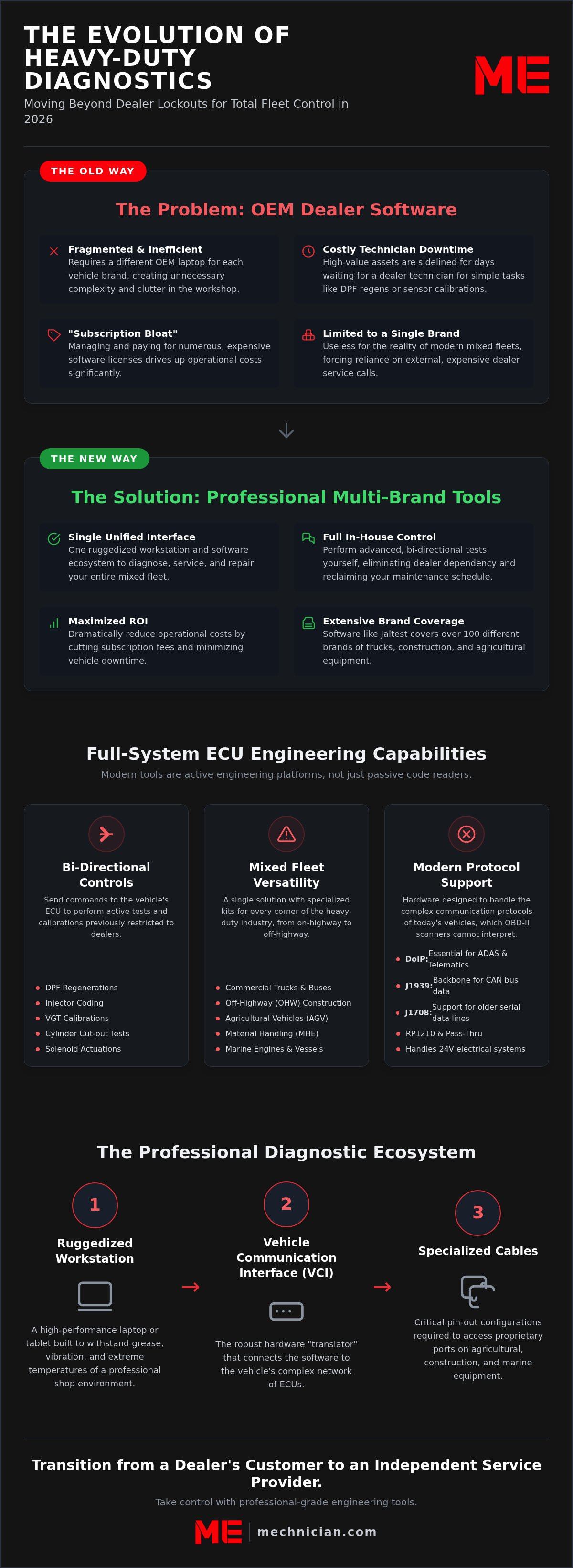
The definition of a professional diagnostic interface has shifted significantly from the simple code-reading devices of the past decade. In 2026, heavy duty diagnostic tools are no longer just passive listeners; they've become active engineering platforms. A technician's ability to maintain a fleet now relies on full-system ECU engineering, which allows for deep-level parameter changes and component calibrations that were previously restricted to factory technicians. This evolution is driven by the increasing complexity of vehicle architectures, where a single fault in a secondary subsystem can trigger a derate or total vehicle shutdown.
Modern diagnostics rely on a sophisticated hierarchy of communication protocols. While J1939 remains the backbone for CAN bus communication in most heavy vehicles and J1708 supports older serial data lines, the industry has seen a massive surge in Diagnostics over IP (DoIP). This Ethernet-based protocol is essential for handling the high bandwidth required by modern Advanced Driver Assistance Systems (ADAS) and complex telematics units. Standard consumer-grade OBD-II scanners simply lack the hardware architecture to interpret these heavy-duty protocols or handle the 24V electrical systems found in Class 8 trucks and Tier 4 Final engines. Attempting to use a generic tool on a modern Cummins or Volvo engine often results in incomplete data or, worse, communication errors that can lock an ECU.
A professional kit is built as a cohesive ecosystem. It consists of a high-performance Vehicle Communication Interface (VCI) that acts as the translator between the machine and the software, a ruggedized workstation, and a comprehensive set of specialized cables. These cables are critical; they aren't just adapters but specific pin-out configurations required to access the proprietary ports found on agricultural machinery, cranes, and marine engines.
The Evolution of On-Board Diagnostics (OBD) in Industry
The transition from mechanical engines to complex Electronic Control Units (ECUs) was accelerated by increasingly stringent emissions standards. Regulations like EPA 2024 and Euro 6 have made advanced diagnostic access a necessity rather than a luxury. Without the ability to trigger a DPF regeneration or monitor SCR efficiency in real-time, a shop cannot legally or practically maintain a modern fleet. Heavy-duty diagnostics today function as a gateway into a complex, interconnected sensor network that governs every aspect of vehicle performance and safety.
Hardware vs. Software: Where the Real Value Lies
While the software provides the intelligence, the hardware provides the reliability. Using a ruggedized diagnostic laptop is a deliberate choice for professionals who work in environments filled with grease, vibration, and extreme temperatures. Standard consumer tablets often fail during long diagnostic sessions or lose connection during critical ECU flashing procedures. The real value of professional heavy duty diagnostic tools lies in their bi-directional capabilities. Unlike generic scanners that only read data, these tools can send commands back to the vehicle. This allows technicians to perform cylinder cut-out tests, actuate solenoids, and calibrate variable geometry turbochargers (VGT) without needing a dealer's intervention.
Deep Dive into Jaltest Software: More Than Just Fault Codes
Identifying a fault code is only the first step in a professional repair process. High-end heavy duty diagnostic tools like Jaltest distinguish themselves by providing the engineering data required to resolve the issue rather than just reporting it. While generic scanners leave technicians searching for external service manuals, this software integrates technical data directly into the diagnostic session. It covers over 100 brands through a single interface, which effectively eliminates the need for maintaining separate OEM software subscriptions for a mixed fleet.
The software's depth includes bi-directional controls that allow for active testing of components. Technicians can perform cylinder cut-out tests to isolate misfires or initiate a forced DPF regeneration to clear emissions-related derates. Access to Variable Geometry Turbocharger (VGT) calibrations ensures that replacement parts are synced correctly with the ECU. Because manufacturers release new ECU profiles and emissions maps frequently, regular updates are vital. The latest software releases, such as version 26.1, ensure compatibility with the newest vehicle models and regulatory changes through the latter half of 2026.
Interactive Wiring Diagrams and System Troubleshooting
Tracing an electrical fault often consumes more time than the actual mechanical repair. Jaltest addresses this with interactive wiring diagrams that allow technicians to click on a component to see its live data, physical location, and pin-out details. This "troubleshooting by symptom" approach guides junior technicians through a logical diagnostic path, ensuring they verify the root cause before replacing expensive sensors. It effectively prevents the "parts-cannon" approach, saving the fleet significant capital on unnecessary component replacements.
Calibrations and Parameter Adjustments
Modern fleet safety depends on precisely calibrated systems. The software handles critical calibrations for ADAS, Bendix or Wabco braking systems, and automated transmissions. Beyond repairs, it allows for parameter adjustments such as idle shutdown timers and maximum speed limits to improve overall fuel economy. Bi-directional control is the gatekeeper to true independent repair, as it allows a shop to finalize complex procedures without a dealer's digital key. If you're looking to upgrade your shop's capabilities, exploring a comprehensive diagnostic kit can provide the necessary autonomy for your maintenance team.
Comparing Multi-Brand Tools vs. OEM Dealer Software
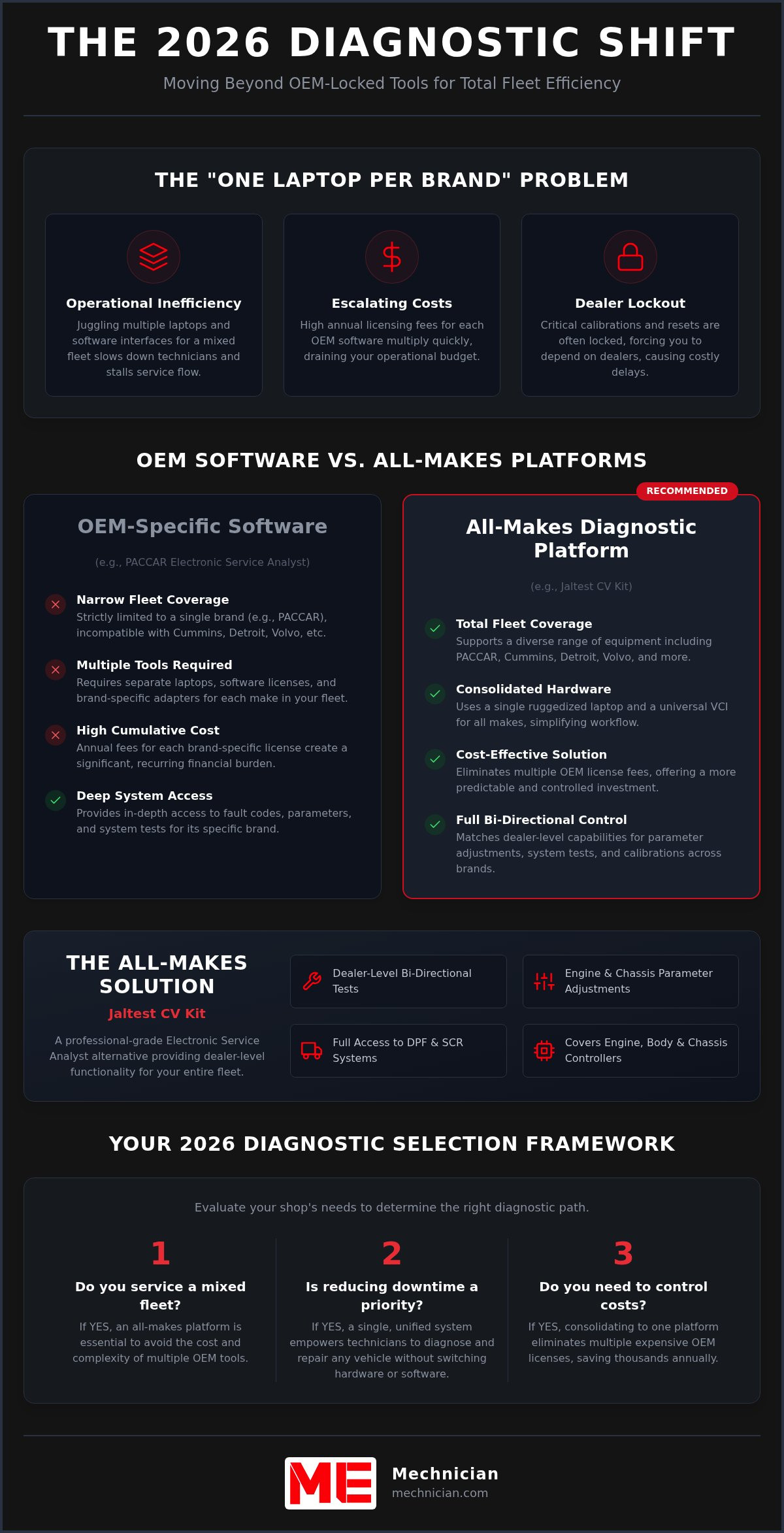
Managing a mixed fleet with only OEM software is a logistical burden that many shops accept as an unavoidable cost of doing business. However, the hidden expenses of this approach extend far beyond the initial purchase price. Each manufacturer requires a dedicated laptop, specific proprietary cables, and a unique annual subscription. This creates a fragmented environment where IT maintenance and hardware clutter consume valuable shop space and technician time. Professional heavy duty diagnostic tools solve this fragmentation by providing a single interface for all brands.
Training a technician to be proficient in five different OEM software packages is a significant investment that carries a high risk of error. When the interface remains consistent across Volvo, Cummins, and Detroit Diesel, the learning curve flattens, and bay throughput increases. The ability to use a unified search function for fault codes across different engine manufacturers allows for faster triage and more accurate job quoting. This efficiency is critical for maintaining high uptime in competitive logistics environments.
The common myth that only a dealer can perform "real" engineering work is rapidly dissolving. While deep-level module programming or total ECU flashing occasionally requires factory-level access, professional multi-brand tools now cover approximately 95% of daily shop needs. From maintenance resets to complex engine work and aftertreatment troubleshooting, the gap between multi-brand and OEM has narrowed significantly. When calculating ROI, consider how many dealer service calls and associated towing fees it takes to offset the cost of a Jaltest CV Kit. For most fleets, the independence gained by performing these tasks in-house pays for the equipment within the first few months of operation.
Consolidating the Diagnostic Bench
A streamlined workspace is a more productive workspace. By reducing hardware clutter to a single ruggedized laptop, you simplify your IT infrastructure and ensure that your diagnostic equipment is always ready for use. Independent shops that have transitioned to this model report a significant reclamation of lost revenue. Some have seen as much as a 40% increase in billable hours by performing calibrations in-house rather than outsourcing them to external vendors. This shift allows the shop to maintain full control over the repair timeline.
When is OEM Still Necessary?
It's practical to acknowledge the edge cases where dealer tools remain the final word. These are typically limited to deep-level module flashing or specific warranty-related software updates. However, using heavy duty diagnostic tools as your primary diagnostic line is a strategic move. This approach ensures that your most expensive resources are only used for the 5% of tasks that truly require them, while the rest of your fleet stays moving through your own bays. This tiered strategy maximizes both capability and cost-efficiency.
Industry-Specific Solutions: OHW, AGV, and MHE Kits
While on-highway trucks dominate much of the diagnostic conversation, the true test of heavy duty diagnostic tools occurs in the field, on the farm, and at the docks. Specialized sectors like Off-Highway (OHW), Agriculture (AGV), and Material Handling (MHE) operate under unique mechanical and environmental constraints. Equipment in these industries, such as a 50-ton excavator or a marine vessel, cannot be easily transported to a dealership. This makes on-site diagnostic capability a fundamental requirement for maintaining operational stability and avoiding the massive logistical costs of moving disabled machinery.
Material handling equipment (MHE) presents its own set of challenges. Troubleshooting forklifts, telehandlers, and lift platforms requires access to specialized controllers for electric powertrains and hydraulic safety interlocks. Similarly, the marine sector requires a distinct diagnostic approach. Marine engines operate in highly corrosive environments, which necessitates the use of specialized water-resistant connectors and software that can interpret cooling system data and hull-specific sensors. Having a unified platform that covers these diverse sectors allows a multi-service shop to expand its revenue streams without investing in dozens of niche tools.
The Construction and Off-Highway Challenge
Heavy yellow iron from manufacturers like Caterpillar, Komatsu, and John Deere Construction relies on proprietary hydraulic systems and specialized transmission controllers. When a loader or crane enters a derate mode on a remote job site, the downtime costs can be catastrophic for a project's timeline. The Jaltest OHW Kit is engineered specifically for field technicians who need to perform deep-level diagnostics where the machine sits. It allows for the calibration of hydraulic valves and the troubleshooting of complex powertrain faults without waiting for a dealer's field service truck to arrive. For those managing diverse fleets, investing in a professional Jaltest OHW Kit is the most direct path to site autonomy.
Precision Agriculture and Modern AGV Diagnostics
Modern tractors and harvesters have evolved into sophisticated mobile data centers. Brands like Case IH, Fendt, and New Holland utilize ISOBUS protocols and complex GPS-integrated systems to manage precision farming tasks. Diagnosing these machines requires more than just engine access; it requires the ability to perform PTO calibrations and hitch adjustments in the middle of a field. The seasonal urgency of the agricultural sector means that a breakdown during a harvest window is a critical emergency. Heavy duty diagnostic tools designed for AGV applications allow technicians to minimize this downtime by identifying sensor failures or software glitches immediately, ensuring the equipment stays in the field when it's needed most.
Maximizing ROI: Support, Training, and the Mechnician Advantage
Acquiring professional heavy duty diagnostic tools represents a significant capital investment, but the hardware itself is only 50% of the solution. True return on investment is realized when your technicians can utilize the full depth of the software without hesitation. In an industry where a single day of downtime can cost thousands in lost revenue, the ability to resolve complex faults quickly is what separates a profitable shop from one that remains dependent on dealer schedules. Maximizing this ROI requires a combination of real-time technical assistance and structured professional development.
The complexity of 2026 vehicle architectures means that even the most experienced lead technicians will eventually encounter intermittent electrical ghosts or undocumented ECU behaviors. This is where the engineering ecosystem becomes vital. By treating your diagnostic setup as a professional service rather than a one-time purchase, you ensure that your shop has the resilience to handle any make or model that enters the bay. This focus on long-term stability is what transforms a repair facility into a high-efficiency maintenance hub.
The Role of Remote Technical Support
Real-time assistance is the most effective way to prevent misdiagnosis and the unnecessary replacement of expensive sensors. Through remote diagnostic capabilities, Mechnician specialists can log directly into your workstation to view live data streams and sensor readings alongside your technician. This "expert in the passenger seat" approach provides a second set of eyes for complex electrical troubleshooting, ensuring that the root cause is identified before any parts are ordered. It significantly reduces the stress on your team and prevents the technician burnout that often leads to high turnover in the heavy-duty sector.
Continuous Learning and Technical Training
The bridge between a traditional mechanic and a modern "mechnician" is built through continuous education. Structured programs like Jaltest University offer a curriculum that covers everything from basic hydraulics to advanced ECU coding and ADAS calibration. This training is essential for maintaining shop competency as new emissions profiles and electronic control systems enter the market. Annual software license renewals are critical here; they don't just provide software updates but ensure your team has access to the latest technical bulletins and interactive wiring diagrams.
Investing in advanced technology also serves as a powerful recruitment tool. Top-tier technicians are drawn to shops that provide the best heavy duty diagnostic tools and the support systems required to use them effectively. When you empower your team with these resources, you're making a conscious decision to prioritize future stability over short-term savings. Empower your technicians with a Jaltest kit and professional support today to ensure your shop remains a leader in independent fleet maintenance.
Securing Your Fleet's Operational Future
The landscape of fleet maintenance in 2026 has moved beyond the era of simple mechanical adjustments. True operational stability now depends on your team's ability to navigate complex electronic architectures and bypass restrictive dealer lockouts. By integrating professional heavy duty diagnostic tools into your shop, you transition from a reactive service model to a proactive engineering environment. This shift allows you to handle everything from Class 8 trucks to specialized agricultural machinery with a single, unified interface, effectively eliminating the need for a dozen different OEM laptops.
Success in this high-tech sector isn't just about owning the right hardware; it's about having a reliable support system behind you. As an authorized Jaltest dealer, we provide the expert remote diagnostic support and specialized training needed to bridge the skills gap in your team. We also offer financing for all kits to ensure that advanced technology remains accessible for growing independent shops. Taking control of your diagnostic capabilities is a strategic decision to protect your long-term autonomy and ensure your assets stay in the field where they belong.
View our range of Jaltest Diagnostic Kits and reclaim your independence. Your shop already has the expertise; we provide the digital keys to unlock its full potential.
Frequently Asked Questions
Can a heavy-duty diagnostic tool perform DPF regenerations on all truck brands?
Professional multi-brand tools like Jaltest are engineered to perform forced DPF regenerations across all major truck manufacturers, including Freightliner, Kenworth, Peterbilt, and Volvo. The software communicates directly with the engine control module to initiate the burn process once all safety parameters are met. This capability is a fundamental requirement for resolving emissions-related derates and maintaining fleet uptime without relying on dealer service centers.
What is the difference between an OBD scanner and a bi-directional diagnostic tool?
A standard OBD scanner is a passive device that primarily reads and clears fault codes. In contrast, heavy duty diagnostic tools with bi-directional capability can send commands back to the vehicle's ECU. This allows you to actuate specific components, such as cycling a fan clutch or performing a cylinder cutout test. This active interaction is necessary for pinpointing mechanical failures and finalizing complex repairs.
Do I need a separate tool for my tractors and my semi-trucks?
You don't need separate hardware, but you do require the specific software modules for each sector. While the Vehicle Communication Interface (VCI) is often universal, tractors require the AGV module, while semi-trucks utilize the CV module. You can bundle these modules onto a single ruggedized laptop, allowing your technicians to service a mixed fleet of agricultural machinery and commercial vehicles using one unified system.
Is Jaltest software compatible with any laptop, or do I need a ruggedized one?
Jaltest software runs on standard Windows platforms, but using a ruggedized diagnostic laptop is the professional standard for shop and field environments. These devices are built to survive drops, vibrations, and exposure to shop fluids that would quickly destroy a consumer-grade laptop. Choosing ruggedized hardware ensures your diagnostic capabilities aren't sidelined by a broken screen or a failed hard drive during a critical repair.
What happens if my annual software license expires?
When an annual license expires, you'll lose access to the latest vehicle coverage, technical data updates, and interactive wiring diagrams. While some basic functions might remains accessible depending on your specific kit, the tool's effectiveness decreases as new ECU profiles are released. Maintaining an active license is critical for staying compliant with 2026 emissions regulations and ensuring your shop can service the newest models entering the market.
Can I use these tools to adjust the top speed or idle time of my fleet vehicles?
Professional engineering tools allow you to modify vehicle parameters such as maximum road speed and idle shutdown timers. These adjustments are essential for fleet managers looking to optimize fuel efficiency and enforce safety policies across their entire operation. Performing these parameter changes in-house saves significant time and money by eliminating the need for a dealer technician to perform a simple software adjustment.
Does the tool include wiring diagrams and component locations?
High-end software includes integrated technical data that provides interactive wiring diagrams and precise component locations. This information is linked directly to the fault codes you are currently diagnosing, which helps your team trace electrical issues with surgical precision. Having this data at your fingertips prevents technicians from having to search through external service manuals, which directly increases your shop's bay throughput and efficiency.
How does remote technical support work for heavy equipment in the field?
Remote support allows a specialist to log into your heavy duty diagnostic tools through an internet connection while you are standing at the machine. They can view live sensor data and guide you through complex troubleshooting steps in real-time. This service effectively provides an expert second opinion for difficult electrical faults, helping you resolve issues on-site and avoiding the logistical nightmare of towing disabled heavy machinery.



Dejar un comentario